The Neuro-Musical Paradox: Why Melodies Stick
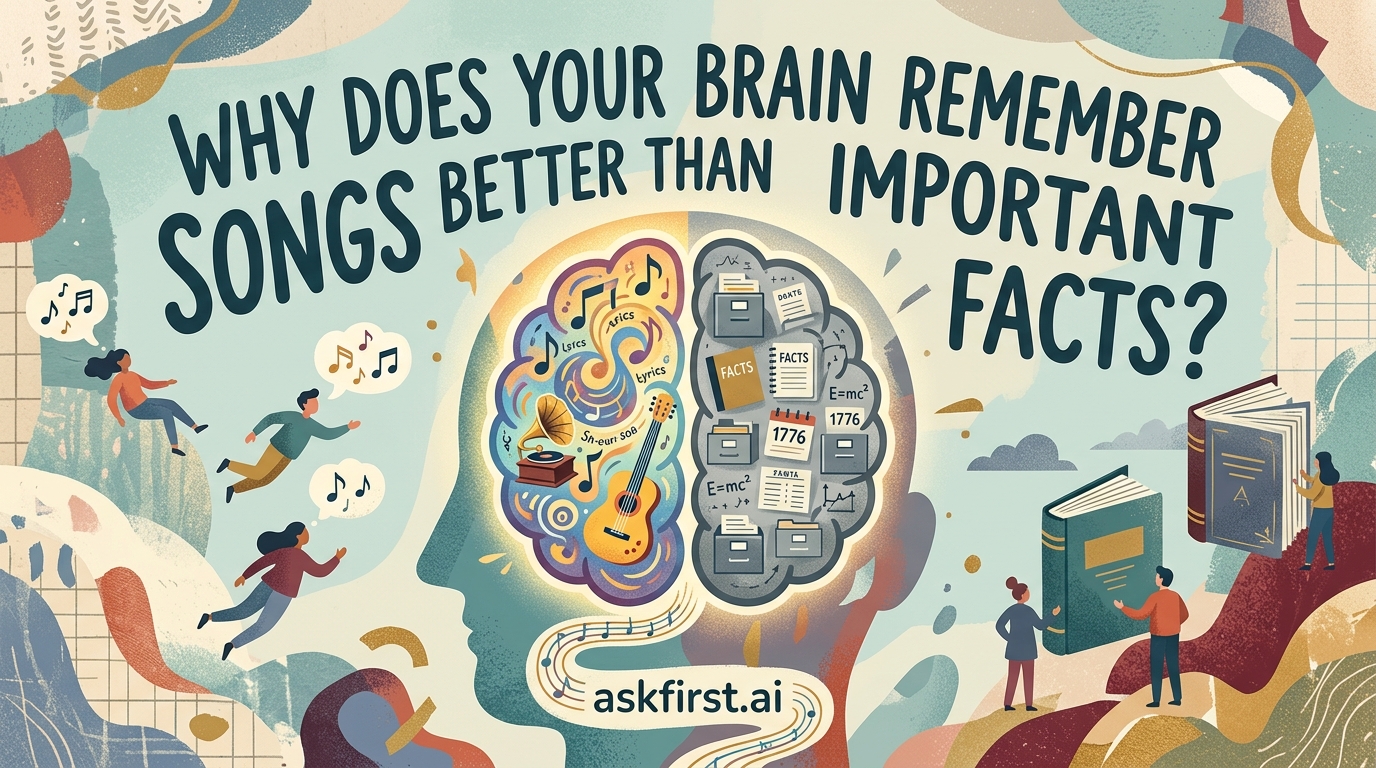
Human memory functions in a highly non-linear fashion, prioritizing emotional salience and rhythmic structure over raw semantic data. The phenomenon where an catchy tune lingers in the consciousness—often referred to as an 'earworm'—stands in stark contrast to the relative struggle involved in memorizing historical dates or abstract scientific principles. This disparity exists because the human brain evolved not as a library for factual storage, but as a survival-oriented processor deeply attuned to patterns, social bonding, and sensory stimuli.
The Role of Auditory Scene Analysis
The auditory cortex is inherently wired for pattern recognition. Music relies on repetition, rhythmic predictability, and tonal consistency. When the brain processes music, it employs a massive network of neural pathways that spans far beyond the temporal lobe. Studies in cognitive neuroscience demonstrate that when a person listens to music, the prefrontal cortex, the hippocampus, and the cerebellum are simultaneously activated. This massive recruitment of neural real estate creates a much stronger memory trace than reading plain text, which primarily engages the language centers like Broca’s and Wernicke’s areas without the sensory-motor integration provided by melody and rhythm.
Emotional Encoding and the Hippocampus
Memories are most effectively encoded when the amygdala—the brain’s emotional center—is engaged. Music has a unique, direct line to the limbic system, which governs emotions and long-term memory formation. When a song triggers a specific emotional response, the amygdala signals the hippocampus to prioritize the consolidation of that information. Because music often evokes feelings of nostalgia, excitement, or sorrow, it creates a high-intensity psychological state that essentially marks the memory as 'important' to the brain, even if the information (the lyrics) is trivial. In contrast, dry facts often lack this inherent emotional trigger, causing the brain to categorize them as low-priority 'background noise.'
The 'Chunking' Mechanism
Cognitive psychology utilizes the concept of 'chunking' to explain memory capacity. Facts are often discrete, isolated units of information. Songs, however, utilize rhythm and rhyme as natural mnemonic devices. Rhyme serves as a linguistic scaffold that makes retrieving words easier because the brain can predict the next syllable or beat, effectively 'chunking' large amounts of data into a single, cohesive rhythmic package. This predictability reduces the cognitive load required to recall the information. When a reader attempts to memorize a fact, they are tasked with serial processing; when they listen to a song, they are participating in parallel, rhythmic engagement.
The Self-Referential Effect
Music is often deeply tied to autobiographical experiences. Because popular music is pervasive in cultural and social settings, it becomes a soundtrack to one's life. This is known as the self-referential effect: information is processed more deeply and remembered more accurately when it is linked to one's own experiences or identity. The neural structures involved in autobiographical memory overlap significantly with those activated by musical perception. Therefore, singing a song isn't just recalling audio data; it is an act of retrieving a complex, multi-sensory mental movie.
Structural Differences: Data vs. Narrative
- Semantic Memory (Facts): Requires conscious effort, repetition, and deliberate focus. It is brittle and prone to decay without maintenance.
- Procedural and Implicit Memory (Music): Involves motor skills and rhythmic expectation. Much of the 'knowing' of a song happens unconsciously, making it easier to trigger automatically.
Practical Implications for Learning
This neurological reality explains why educators often use mnemonic songs to teach complex concepts, such as the periodic table or historical chronologies. By mapping abstract data onto familiar melodies and rhythmic structures, the learner is forced to use the brain's superior auditory and emotional pathways. The 'stickiness' of a song is essentially a feature of biological architecture designed to keep the mind engaged with environmental patterns. To remember a fact better, the brain must be tricked into treating that information like a song, by attaching rhythm, emotion, and sensory context to the dry material.
In summary, the brain remembers songs better because it is designed to thrive on social connection, emotional resonance, and rhythmic consistency. Music engages the entire brain, while pure fact retention occupies only narrow, focused channels. Embracing this cognitive bias allows individuals to transform the way they learn by turning static information into dynamic, patterned knowledge.