The Psychology of Social Persistence
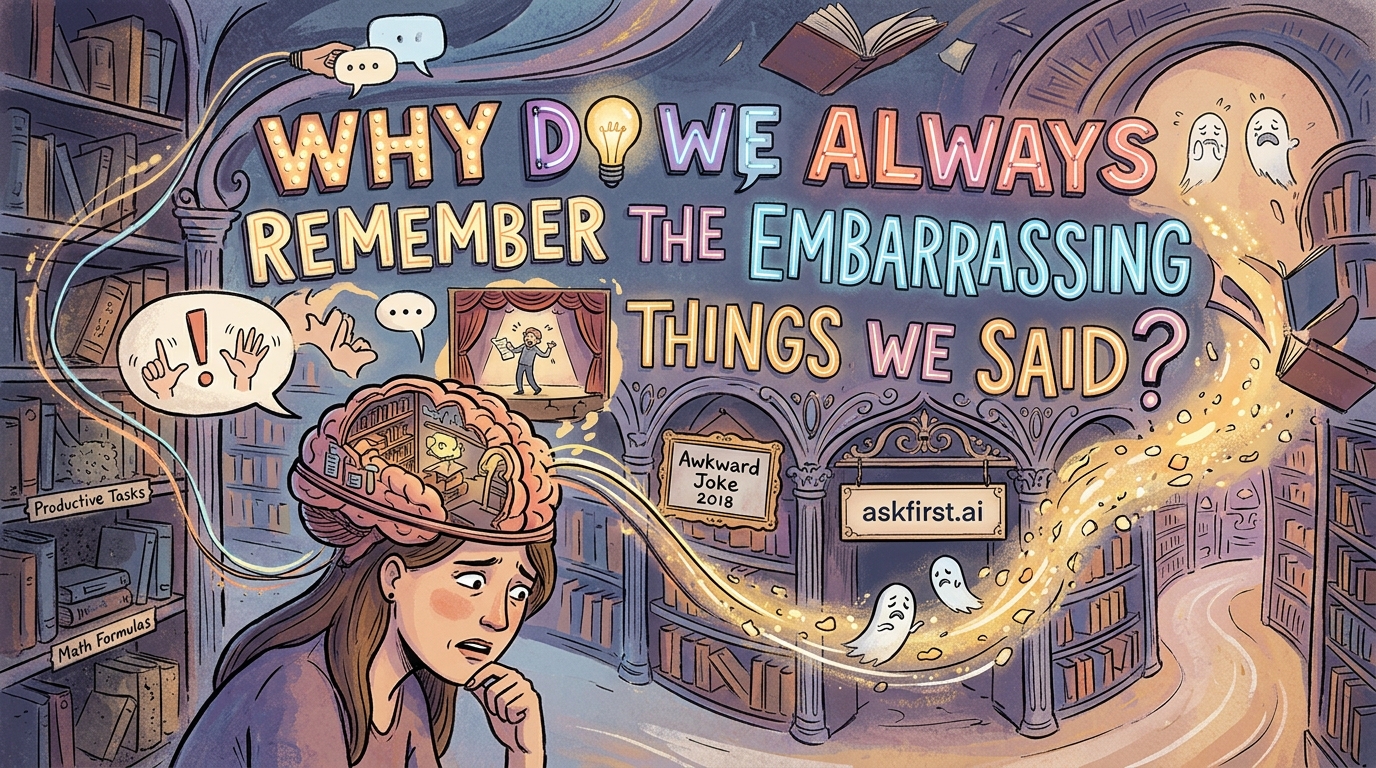
The phenomenon of ruminating on past social blunders is a deeply ingrained cognitive process. Known in psychology as the 'Spotlight Effect' or more broadly as 'Intrusive Rumination', this mechanism serves as a double-edged sword in human evolution. While it feels like an internal punishment, the brain is actually performing a high-stakes simulation to prevent future social ostracization.
The Evolutionary Root: Social Safety
Humans are biologically wired to be communal creatures. Historically, belonging to a tribe was the primary determinant of survival. In ancestral environments, social rejection could lead to isolation, which effectively meant death. Consequently, the brain developed a hyper-vigilant system to monitor social status and behavior. When an individual says something perceived as embarrassing, the brain triggers a strong emotional response—typically shame—to encode that moment as a 'high-priority warning' in long-term memory. The purpose is to ensure that the individual does not repeat the behavior that threatened their social standing.
Cognitive Bias: The Negativity Bias
One primary reason these memories stick is the Negativity Bias. Human beings are evolutionarily predisposed to pay significantly more attention to negative events than positive ones. A single awkward comment often carries more weight than ten instances of professional competence. This is because negative events represent threats that must be mitigated, whereas positive events are simply signals of stability. Our minds are effectively designed to be 'anxiety engines' that prioritize the retrieval of failures to prevent their recurrence.
The Spotlight Effect
Psychologists Thomas Gilovich and Kenneth Savitsky coined the term 'Spotlight Effect' to describe the tendency to overestimate how much others notice our appearance and behavior. Most people believe they are under a constant, harsh spotlight, but in reality, most observers are preoccupied with their own lives. When an embarrassing moment is remembered, the mind often forgets that the external audience has already moved on. The memory persists because it is felt so intensely internally, creating a false perception that it is just as intense for everyone else.
The Role of Counterfactual Thinking
After an embarrassing event, the brain engages in 'Counterfactual Thinking', specifically a process called 'upward counterfactuals.' This involves imagining how things could have turned out better if a different path had been taken. While this is a hallmark of intelligent, analytical minds, it also leads to a feedback loop of regret. The mind repeatedly simulates the 'correct' version of the social interaction, deepening the neural pathway associated with the original memory and making the embarrassment feel fresh every time it is recalled.
Strategies to Manage the Rumination
- Reframing as Learning: Instead of viewing the memory as a stain on one's character, consciously label it as a 'data point' for social intelligence. Ask: 'What specifically did I learn from this that makes me better equipped for future interactions?'
- Perspective Taking: Practice active realization that most individuals have already forgotten the event. This is the 'Imaginary Audience' phenomenon. Acknowledging that others are self-centered—in a literal, psychological sense—is liberating.
- Mindfulness and Distraction: Intrusive thoughts thrive on attention. When an embarrassing memory triggers, rather than fighting it, note it and engage in a task that requires cognitive load, such as complex problem-solving or deep reading. This disrupts the neural loop.
- Self-Compassion: Adopting a posture of kindness toward one's own limitations allows for recovery. Everyone has committed social errors; acknowledging this universal human experience reduces the emotional intensity of the memory.
Conclusion
Remembering embarrassing moments is not a sign of personality failure; it is a manifestation of an brain designed for survival. While it remains a source of occasional mental fatigue, understanding the biological and psychological drivers behind it transforms the experience from a personal burden into a manageable cognitive process. By mastering the art of self-detachment, individuals can move from being prisoners of their past to active designers of their future social experiences.