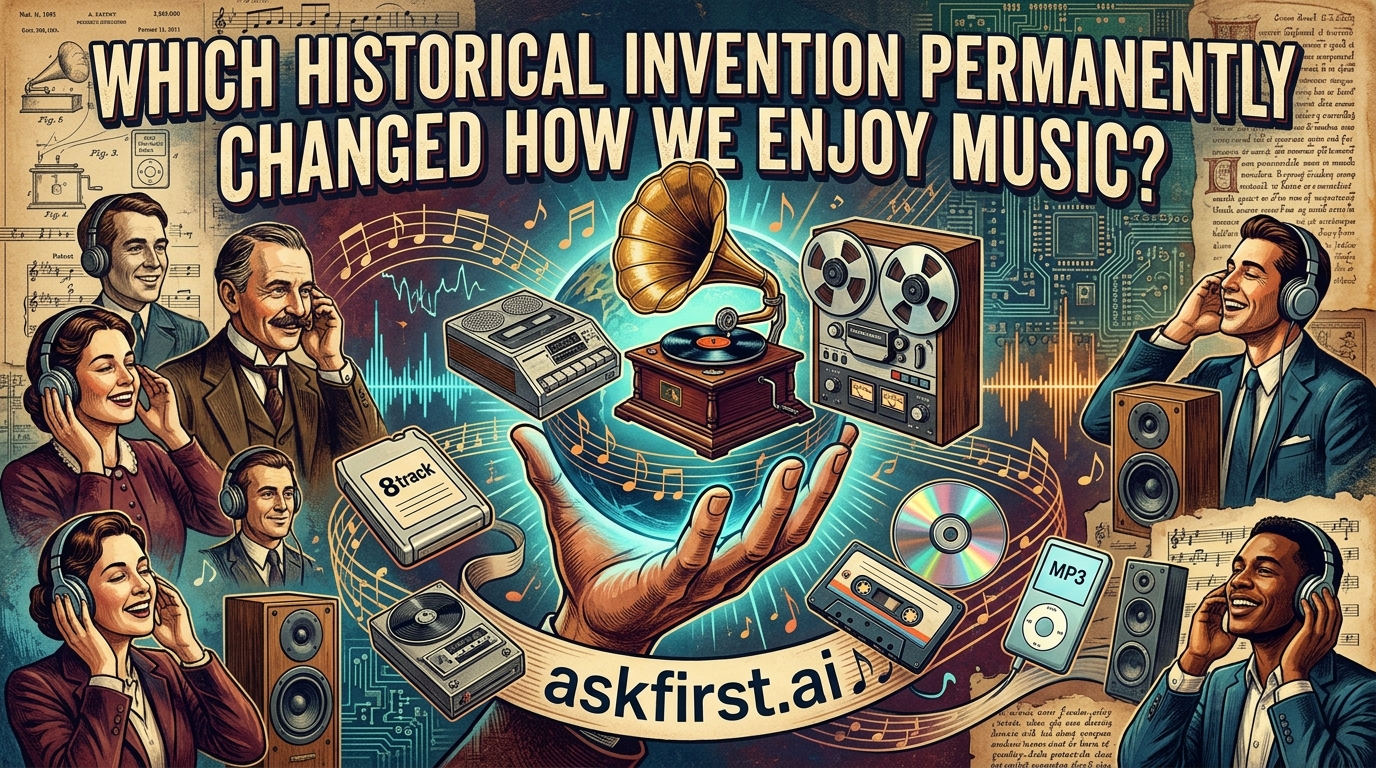
The Phonograph: A Paradigm Shift in Sound
The history of music consumption is defined by one singular, earth-shattering invention: Thomas Edison’s phonograph. Unveiled in 1877, this device did not merely play sound; it captured the ephemeral nature of live performance and etched it into physical matter. Before the phonograph, music was inherently communal and ephemeral—it existed only in the moment of its performance. If one wanted to hear a symphony, they had to be in the concert hall. If one wanted a folk song, they had to find a musician willing to play it. The phonograph fundamentally decoupled music from the musician, transforming sound into a tangible, repeatable, and transportable commodity.
The Technological Evolution: From Foil to Digital
The phonograph operated on a simple yet revolutionary principle: sound waves cause a diaphragm to vibrate, moving a stylus that cuts a groove into a rotating cylinder. This analog process was the precursor to all modern recording technologies.
- Cylinders and Discs: Following Edison's cylinders, Emile Berliner introduced the flat disc or 'gramophone record,' which proved easier to mass-produce.
- The High-Fidelity Era: The jump from acoustic recording (using horns) to electrical recording in the 1920s allowed for richer tonal quality and wider dynamic ranges.
- Magnetic Tape: By the mid-20th century, magnetic tape allowed for editing and multi-tracking, effectively changing the composition process itself.
- The Digital Revolution: Finally, the transition to digital formats like the Compact Disc and, eventually, compressed MP3 files, turned music into pure information, making it globally accessible instantly.
Psychological and Societal Impacts
The ability to listen to music in private changed the social landscape of the domestic home. In the Victorian era, the piano was the center of social entertainment; households gathered to play sheet music together. The invention of recording technology moved music from a social requirement to a solitary, introspective luxury. This shift fueled the rise of the 'audiophile' culture, where the clarity and fidelity of the recording became just as important as the musical composition itself. Listeners began to expect a specific sound profile, which in turn pressured musicians and producers to create studio versions of songs that sounded 'perfect' rather than raw.
Democratization of Genres
Before recording technology, folk, ethnic, and regional music remained confined to specific geographic locales. The phonograph and subsequent radio broadcasts enabled a global exchange of artistic styles. A listener in rural Japan could hear the blues of the Mississippi Delta, or a teenager in London could discover the complex rhythms of Afro-Cuban jazz. This cross-pollination of genres is directly attributable to the invention of sound storage. The barriers to access were dismantled, allowing for the birth of global pop culture and the evolution of fusion genres that dominate today’s charts.
The Future of Musical Consumption
Today, we operate in an era of 'infinite access' through streaming platforms. While we are lightyears away from the scratching needles of a tinfoil-covered cylinder, the core objective remains the same as Edison’s original invention: to capture a performance and preserve it indefinitely. Whether through 3D spatial audio or high-resolution lossless files, the goal is to bridge the gap between the listener and the performer. The invention of the phonograph didn't just give us a way to listen to music; it invented the modern concept of the musical 'canon' and the archival legacy of artists.
Conclusion: A Legacy of Sound
When looking back at the trajectory of human history, few inventions have altered our daily emotional landscape as profoundly as the phonograph. It allowed us to carry our favorite memories in our pockets and provided the soundtrack to our private lives. By turning music into an object, the phonograph ensured that no song ever truly has to disappear, allowing humanity to build a collective library of its greatest artistic achievements. Whether you are listening to a vinyl record or a cloud-based playlist, you are engaging with a lineage that began with a man turning a crank in a laboratory, forever changing the way we interact with the invisible art of sound.