The Frontiers of Miniaturization: Understanding the Smallest Insects
When we consider the insect world, we often visualize buzzing bees, fluttering butterflies, or the common housefly. However, the true marvels of the class Insecta lie at the extreme edge of biological possibility, where the laws of physics—specifically fluid dynamics and surface tension—begin to dictate the limits of life. The smallest insects on our planet are not merely scaled-down versions of larger beetles or ants; they are highly specialized organisms that have undergone dramatic physiological restructuring to survive at a microscopic scale.
The Record Holder: Dicopomorpha echmepterygis
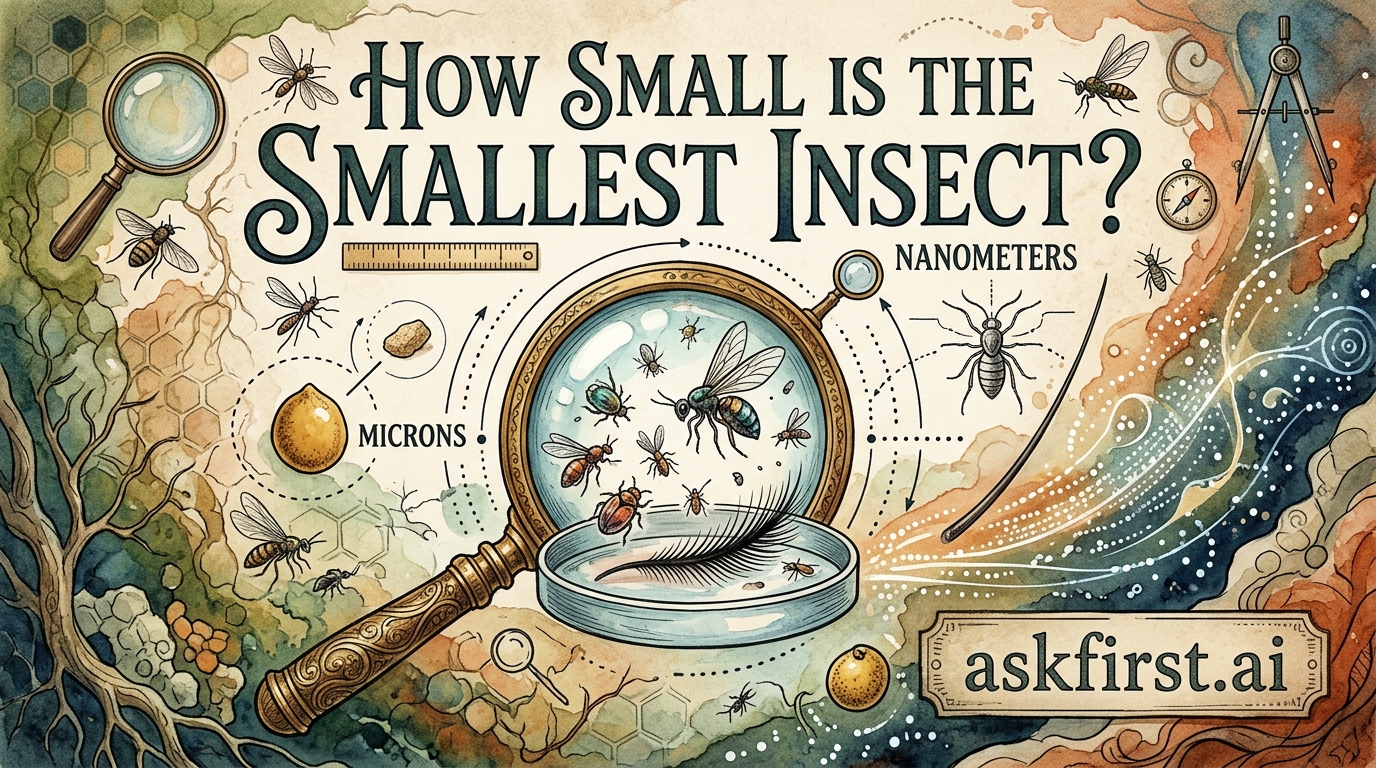
The title for the smallest known insect currently belongs to the fairyfly, specifically the species Dicopomorpha echmepterygis. Discovered and described by entomologist John T. Huber in 1997, this parasitic wasp is a member of the family Mymaridae. Measuring a mere 139 micrometers (0.139 millimeters) in length, this creature is significantly smaller than many species of single-celled protozoa, such as the common Paramecium.
To put this size into perspective, a human hair is roughly 70 to 100 micrometers in diameter. Therefore, this wasp is barely wider than two human hairs placed side-by-side. These insects are so minute that they do not possess the traditional "wing" structures seen in larger insects; instead, they utilize thin, feathery filaments that act like oars to "swim" through the air, which, at their scale, behaves more like a viscous fluid than the thin gas we experience.
Evolutionary Adaptations: The "Pygmy" Challenge
Achieving such extreme miniaturization requires radical biological compromises. According to the research of Dr. Alexey Polilov, a leading expert in the morphology of minute insects at Moscow State University, these creatures undergo a process known as "nucleic reduction." In many of the smallest insects, the nuclei of the neurons are so large relative to the size of the cell that they occupy almost the entire space, leading to a reduction in the total number of neurons.
In some cases, the brain of the smallest fairyflies is so packed that it actually extends into the thorax. Furthermore, these insects often lose the ability to maintain complex circulatory systems. Instead of having a fully developed heart and extensive vascular network, they often rely on simple diffusion of hemolymph. They also frequently lose their internal organs' complexity, sometimes even lacking a traditional digestive tract, as they are parasitoids that spend their entire adult lives (which may last only a few days) focused solely on reproduction.
The Niche of the Fairyfly
Why evolve to be so small? The answer lies in the specialized ecological niche these insects occupy. Dicopomorpha echmepterygis is an egg parasitoid. It spends its entire life cycle inside the eggs of other insects, specifically those of the barklouse (Echmepteryx hageni).
Because the host eggs are incredibly small, the parasitoid must be small enough to fit inside them. This is a classic example of an evolutionary arms race. As the host egg evolves to be smaller or more protected, the parasite must shrink in response. This extreme specialization has led to sexual dimorphism that is almost unheard of in the animal kingdom. In D. echmepterygis, the males are blind, wingless, and possess mouthparts that are essentially non-functional; their entire existence is dedicated to emerging within the host egg, mating with a female sibling, and dying before ever leaving the shell.
Constraints of Physics and Biology
One might wonder: could there be even smaller insects? In his seminal work, The Insects: Structure and Function (Cambridge University Press), R.F. Chapman outlines the fundamental physical limits imposed on living organisms. At the scale of 100 micrometers, the surface-area-to-volume ratio becomes so high that desiccation (drying out) becomes an existential threat. Furthermore, the nervous system requires a minimum number of cells to perform basic sensory processing and locomotion.
If an insect were to shrink further, it would likely lose the ability to coordinate its movements or interact with the environment effectively. While some mites (which are arachnids, not insects) are smaller, they are not constrained by the same developmental blueprints as insects. For insects, the rigid exoskeleton, the tracheal respiratory system, and the complex compound eye structure provide a "lower limit" of size that evolution struggles to bypass.
Conclusion
The existence of Dicopomorpha echmepterygis serves as a humbling reminder of the sheer diversity of life on Earth. These tiny wasps, barely visible to the naked eye, represent the absolute limit of what it means to be an insect. They navigate a world governed by the physics of the micro-scale, where air is thick and water is a deadly trap of surface tension. By studying these creatures, entomologists are not just cataloging small bugs; they are exploring the fundamental boundaries of biology, genetics, and structural engineering. The fairyfly remains a testament to the fact that even at the smallest scales, life finds a way to thrive, adapt, and persist in the most specialized niches imaginable.