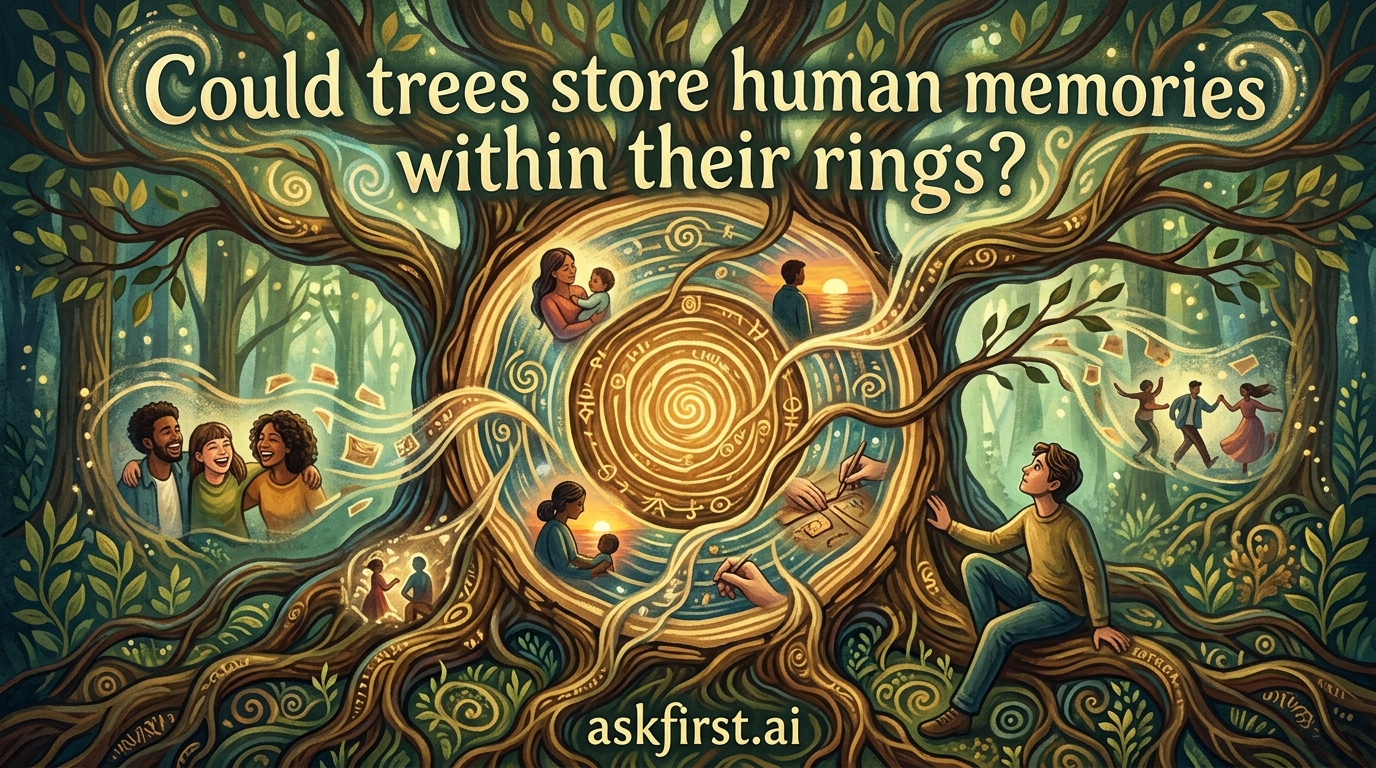
The intersection of dendrochronology (the science of dating tree rings) and the theoretical possibility of biological memory storage is a subject that bridges the gap between empirical botany and speculative neuroscience. While the concept of a tree "remembering" human events carries a poetic weight often explored in literature—such as Richard Powers’ Pulitzer Prize-winning novel The Overstory—it is essential to distinguish between the physical recording of environmental data and the storage of conscious, subjective human experience.
The Mechanism of Dendrochronology: Nature’s Archive
To understand why trees are often poetically linked to memory, we must first examine what they actually record. Every year, a tree adds a layer of growth to its trunk: the earlywood (light-colored, fast growth in spring) and the latewood (dark-colored, slower growth in autumn). This sequence forms a biological ledger that tracks the climate of the past.
According to Tree Rings: Basics and Applications by Dieter Eckstein and Fritz Hans Schweingruber, these rings are sensitive indicators of temperature, precipitation, and even catastrophic events like forest fires or insect outbreaks. If a tree survives a drought, that year’s ring will be significantly narrower. If a tree experiences a fire, the wound is often physically encapsulated within the wood, creating a "scar" that remains for centuries. In this sense, trees are the most accurate historical archives on Earth, preserving the "memory" of the planet's atmospheric conditions rather than the narrative events of human history.
The Biological Reality of Memory Storage
Human memory is a neurobiological process involving the strengthening and weakening of synaptic connections in the brain, primarily mediated by the hippocampus and the neocortex. As noted by neuroscientist Eric Kandel in his seminal work In Search of Memory, human memory requires a complex nervous system capable of encoding, storing, and retrieving symbolic information.
Trees lack a nervous system, neurons, or neurotransmitters. Their "responses" to the environment are governed by hormonal signaling—specifically auxins, gibberellins, and abscisic acid. While plants exhibit a form of "plant intelligence" (as argued by Stefano Mancuso in Brilliant Green: The Surprising History and Science of Plant Intelligence), this is fundamentally different from memory. Trees process environmental stimuli to optimize growth and survival, but they do not possess the capacity to encode linguistic or episodic human experiences. A tree cannot "remember" a conversation held beneath its boughs because it has no biological apparatus to convert sound waves or human language into structural changes in its xylem or phloem.
Could Trees "Store" Information in a Non-Biological Way?
While trees do not store memories in the neurobiological sense, there is a fascinating field of research regarding the physical imprinting of history on trees. In the 20th century, researchers at the Laboratory of Tree-Ring Research at the University of Arizona discovered that trees can act as passive witnesses to history.
For example, the Constitution Tree in Philadelphia or various "witness trees" found on American Civil War battlefields are often cited in historical geography studies. These trees are not "storing" the memories of the soldiers, but they are physical repositories of the environmental conditions of those moments. A tree standing on a battlefield during a conflict might show a distinct growth pattern due to the presence of chemicals in the soil from gunpowder or the sudden thinning of the forest canopy, which allowed for an abnormal surge in sunlight. In this capacity, the tree acts as a physical artifact—a silent, living witness that correlates with human history, even if it does not contain the "thought" or "voice" of the humans involved.
Epigenetics and the "Memory" of Stress
An emerging field that adds complexity to this discussion is plant epigenetics. As explored in Thus Spoke the Plant by Monica Gagliano, plants can exhibit "learned" behaviors or epigenetic modifications that allow them to respond more effectively to recurring stressors. If a tree is subjected to a specific type of drought, it may alter its gene expression to better survive a second drought.
While this is technically a form of "memory"—often called "priming"—it is strictly restricted to the survival of the organism. It is a chemical legacy passed down through cellular division, not a repository for human observation. There is no evidence in the current scientific literature to suggest that these epigenetic markers can be influenced by external human cognitive states or that they could serve as a medium for storing human data.
Conclusion
The allure of trees as keepers of human memory stems from our profound desire to connect with the deep time that these organisms represent. While trees are unparalleled in their ability to record the climatic history of our world, they do not possess the architecture to store human memories. They are biological chronometers, not hard drives for human consciousness.
The "memory" of a tree is a record of light, water, and fire. It is a testament to the survival of the organism in a changing world. To look at a tree and see a repository of human history is a beautiful act of empathy, but it remains a metaphor. We must value trees not because they hold our memories, but because they hold the history of the earth itself—a record that is, in its own right, just as profound as any human recollection.