The Linguistic Capabilities of Canines: Beyond the Bark
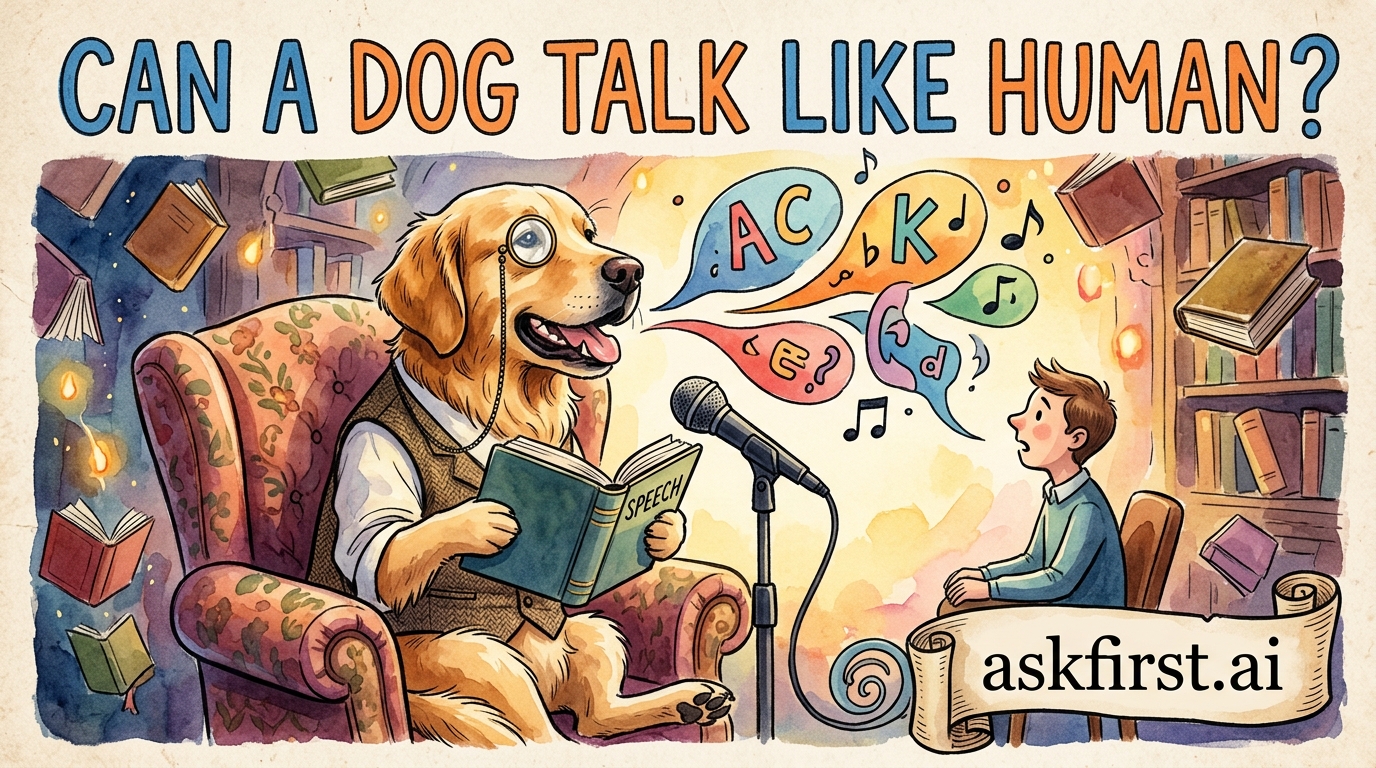
The question of whether a dog can "talk" like a human is a fascinating intersection of evolutionary biology, linguistics, and cognitive science. To address this, we must first define what we mean by "talking." If we define talking as the ability to produce complex, syntax-driven speech using a larynx and vocal cords as humans do, the answer is a definitive "no." However, if we define it as the ability to understand human language, communicate abstract desires, and utilize external tools to mimic human syntax, the answer becomes significantly more nuanced.
The Physiological Barrier: Why Dogs Cannot Speak
The primary reason dogs cannot speak like humans is anatomical. Human speech is a product of our unique vocal tract, specifically the position of the larynx (the voice box) and the shape of the tongue and palate. According to Philip Lieberman in his foundational work The Biology and Evolution of Language (Harvard University Press), the descent of the human larynx allows us to produce a vast array of phonetic sounds that other mammals simply cannot replicate.
Dogs possess a larynx that is positioned much higher in the throat. This is an evolutionary adaptation that allows them to breathe and swallow simultaneously without choking—a critical survival mechanism for a predator. Furthermore, a dog’s tongue is not as flexible or as muscular as the human tongue. While a dog can certainly manipulate its mouth to create "vowel-like" sounds or mimic the cadence of human speech—as seen in viral videos of "talking" huskies or bulldogs—these are essentially sophisticated forms of mimicry rather than the generation of linguistic meaning. They are imitating the pitch and rhythm of their owners, not constructing sentences.
The Cognitive Frontier: Understanding Language
While dogs lack the hardware for speech, they possess an extraordinary capacity for language comprehension. Research conducted by Dr. Stanley Coren, a professor of psychology and author of The Intelligence of Dogs (Free Press), suggests that the average dog can learn approximately 165 words, including signals and gestures. Highly intelligent breeds, such as Border Collies, have been shown to understand over 1,000 words.
A landmark study by researchers at the Family Dog Project at Eötvös Loránd University in Budapest, published in the journal Science, demonstrated that dogs have the capacity to associate specific words with specific objects, even without extensive training. This suggests that dogs process human language in a way that is neurologically similar to human infants. They are not merely responding to the tone of voice; they are mapping phonemes to mental representations of the world.
The Rise of Augmentative Communication: The "Button" Phenomenon
In recent years, the discourse around canine communication has shifted toward augmentative and alternative communication (AAC). This involves the use of soundboards with buttons that, when pressed, play pre-recorded human words. Proponents of this method, such as Christina Hunger, a speech-language pathologist and author of How Stella Learned to Talk (HarperCollins), argue that dogs can indeed learn to construct "sentences" to express complex needs.
For example, a dog might press a button sequence like "Outside," "Play," and "Ball" to communicate a specific desire. While critics argue that these behaviors are often a result of operant conditioning—where the dog learns that pressing a button yields a reward—the speed and context-sensitivity of these interactions have challenged our traditional understanding of canine cognition. It is no longer just about the dog "talking"; it is about the dog using human-designed tools to bridge the gap between their internal state and our verbal world.
The Neurobiology of Communication
The brain of a dog is wired for social intelligence. Research by Attila Andics, a neuroscientist who used fMRI imaging on awake dogs, revealed that dogs have specialized brain regions for processing human voices and emotional intonation. When a dog hears a human voice, the same reward-processing centers light up as they do when they receive a treat. This suggests that dogs are not just observers of human speech; they are active participants in a cross-species dialogue. They listen to our syntax, track our gaze, and interpret our emotional state to form a holistic understanding of our intent.
Conclusion: The Future of Interspecies Dialogue
Can a dog talk like a human? Biologically, they are constrained by their anatomy; they cannot articulate the nuances of a Shakespearean sonnet. However, they are clearly capable of a form of "functional communication" that borders on rudimentary language. As we continue to study the cognitive architecture of our canine companions, it is becoming increasingly clear that they are far more than just pets. They are linguistic learners who are constantly trying to decode the complex, noisy, and often contradictory world of human speech. Whether through the press of a button or the subtle tilt of a head, dogs are communicating with us every day—we simply have to be willing to listen in a language that transcends the spoken word.