The Evolutionary Anchoring of Negative Counsel
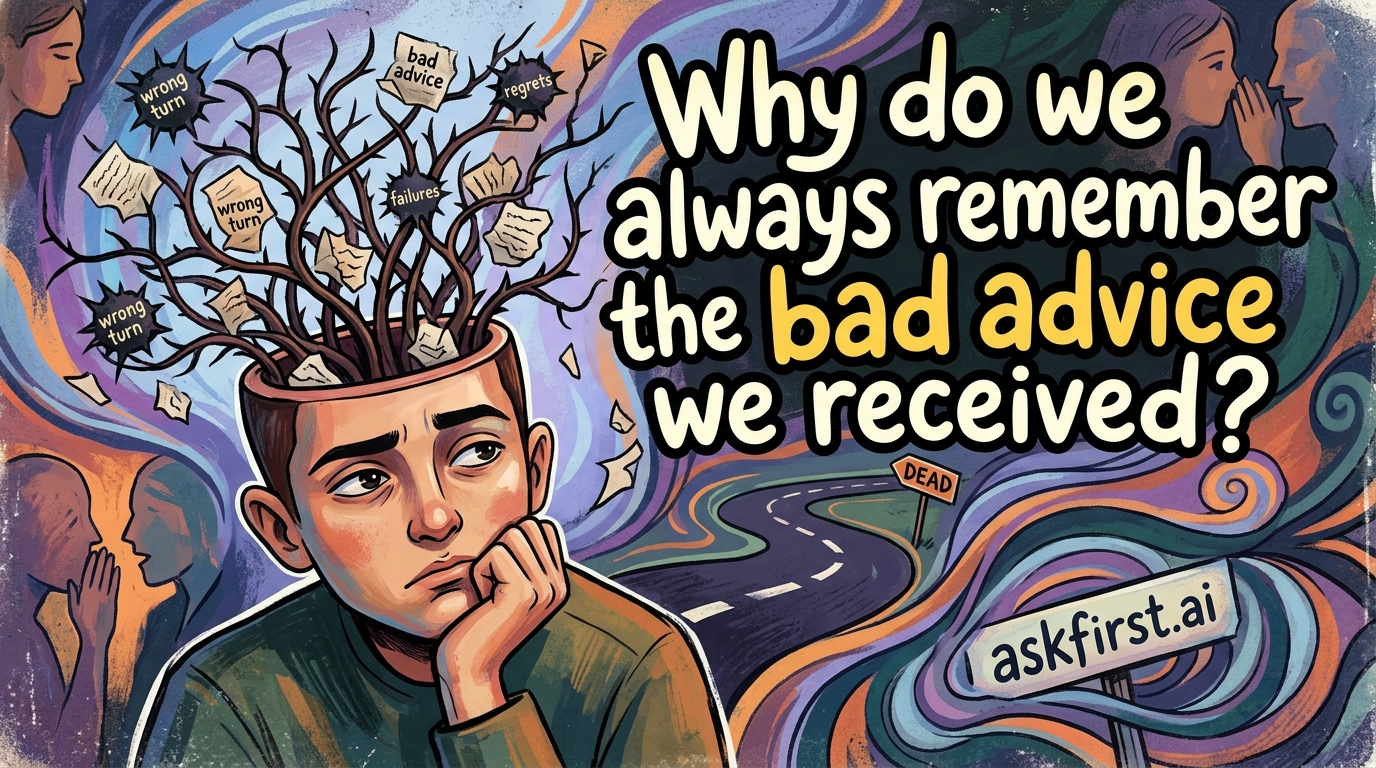
Human memory does not function as an impartial recording device that archives every piece of information with equal weight. Instead, it acts as a selective filter designed primarily for survival and social navigation. When individuals find themselves fixated on the 'bad' advice received in the past—such as a misguided career path suggestion or a flawed investment tip—it is rarely a sign of poor cognitive habits. Rather, it is a testament to the negativity bias, an evolutionary psychological phenomenon where humans register negative stimuli more readily and process them with greater intensity than positive ones.
The Mechanism of Negativity Bias
From an ancestral standpoint, failing to notice a potential threat was far more costly than failing to notice a potential reward. A predator or a poisonous berry required immediate cognitive attention, whereas a missed opportunity for a pleasant encounter was merely a missed surplus. Consequently, the brain evolved to prioritize 'dangerous' information. When advice is perceived as detrimental, the brain tags it as a threat to one's well-being or reputation, locking it into the amygdala—the brain’s emotional processing center. This creates a stronger neural trace, making the memory of that bad advice significantly more 'sticky' than the benign or positive guidance provided by others.
Cognitive Dissonance and the 'Regret' Loop
Beyond simple biology, the psychological concept of Cognitive Dissonance plays a massive role in why we dwell on poor advice. When we act on advice that leads to a suboptimal outcome, the resulting internal friction creates a profound sense of discomfort. The human brain seeks consistency; when reality clashes with the promised outcome of the advice, the brain attempts to resolve the tension by ruminating on the error. This rumination, while often perceived as unproductive, is actually an attempt by the mind to 'solve' the mistake so it can be avoided in the future. The memory of the advice becomes a marker for a boundary that should not be crossed again.
Factors Influencing the Persistence of Negative Memory
- Social Hierarchy and Status: Advice given by individuals in positions of power—such as mentors, parents, or authority figures—carries more emotional weight. If this advice results in failure, the impact on self-esteem is magnified, cementing the memory as a core lesson.
- The Contrast Effect: Human memory relies heavily on contrast. If a person was generally happy but took one piece of bad advice that led to a significant life shift, the contrast between the 'before' and 'after' states makes the advice stand out in relief against a backdrop of mundane daily events.
- The Narrative Arc: Humans are storytelling creatures. Bad advice often serves as the 'inciting incident' or the 'villain' in the narrative of a person's life journey. It is easier to structure one's autobiography around a clear mistake caused by external influence than to accept that life paths are often the result of complex, multifaceted circumstances.
How to Reframe the Retention of Bad Advice
Instead of viewing the retention of negative advice as a burden, it is more beneficial to treat these memories as cognitive firewalls. By analyzing the faulty logic behind the advice received, individuals develop critical discernment.
- Deconstruction: Instead of repeating the memory as a regret, deconstruct the advice. Ask: 'What were the underlying assumptions of the person who gave this?' Often, bad advice is simply advice meant for someone else—or a different era.
- Contextualization: Recognize that advice is time-bound. Guidance that failed in 2015 might have been intended for the market conditions or social dynamics of that specific moment. Detaching the advice from one's personal identity helps dissipate the emotional sting.
- The Wisdom Shift: True growth comes from turning the 'bad advice' into a template for what to avoid. By cataloging these memories, individuals create a personal 'anti-manifesto' that guides future decision-making with greater clarity.
The Future Utility of Past Missteps
In the long run, the most valuable lessons are often those taught by the most challenging experiences. While the brain is evolutionarily predisposed to remember the sting of bad counsel, the conscious mind possesses the ability to override this by extracting the utility from the error. We remember the bad advice not because we are trapped in the past, but because our minds are constantly refining their internal survival algorithms to ensure that the same error is never committed twice. In this sense, those painful memories are not just remnants of the past—they are the architectural blueprints for a more robust and discerning future.