The Great Ontological Divide: Is Mathematics Discovered or Invented?
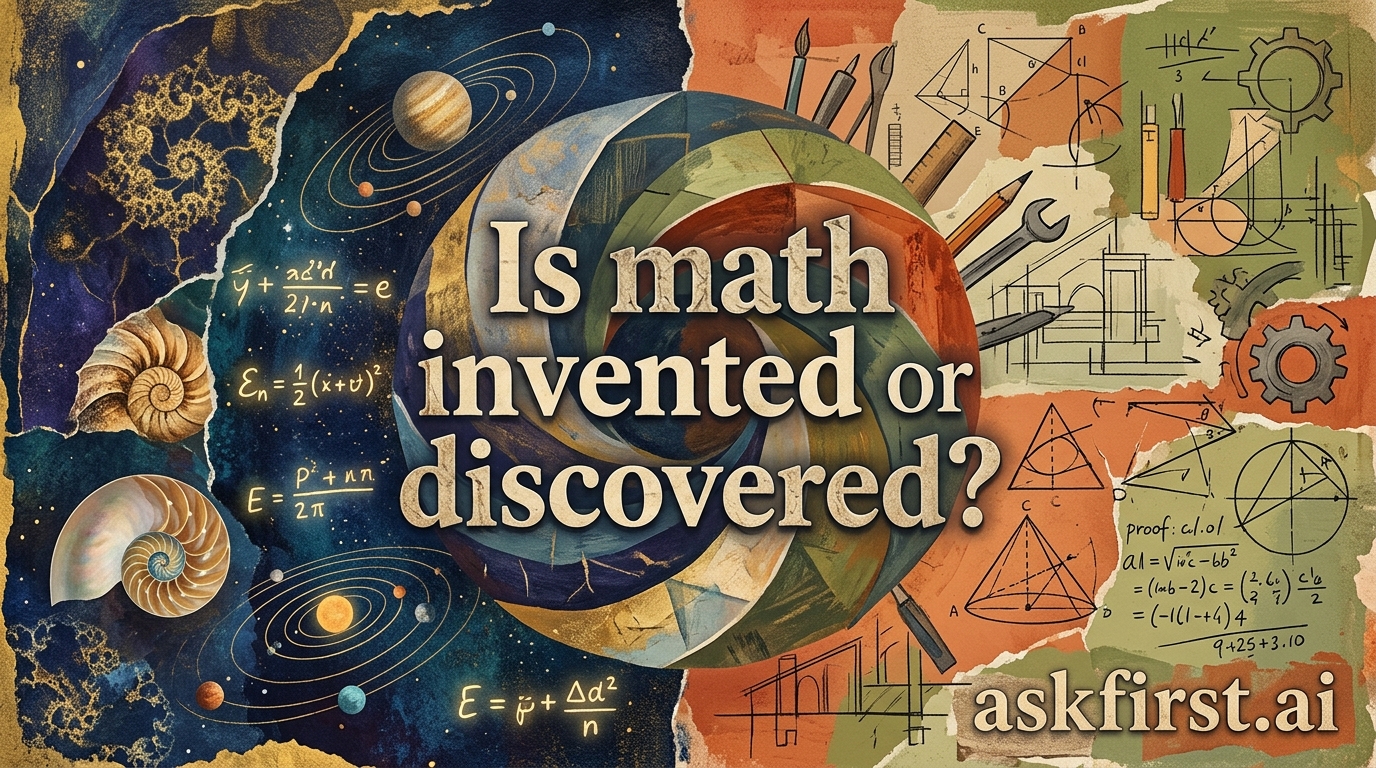
The question of whether mathematics is a fundamental fabric of the universe waiting to be unveiled, or merely a sophisticated linguistic construct created by the human mind, is perhaps the most enduring debate in the philosophy of science. This inquiry, often termed the "ontological status of mathematical objects," has divided the greatest intellects in history, ranging from Plato to modern computational theorists. To navigate this complexity, one must examine the tension between Mathematical Platonism and Mathematical Formalism.
The Platonist Perspective: Discovery as Revelation
The Platonist school of thought posits that mathematical truths exist independently of human existence. In this view, mathematicians are akin to explorers mapping a pre-existing landscape. When a mathematician proves a theorem, they are not "creating" a new truth; they are discovering a relationship that has existed since the dawn of time.
Gottlob Frege, in his seminal work The Foundations of Arithmetic (1884), argued that mathematical objects possess an objective reality that is neither physical nor mental. Similarly, Kurt Gödel, arguably the most significant logician since Aristotle, famously stated that mathematical objects are as real as physical objects, though they reside in a non-physical realm. He believed that our intuition allows us to perceive these abstract structures.
Concrete Example: Prime Numbers
Consider the distribution of prime numbers. A prime number is defined as a natural number greater than 1 that has no positive divisors other than 1 and itself. We did not "invent" the fact that 2, 3, 5, 7, and 11 are primes. Even if an alien civilization were to evolve in a distant galaxy, they would inevitably reach the same conclusion about the nature of these integers. The sequence of primes is a bedrock feature of reality, regardless of whether human consciousness is present to observe it.
The Formalist and Constructivist Perspective: Invention as Tool-Making
On the opposite side of the spectrum, Formalists argue that mathematics is a human invention—a game played with arbitrary symbols and rules. From this viewpoint, mathematics is a language, much like music or poetry, designed to organize our experiences and solve practical problems.
David Hilbert, the titan of 20th-century mathematics, championed the idea that mathematics is a formal system. In his view, mathematical statements are just strings of symbols that follow specific rules of manipulation. When we "discover" a new theorem, we are simply exploring the logical consequences of the axioms we chose to define at the start. If we change the axioms, we change the math.
Concrete Example: Non-Euclidean Geometry
For centuries, Euclid’s fifth postulate—the parallel postulate—was considered an absolute truth of the universe. However, in the 19th century, mathematicians like Nikolai Lobachevsky and Bernhard Riemann realized that one could "invent" a consistent geometry by simply changing that one rule. By assuming that parallel lines could curve toward or away from each other, they birthed non-Euclidean geometries. These were not "discovered" in the natural world at the time; they were invented as theoretical frameworks, which later proved essential to Albert Einstein’s General Theory of Relativity. Here, the "invention" turned out to be the perfect map for the "discovery" of spacetime curvature.
The Middle Ground: The Unreasonable Effectiveness
Perhaps the most haunting aspect of this debate is captured by the physicist Eugene Wigner in his 1960 essay, The Unreasonable Effectiveness of Mathematics in the Natural Sciences. Wigner noted that it is a "miracle" that purely abstract mathematical inventions, created without any physical application in mind, so often describe the physical world with uncanny precision.
Think of Complex Numbers. Invented in the 16th century by mathematicians like Gerolamo Cardano to solve cubic equations, they were initially dismissed as "imaginary" or useless. Yet, today, the entire field of quantum mechanics—the very foundation of our modern electronic world—is written in the language of complex numbers. Did we invent them to describe the subatomic world, or did we stumble upon a fundamental structure of reality that had been hiding in plain sight?
Conclusion: A Synthesis of Two Worlds
The dichotomy between invention and discovery may be a false one. A compelling synthesis, often discussed by philosophers like Mario Livio in his book Is God a Mathematician?, suggests that mathematics is a co-evolutionary process.
We likely "invent" the symbols, axioms, and logical frameworks based on our neurological capacity to perceive patterns (such as quantity, symmetry, and logic). However, because those patterns are rooted in the physical reality in which we evolved, the systems we invent eventually "discover" the deep, objective structures of the cosmos.
Ultimately, mathematics is likely both: it is a human language (invention) that is uniquely tuned to describe the underlying architecture of existence (discovery). We are not just inventing rules; we are building a bridge between the subjective human mind and the objective, logical structure of the universe. Whether this bridge is a product of our own design or a window into an eternal reality remains the most profound open question in intellectual history.