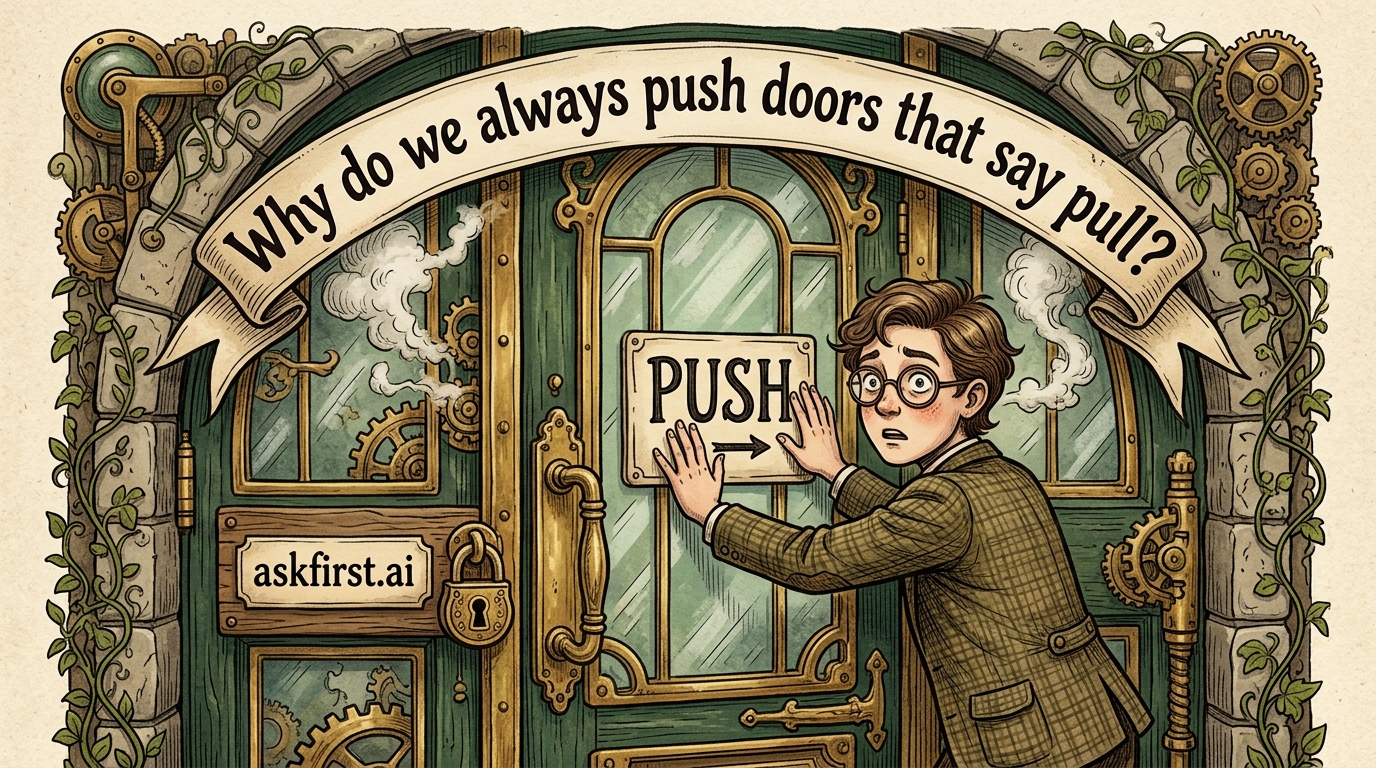
The phenomenon of pushing a door labeled 'pull' is so prevalent that it has been dubbed the 'Norman Door' in honor of Don Norman, the renowned psychologist and design expert. This cognitive mishap is not a sign of poor intelligence, but rather a perfect case study in how human-centric design, or the lack thereof, interacts with our hard-wired psychological shortcuts. When navigating the physical world, humans do not stop to read every sign. Instead, we rely on 'affordances'—physical cues that suggest how an object should be used. A flat plate on a door invites a push, while a vertical handle invites a grasp and pull. When the physical affordance conflicts with the written instruction, our brains prioritize the immediate physical sensation over the intellectual decoding of text, leading to the embarrassing 'push-pull' dance we have all performed.
The Psychology of Habituation
Human behavior is heavily governed by habituation. We spend most of our waking hours acting on autopilot, performing routine tasks without active deliberation. Walking through a doorway is a mundane transition, one that our brains have automated to conserve cognitive energy. Because many doors we encounter in commercial settings are designed to be pushed for egress (often for fire safety reasons), the brain establishes a 'push' heuristic. When confronted with a door that deviates from this learned expectation, our subconscious override remains active until we meet resistance. The physical act of pushing is faster than the mental process of reading, processing, and reacting to a sign.
The Impact of Design Affordances
Don Norman’s seminal work, The Design of Everyday Things, highlights that good design should speak for itself. A door requiring a pull should have a handle that clearly indicates grabbing, not a flat metal plate. When a manufacturer places a 'pull' sticker on a door with a push-plate, they are creating a 'design trap.' The error lies not with the user, but with the failure of the interface. This disconnect illustrates the importance of 'signifiers.' A signifier is an indicator—a mark, a sound, or a physical shape—that tells the user what action to take. In this instance, the plate functions as a visual signifier for pushing, while the sticker acts as a competing, contradictory signifier. This sensory overload forces the user into a state of 'split-attention,' where the visual cues are processed at different speeds.
Evolutionary Shortcuts and Cognitive Load
From an evolutionary perspective, the human brain is optimized to minimize energy expenditure. If a solution (pushing) has worked for 99% of doors in the past, the brain categorizes that method as a 'low-risk' behavior. It effectively ignores the sign until the interaction fails. This is a survival mechanism: we are wired to react to the environment faster than we are wired to interpret symbolic language. By the time our eyes register the word 'pull,' our arms have already initiated the kinetic motion of pushing. The cognitive load required to stop that motion is high, resulting in that awkward pause where we realize the door is locked against us.
How Architects Can Fix the Friction
To solve this, designers must align the physical interface with the expected outcome. The 'pull-only' door should possess a handle that is uncomfortable to push, or simply lack any surface that suggests a push. This alignment between the user's mental model and the product's function is the gold standard of UX (User Experience) design. When the environment matches our intuitive expectations, we stop making errors. Companies that prioritize ergonomic clarity find that their patrons are less frustrated and move through spaces more fluidly. Effective design communicates in silence, requiring no signs at all because the shape of the handle tells the whole story.
Lessons for the Future
While the 'Norman Door' is a source of amusement, it teaches a serious lesson about the power of environmental prompts. If one seeks to guide human behavior in any capacity—be it in software design, urban planning, or product manufacturing—one must account for the fact that people rarely stop to read directions. We rely on the physical shape of the world to tell us how to act. Next time a door foils your efforts, remember that you are not failing the test; the design is failing you. By understanding these psychological triggers, we can move toward a more intuitive world where our objects work with our minds rather than against them.