The Evolutionary Architecture of Memory
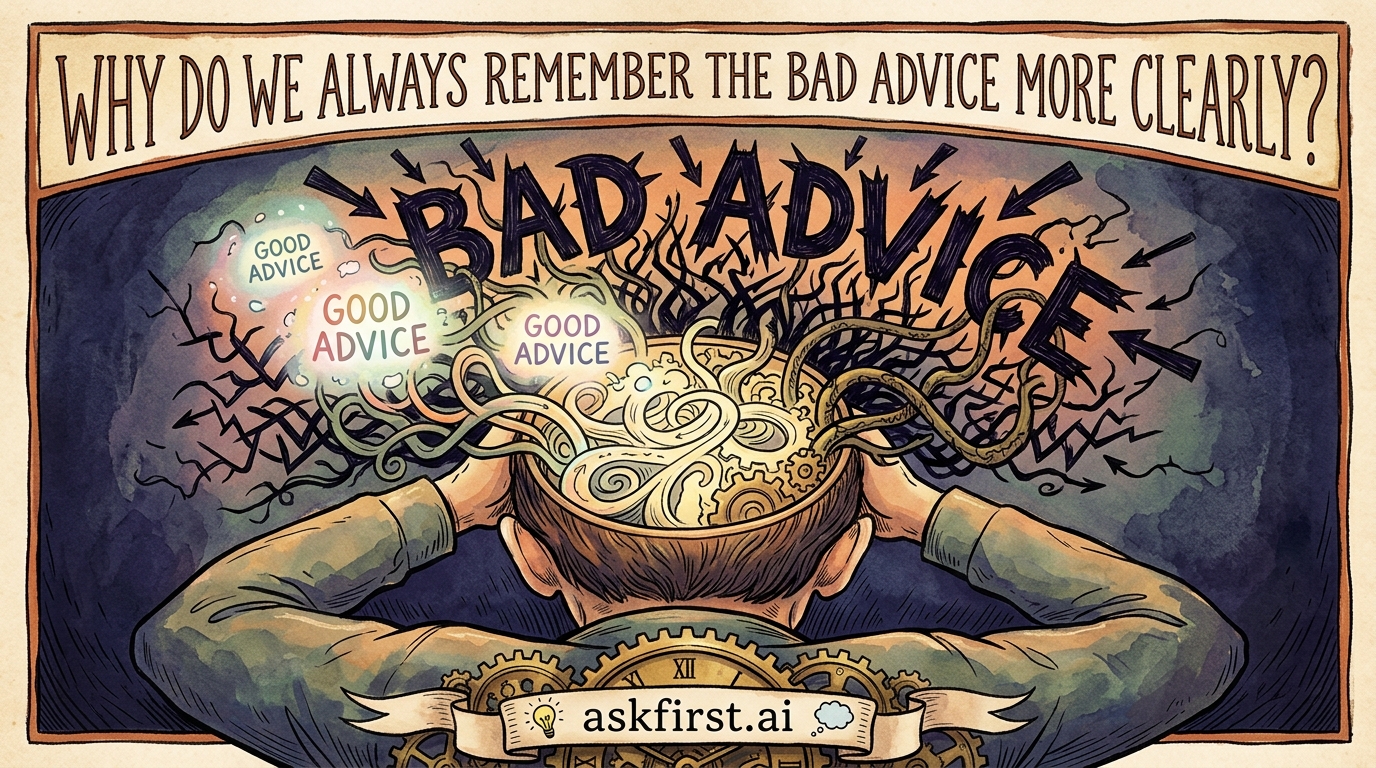
The tendency to recall negative or poor advice with greater clarity than positive guidance is deeply rooted in the evolutionary psychology of human survival. Throughout history, the human brain has been meticulously optimized for threat detection. This biological prioritization, often termed the Negativity Bias, suggests that the human nervous system is conditioned to assign more weight to negative stimuli than to positive ones. When an individual receives bad advice—especially advice that leads to a setback—the brain processes this as a potential hazard. By cementing the memory of this failure, the brain attempts to create a heuristic, or mental shortcut, to prevent similar negative outcomes in the future. In essence, our internal survival mechanism values avoiding pain over seeking pleasure.
Cognitive Mechanisms at Play
Several cognitive phenomena explain why poor advice lingers in the memory:
- The Zeigarnik Effect: This psychological principle states that people remember uncompleted or interrupted tasks better than completed ones. If bad advice leads to an unfinished or problematic situation, the mind remains preoccupied with the unresolved tension of that bad advice, causing it to resurface frequently.
- Emotional Salience: Memory is not a passive recording device; it is emotionally charged. Negative experiences are usually accompanied by stronger emotional reactions like frustration, regret, or embarrassment. Because emotions are processed in the amygdala, which is intricately connected to the hippocampus (the brain’s memory center), high emotional arousal acts as a chemical highlighter for memory consolidation.
- Contrast and Novelty: Positive, sound advice often feels mundane or expected. However, bad advice often defies social norms or common sense, making it unique or 'novel.' The brain prioritizes novel information because it stands out against the backdrop of standard, predictable occurrences.
The Role of Social Learning
Humans are fundamentally social creatures. We learn vicariously through the experiences of others, a process called Social Learning Theory. When we observe or experience a 'negative' outcome resulting from a specific piece of advice, our brains engage in social cognition to map that action to its consequence. This is a survival adaptation. If a peer provides advice that leads to social embarrassment or resource loss, the brain marks that advice as 'dangerous metadata.' This allows the individual to bypass the need to test the advice personally, which would be a much higher-cost learning process.
Overcoming the Bias: A Practical Framework
Recognizing that the brain is biased toward the negative is the first step toward better decision-making. To balance this perspective, one must employ conscious cognitive reappraisal techniques:
- The Positive Anchoring Technique: Since the brain naturally discards positive input in favor of negative warnings, individuals must intentionally anchor themselves to successful outcomes. Keep a journal of 'Best Advice Received' to balance the mental weight against the 'Worst Advice' collection.
- Cognitive Distancing: When recalling bad advice, analyze it with the objectivity of a scientist. View the bad advice as an 'experiment that gathered data on what does not work,' rather than a personal failure or a looming threat.
- Active Information Synthesis: Instead of letting the memory of bad advice dictate future behavior through fear, translate that negative memory into a positive rule. For instance, if you recall bad advice about a financial investment that failed, define a specific, actionable rule for how to vet future investments properly. Turn the memory into a strategy.
The Future of Knowledge Retention
As society becomes increasingly data-driven, the ability to filter out the 'noise' of poor advice is more valuable than ever. By understanding that our recollection of poor advice is a byproduct of ancestral survival traits, we can stop viewing these memories as sources of regret and start viewing them as valuable, if slightly biased, databases for wisdom. Remember that human memory is a reconstruction rather than a playback. Every time you recall that 'bad' advice, you have the opportunity to rewrite the narrative. Rather than dwelling on the error, extract the lesson, update your internal model of the world, and move forward. In the digital age, being able to distinguish between 'noisy' advice and wisdom requires the discipline to bypass our default bias toward the negative, ensuring that constructive and healthy strategies receive the same mental real estate as the cautionary tales of the past.