The Mechanics of the Hydrological Cycle: Earth’s Perpetual Engine
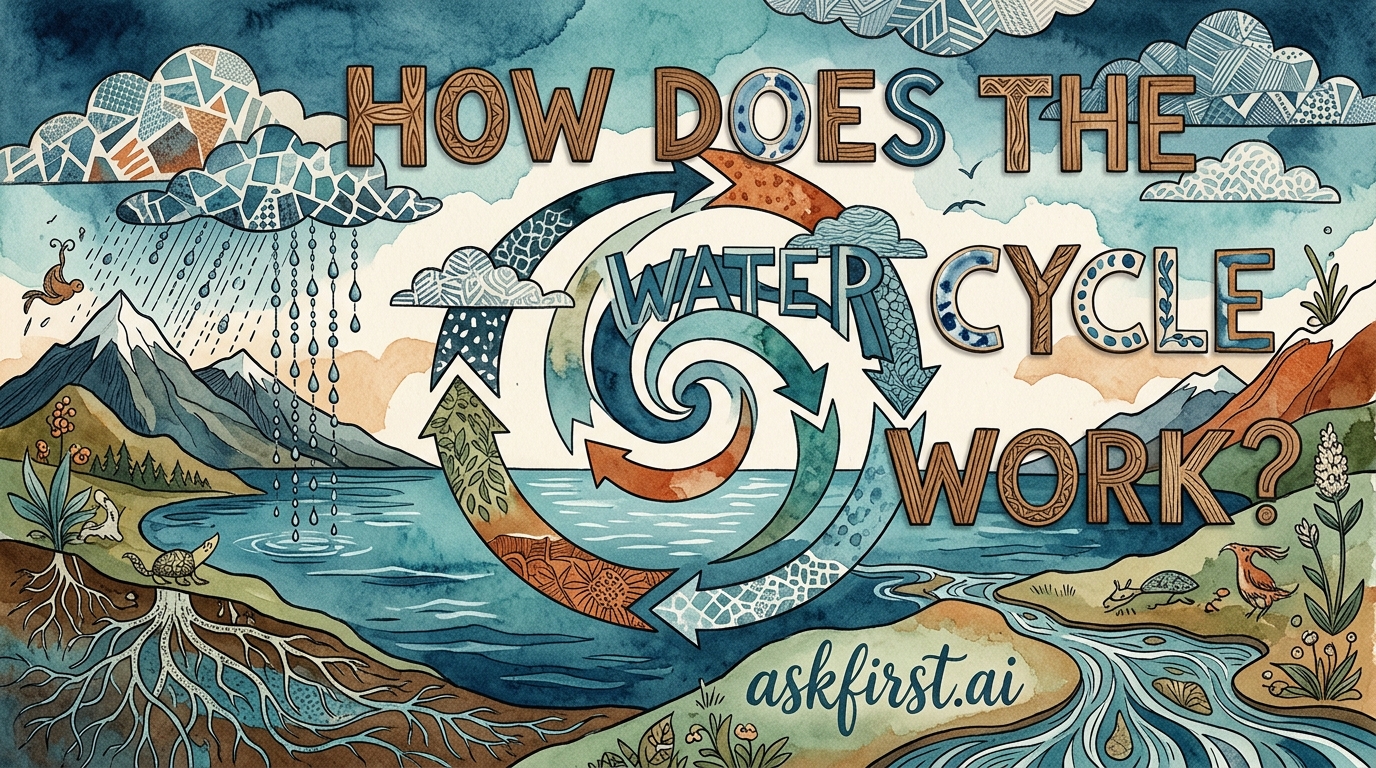
The water cycle, scientifically referred to as the hydrological cycle, is the continuous, intricate movement of water on, above, and below the surface of the Earth. It is a closed system, meaning that the total amount of water on our planet remains relatively constant, though it constantly shifts between states—liquid, vapor, and ice. Understanding this process is vital to comprehending everything from local weather patterns to global climate stability.
1. Solar Energy: The Primordial Catalyst
The entire cycle is powered by the sun. Without solar radiation, Earth’s water would remain frozen in a stagnant, icy state. When sunlight hits the surface of the oceans, lakes, and rivers, it provides the thermal energy necessary for evaporation. During this phase, water molecules gain enough kinetic energy to transition from a liquid state into water vapor—a gaseous form that rises into the atmosphere.
A critical nuance often overlooked is transpiration. As noted by Dr. Igor Shiklomanov in his seminal work World Water Resources (published by the UNESCO International Hydrological Programme), plants play a massive role in this stage. Through tiny pores in their leaves called stomata, plants release water vapor into the atmosphere, a process known as evapotranspiration. Combined, these processes act as the primary "pump" that lifts water from the surface into the sky.
2. Atmospheric Transport and Condensation
Once water vapor enters the atmosphere, it is carried by global wind currents across vast distances. As this vapor rises, the air pressure decreases, causing the air to cool. According to the principles of the Clausius-Clapeyron relation in atmospheric physics, cooler air cannot hold as much moisture as warmer air.
When the air reaches its dew point, the water vapor undergoes condensation. It clings to microscopic particles suspended in the air, such as dust, salt, or smoke, known as cloud condensation nuclei. This forms clouds. If you look at the research presented in The Earth's Hydrological Cycle by Dr. Kevin Trenberth, you will find that this phase is essential for the redistribution of heat. When water condenses, it releases "latent heat," which acts as a primary driver for major storm systems and atmospheric circulation.
3. Precipitation: The Return to Earth
When cloud particles collide and coalesce, they grow heavy enough that the atmosphere can no longer support them against the force of gravity. This results in precipitation. Depending on the temperature profile of the atmosphere, this water returns to the surface as rain, snow, sleet, or hail.
Precipitation is not distributed evenly across the globe. Orographic lift—where air is forced upward by mountain ranges—is a prime example of how geography dictates water distribution. For instance, the windward side of the Cascade Range in the Pacific Northwest receives massive amounts of rainfall, while the leeward side remains in a rain shadow, creating arid conditions.
4. Collection, Infiltration, and Runoff
Once water reaches the ground, its journey takes one of three paths:
- Surface Runoff: Water flows over the landscape into streams, rivers, and eventually oceans. This is the primary mechanism that sculpts the Earth’s topography through erosion.
- Infiltration and Percolation: Much of the water soaks into the soil. This water travels through cracks and pores in the Earth's crust to become groundwater. It accumulates in aquifers, which serve as massive, slow-moving reservoirs. As detailed in the United States Geological Survey (USGS) Water Science School resources, this groundwater can remain stored for thousands of years before eventually seeping back into a body of water or being extracted by human wells.
- Storage: Water can be sequestered in ice caps, glaciers, or snowpacks. These "frozen reservoirs" are critical because they release water slowly over the spring and summer, providing a consistent supply for river systems during drier months.
5. The Human Impact on the Cycle
Modern human activity has significantly altered the pace and purity of the hydrological cycle. Urbanization, with its vast stretches of impermeable concrete and asphalt, prevents natural infiltration, leading to increased flash flooding and reduced groundwater recharge. Furthermore, deforestation reduces the rate of transpiration, which can alter local rainfall patterns. As documented by Dr. Peter Gleick in The World's Water, the over-extraction of aquifers is causing land subsidence and the permanent depletion of water sources that take millennia to replenish.
Conclusion
The water cycle is far more than a simple schoolroom diagram; it is a complex, life-sustaining system that regulates Earth’s climate and supports all biological existence. From the solar-driven evaporation in the tropics to the slow percolation of groundwater through subterranean rock, every stage is interconnected. By recognizing that we are not merely observers of this cycle but active participants who influence its flow, we gain a deeper appreciation for the necessity of water conservation and the delicate balance of our planet's most precious resource. Understanding these mechanics is the first step toward responsible stewardship of the environment in an era of rapid climatic change.