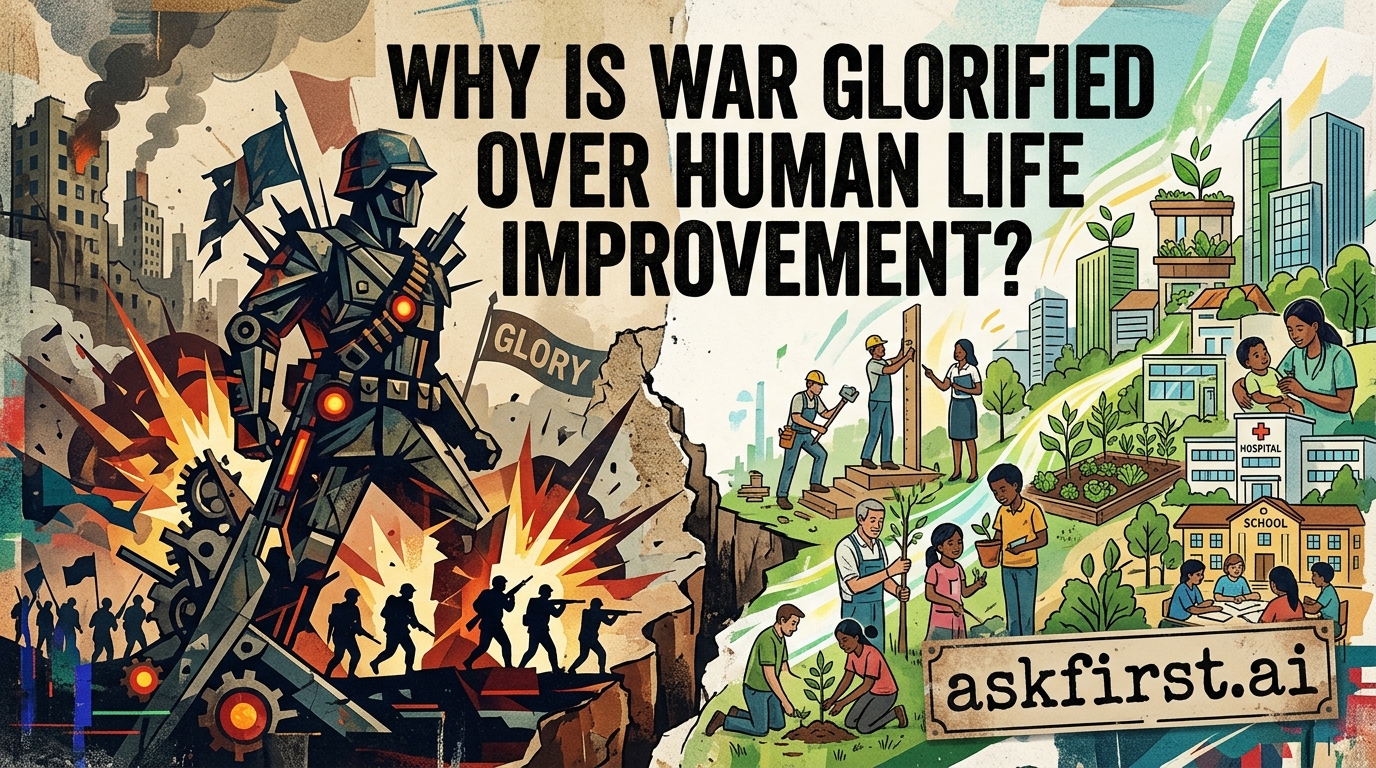
The Paradox of Conflict: Why Humanity Prioritizes Martial Glory Over Collective Flourishing
The history of human civilization is frequently written in the ink of blood rather than the blueprints of progress. While the annals of history celebrate the advancements in medicine, art, and philosophy, these achievements are almost always framed within the context of great power struggles or the aftermath of industrial-scale slaughter. This phenomenon—the glorification of war over the systematic improvement of human life—is not a mere historical accident. It is a deeply ingrained sociological, psychological, and economic pattern that has shaped the trajectory of our species for millennia.
The Evolutionary and Psychological Roots of Martial Valor
At the core of the glorification of war lies the evolutionary legacy of tribalism. In The Better Angels of Our Nature, psychologist Steven Pinker explores how human cognitive architecture was shaped by environments where intergroup competition was a constant threat. For much of human existence, the survival of the tribe depended on the ability to project force and defend resources. Consequently, societies evolved to reward aggression and sacrifice in the name of the group.
This psychological predisposition is reinforced by what sociologists call "the hero narrative." War provides a clear, high-stakes framework where the virtues of courage, loyalty, and self-sacrifice are distilled into a singular, unambiguous purpose. In contrast, the improvement of human life—such as eradicating malaria, improving literacy, or addressing systemic poverty—is a slow, incremental, and often invisible process. It lacks the visceral, adrenaline-fueled climax of a battlefield victory. As noted by the historian Christopher Clark in The Sleepwalkers: How Europe Went to War in 1914, the perception of war as a "cleansing" or "ennobling" force was a dominant cultural sentiment in the early 20th century, precisely because it offered a sense of collective purpose that mundane civilian life could not replicate.
The Economic Engine of Conflict
Beyond psychology, the glorification of war is inextricably linked to the mechanics of power and capital. War acts as a massive stimulus for state-led innovation. The "Military-Industrial Complex," a term popularized by President Dwight D. Eisenhower in his 1961 farewell address, describes the symbiotic relationship between military contractors, the defense establishment, and political institutions.
When a nation is at war, the barriers to spending are removed. Resources that would be deemed "too expensive" for public health or education are suddenly mobilized for the production of weaponry and logistics. This creates a feedback loop: innovation occurs rapidly in military tech (like the development of the internet via ARPANET or jet propulsion), which then trickles down into civilian society. Because these advancements are born of conflict, the public narrative credits the war effort for the technology, rather than acknowledging that the same scientific minds could have achieved those breakthroughs in a peaceful, well-funded environment.
The Media and the Aesthetics of Violence
The way we consume information plays a critical role in maintaining the prestige of war. War is inherently telegenic and dramatic. It creates heroes, villains, and clear-cut narratives that captivate the public imagination. In The Society of the Spectacle, Guy Debord argues that modern society has replaced lived experience with representations. War, when filtered through news media, film, and literature, becomes a stylized product—an aesthetic experience that masks the gruesome reality of human suffering.
We are culturally conditioned to honor the "fallen soldier" as a martyr for a greater cause. This sentiment, while deeply empathetic, serves to sanitize the brutality of state-sponsored violence. By focusing on the nobility of the individual fighter, the discourse shifts away from the systemic failures of diplomacy and the tragic loss of potential that those lives represented. We celebrate the veteran’s sacrifice, but we rarely interrogate why the society they served could not find a way to improve human conditions without requiring that sacrifice in the first place.
The Cost of Misplaced Priorities
The opportunity cost of prioritizing war is staggering. In his famous 1953 "Chance for Peace" speech, Eisenhower poignantly observed: "Every gun that is made, every warship launched, every rocket fired signifies, in the final sense, a theft from those who hunger and are not fed, those who are cold and are not clothed."
When we prioritize the glorification of war, we normalize the idea that human life is expendable for the "greater good" of the state. This mindset discourages long-term investment in human capital. It is far easier to convince a populace to fund a new fighter jet than to fund a multi-generational program to eliminate systemic inequality, because the former promises a tangible, immediate sense of security, whereas the latter requires patience, nuance, and the admission that societal problems are complex and difficult to solve.
Conclusion
The glorification of war over human life improvement persists because it satisfies deep-seated psychological cravings for heroism, serves as a powerful driver of state-led economic mobilization, and is sustained by a media culture that favors the drama of conflict over the quiet progress of development. However, this is not an immutable law of nature. As humanity faces global challenges—from climate change to pandemics—the definition of "strength" must shift. A society that views the successful education of its youth, the health of its citizens, and the reduction of poverty as its primary "victories" will eventually prove more resilient and prosperous than one that measures its greatness by the reach of its armaments. The transition away from the glorification of war is not merely a moral imperative; it is a prerequisite for our continued evolution as a species.