The Evolutionary Bias Toward Negative Information
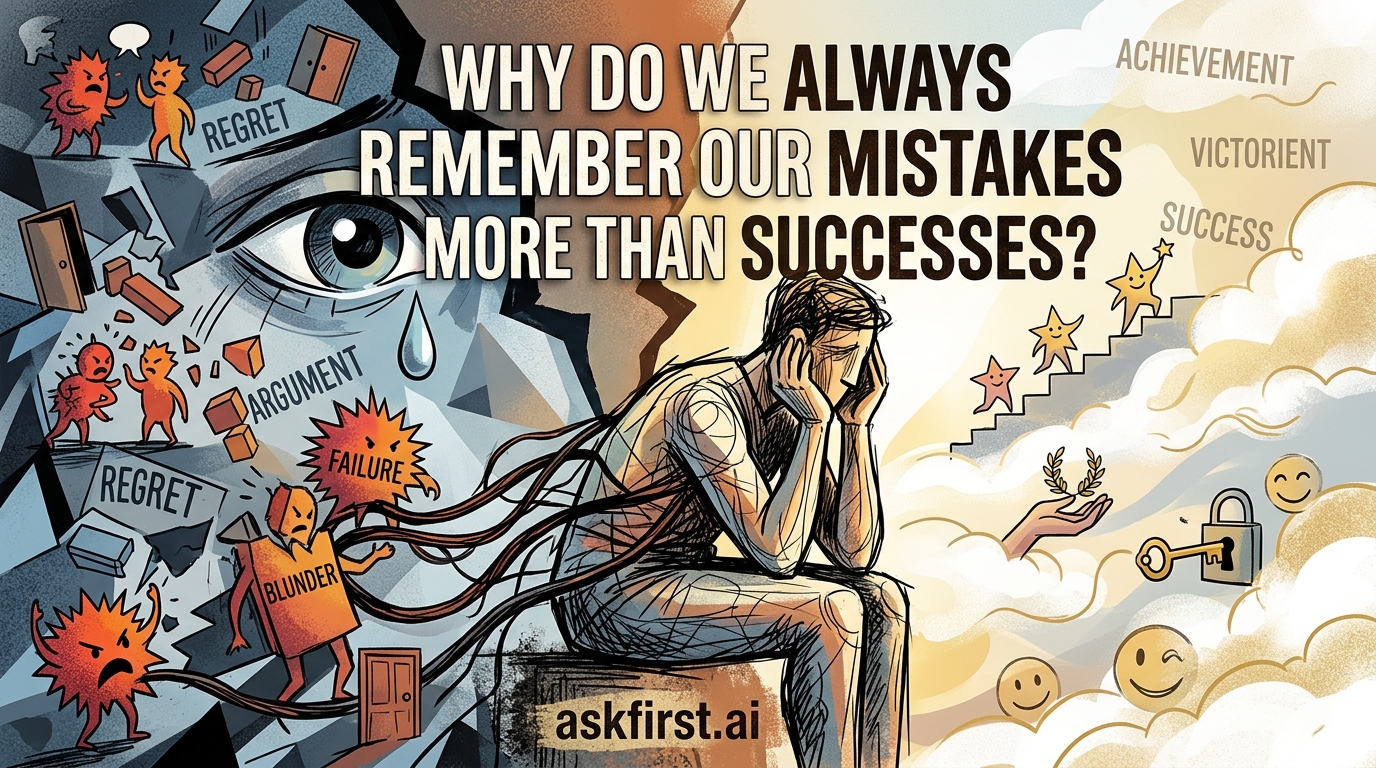
The human tendency to remember errors far more vividly than triumphs is rooted in the evolutionary concept of the negativity bias. From an ancestral perspective, survival was far more dependent on avoiding life-threatening dangers than on celebrating successful forage. A single mistake—such as eating a toxic plant or ignoring a rustle in the tall grass—could result in immediate death, whereas a successful hunt provided only transient nutritional gain. Consequently, the human brain evolved to prioritize negative stimuli, encoding them with greater emotional intensity and neural depth to ensure that the same error would not be repeated in the future.
The Neurobiology of Regret
When an individual makes a mistake, the brain often experiences a sharp spike in activity within the anterior cingulate cortex (ACC). This region serves as the brain's error-detection mechanism, acting as a monitor for discrepancies between intended outcomes and actual results. When a failure occurs, the brain releases a surge of cortisol and adrenaline, physiological markers of stress that effectively 'anchor' the memory. This mechanism, known as amygdala activation, ensures that the memory is not just stored, but prioritized. Unlike successful moments, which are often processed as expected outcomes, mistakes trigger a neurochemical alert system designed to prevent recurrence, effectively sealing the memory deep within the hippocampus for long-term retrieval.
Psychological Factors and Cognitive Dissonance
Beyond basic neurobiology, the Zeigarnik Effect plays a significant role in memory retention. This phenomenon posits that people remember uncompleted or interrupted tasks better than completed ones. A mistake represents an 'unfinished' or 'suboptimal' state of reality, forcing the brain to return to the memory repeatedly in a quest to rectify or process the data. Furthermore, cognitive dissonance—the discomfort caused by holding conflicting ideas—drives the brain to fixate on errors. Because most individuals view themselves as capable and intelligent, a blunder creates an internal conflict that demands resolution. The brain ruminates on the mistake, replaying scenarios and 'what-if' sequences in an attempt to reconcile the discrepancy between self-perception and reality.
The Contrast of Success and Expectedness
Success is often internalized through the lens of hedonic adaptation. This is the process by which humans quickly return to a relatively stable level of happiness despite positive events. Once a goal is achieved, the dopamine hit associated with the victory rapidly fades, and the success is categorized as the 'new normal.' Because success is often interpreted as fulfilling expectations, the brain does not deem it necessary to store the memory with the same high-resolution vigilance used for mistakes. Success is a destination reached, whereas a mistake is a signal that a deviation occurred; the brain cares much more about deviations than it does about smooth sailing.
Social Learning and the 'Worst-Case' Simulation
Human cognition is highly social and prospective. Humans are essentially 'simulation machines' that constantly model future scenarios to predict outcomes. By replaying mistakes, the mind is actually conducting a low-stakes rehearsal for future events. This mental simulation allows individuals to refine their strategies, essentially learning from a 'near-miss' without having to experience the physical consequences again. This is why hindsight feels so acute; the brain is continuously updating its internal model of the world based on the most salient data points, which, by design, are the mistakes that caused the most internal disruption.
Strategies for Balanced Memory
Understanding this bias is the first step toward mitigating its potentially paralyzing effects. While the brain is wired to focus on the negative, conscious effort can redirect this attention:
- Intentional Success Journaling: By writing down achievements, the brain is forced to engage in 'active encoding,' treating these successes with the same narrative importance as mistakes.
- Cognitive Reframing: Recognizing the negativity bias as a survival mechanism rather than a personal character flaw helps reduce the shame associated with past failures.
- Focus on Process over Outcome: Instead of obsessing over the error (the negative result), analyze the mechanics of the performance. This shifts the focus from emotional rumination to logical, skill-based improvement.
In summary, the obsession with past mistakes is not a sign of weakness, but a testament to the sophistication of the human survival apparatus. By shifting the perspective to view these memories as essential data for refinement, individuals can transform the 'sting' of failure into a engine for consistent, long-term personal growth.