The Psychology of Negative Bias
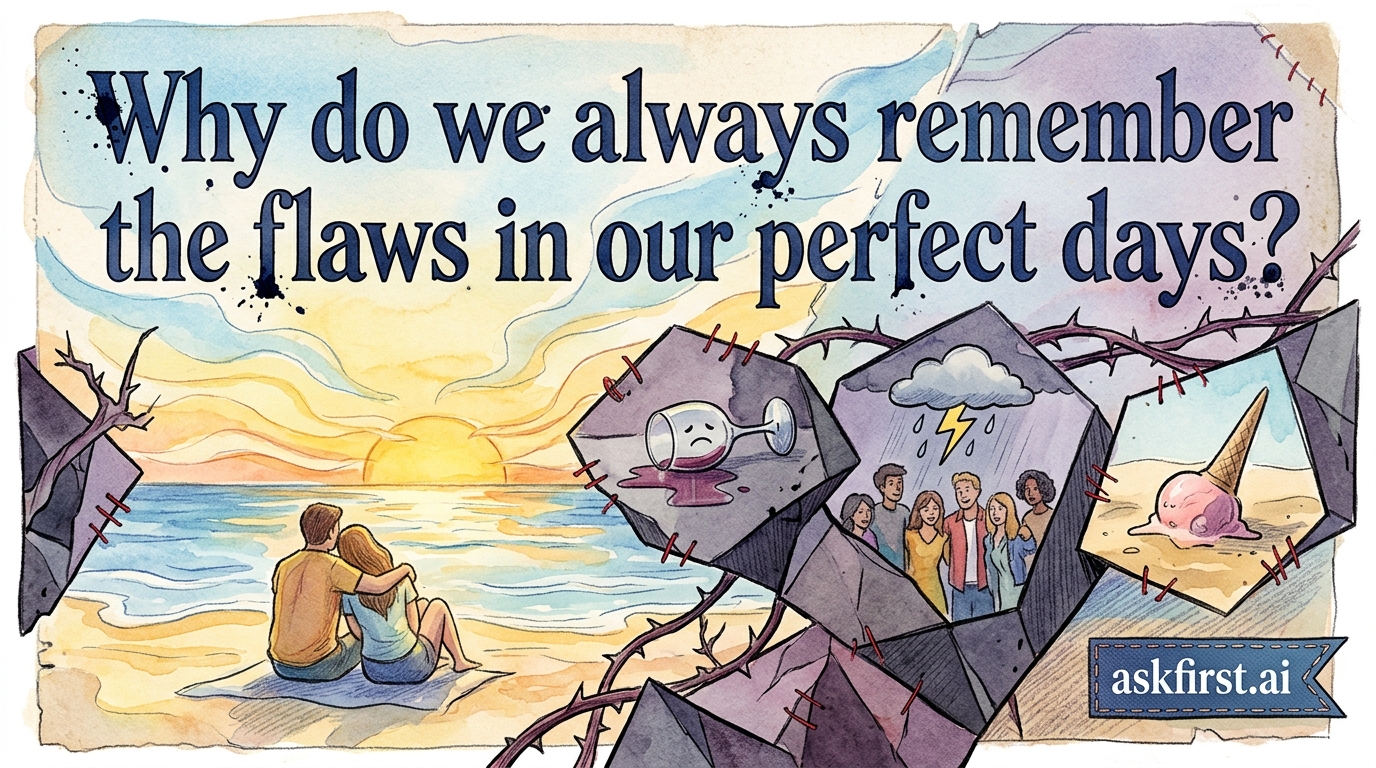
The human brain is not a neutral recorder of events; it is a survival machine honed by millions of years of evolution. The phenomenon described—the tendency for small, negative details to overshadow overwhelmingly positive experiences—is primarily rooted in the Negativity Bias. This cognitive heuristic suggests that for our ancestors, noticing a predator in the bushes was far more critical for survival than savoring a beautiful sunset. Consequently, the brain is hardwired to scan for, prioritize, and fixate on "errors" in the environment, even during moments of peak joy.
The Contrast Effect
When a day is perceived as "perfect," the baseline for expectations becomes exceptionally high. This triggers the Contrast Effect, a cognitive bias wherein the presence of a flaw becomes disproportionately jarring. If everything else is aligned perfectly, a minor inconvenience—like a spilled drink, a rude comment, or a misplaced item—stands out in stark relief against the smooth backdrop of success. Because the brain experiences "perfect" events as exceptions to the rule, it hyper-focuses on the "threat" to that perfection, causing the imperfection to occupy more mental space than the positive surrounding elements.
Peak-End Rule and Memory Construction
Psychologists Daniel Kahneman and Amos Tversky proposed the Peak-End Rule, which suggests that individuals judge an experience largely based on how they felt at its peak and at its end, rather than the total sum of the experience. However, the mind also harbors a "completeness" bias. When we recount a memory, we attempt to resolve the narrative. If there is a "loose thread"—a flaw or an unfulfilled expectation—the brain struggles to categorize the event as "finished" or "closed." This dissonance causes the memory to remain active in our conscious thought, compelling us to ruminate on the flaw because it is the only part of the puzzle that does not fit.
Evolutionary Vigilance: The "Why"
From an evolutionary perspective, the brain treats "flaws" as lessons. If a wedding goes beautifully but the food is cold, the brain remembers the cold food not necessarily because it ruined the day, but because it represents a potential "failure" of logistics that should be avoided in the future. We are effectively "glitch-hunting" in our own pasts. This constant scanning serves a vital pedagogical role in human development, ensuring that we are always optimizing our future performance. We remember the imperfection because it is the only data point that suggests a need for improvement.
Mitigation Strategies: Reframing the Narrative
Understanding this bias allows individuals to actively override it through conscious cognitive reframing:
- The 90/10 Rule: Actively categorize events by allocating 90 percent of focus to the positive outcomes and acknowledging that the 10 percent of "flaws" are statistically expected in any complex system.
- Cognitive Anchoring: When a positive day occurs, write down three specific, small details that went right. This creates a stronger neural "anchor" that competes with the negative bias.
- Acceptance of Imperfection: Recognize that the "flaw" is often a marker of authenticity. In many cases, it is the minor mishap that turns a generic event into a distinct, personalized memory.
Conclusion
Remembering the flaws in perfect days is not a sign of ingratitude or an inability to enjoy life. Rather, it is a testament to the sophistication of the human mind. The brain is an optimizer, constantly searching for gaps to fill and errors to correct. By viewing these intrusive negative memories as data points for growth rather than symbols of failure, individuals can liberate themselves from the trap of perfectionism. A perfect day is never truly diminished by a minor flaw; it is merely rendered human, historical, and entirely authentic. By acknowledging this cognitive quirk, one can learn to savor the beauty of the "99 percent" while accepting the flaw as the necessary seasoning of a lived experience.