The Psychology of Temporal Distortion
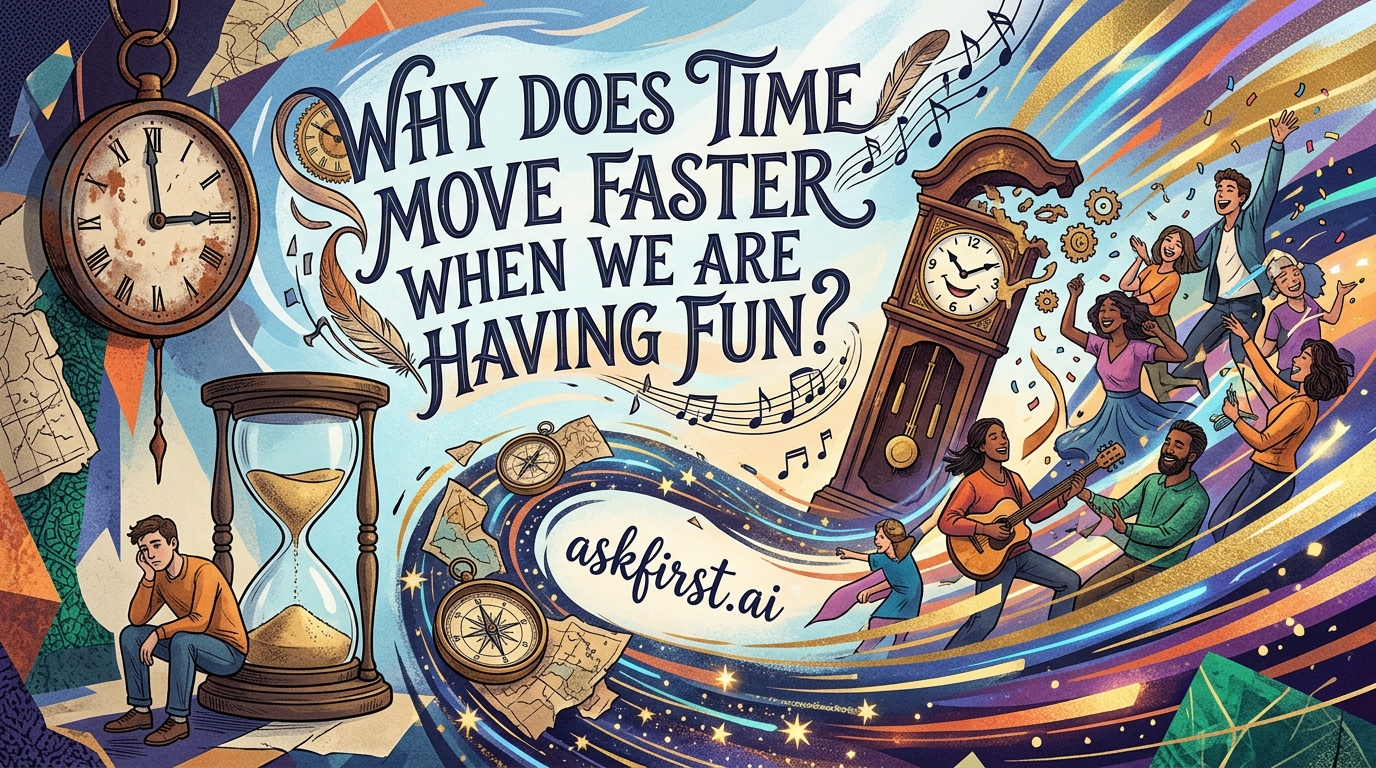
Time is a fundamental constant in the physical universe, ticking away with absolute precision according to the laws of entropy and relativity. However, for the human brain, time is not an external ruler but an internal construct heavily influenced by cognition, attention, and memory. The phenomenon where time appears to accelerate during periods of enjoyment is a classic example of cognitive temporal distortion.
The Role of Retrospective Assessment
To understand why time seems to fly, one must distinguish between the 'prospective' experience of time (watching the clock) and the 'retrospective' judgment of time (reflecting on an event after it concludes). When people are having fun, they are often in a state of 'flow'—a psychological concept popularized by Mihaly Csikszentmihalyi. During flow, the individual is so fully immersed in the activity that the conscious monitoring of time is temporarily suppressed.
When the brain is not checking the clock, it does not encode the duration of the event as a series of distinct time-stamps. Consequently, when the activity ends and the person looks back, the lack of encoded memory markers creates the illusion that the duration was shorter than it actually was. The brain essentially says, 'I remember very little detail about the progression of time, therefore, not much time could have passed.'
The Memory Encoding Hypothesis
According to the memory-storage theory of time perception, the brain estimates the duration of an event based on the number of non-redundant memories it stores during that interval. This is often referred to as the 'Holiday Paradox.' When someone is doing something exciting or fun, their attention is fixated on the action itself rather than the background details or the passage of time.
- High Engagement: During fun activities, the brain discards mundane contextual information.
- Low Memory Density: Because the brain is busy processing the pleasure of the experience, it creates fewer discrete memories of the 'waiting' or 'ticking' moments.
- Retrospective Compression: Upon reflection, the brain finds a 'sparse' memory bank of the event, which the mind interprets as a short timeframe.
Conversely, during boring or mundane tasks, the brain has nothing to focus on, so it begins to notice the slow, incremental passage of seconds. This generates a dense collection of memories filled with boredom, which the brain perceives as an extended, drawn-out period.
The Impact of Neurochemistry
Neurotransmitters play a significant role in how we perceive the duration of events. Dopamine, the brain's 'reward' chemical, is heavily released during enjoyable experiences. Scientific studies have suggested that dopamine levels can influence the speed of the brain’s internal pacemaker. When dopamine levels are high, the internal clock may speed up, causing the brain to process events as if they are occurring in rapid succession. This physiological acceleration makes external events feel as though they are passing by much faster in comparison to the brain's internal rhythm.
The Curiosity Gap and Engagement
When a person is engaged in a hobby, a social outing, or a complex creative task, their brain is in a state of high arousal. This state requires significant cognitive resources, leaving little room for 'metacognition'—the act of thinking about one's own thinking. When we monitor time, we are essentially performing a meta-task. By dropping this task in favor of immersion, we inadvertently delete the mechanism that informs us of time's movement.
Summary of Theoretical Models
- The Attention Model: Time is perceived as moving slowly when we pay attention to it. Fun diverts attention away from time, causing it to disappear from our conscious radar.
- The Memory Model: We judge time based on the volume of encoded memories. Fewer markers lead to a faster perception of time's passage.
- The Pacemaker Model: Neurochemical changes, specifically dopamine release, alter our internal temporal rhythm, making external time seem to move more quickly.
Understanding this mechanism helps explain why vacations often feel like they end in a flash, whereas a two-hour lecture can feel like an eternity. Ultimately, the brain is not designed to be an accurate chronometer; it is a meaning-making machine that prioritizes engagement and emotion over the objective, mechanical tick of a clock. Embracing this distortion is a testament to the power of human focus and the capacity for joy to temporarily disconnect us from the rigidity of reality.