The Psychology of Social Stigma
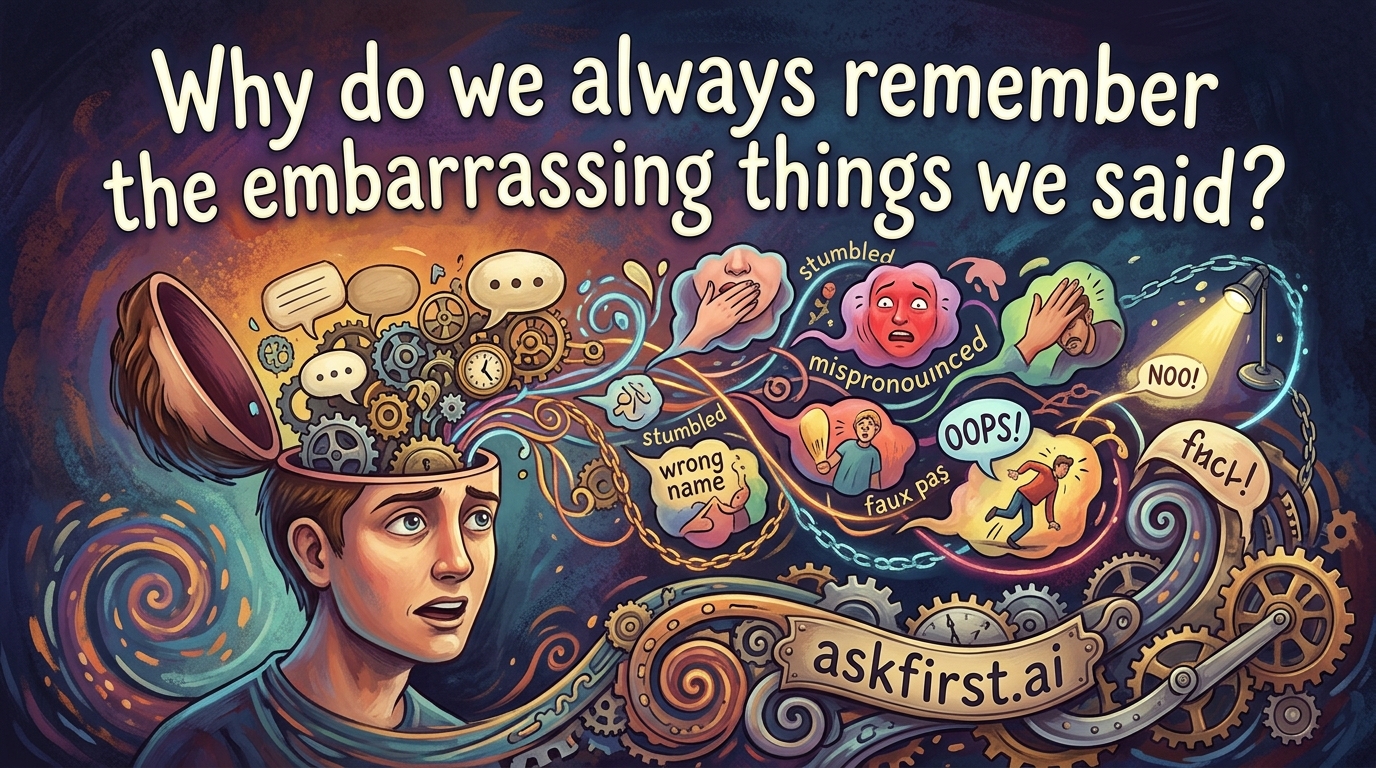
The phenomenon of ruminating on past social blunders is a deeply rooted survival mechanism known in psychology as the 'Spotlight Effect' combined with 'Negative Bias.' Human beings are fundamentally social animals, and for the vast majority of our evolutionary history, being ostracized from the tribe meant the difference between life and death. Because of this, the human brain evolved to prioritize negative social information—such as an embarrassing comment or a social faux pas—far more intensely than positive or neutral interactions.
The Negative Bias: Why Bad Memories Stick
Evolutionary psychologists suggest that our ancestors who were hyper-vigilant about their reputation survived and reproduced more effectively. If an individual violated a social norm, the internal penalty was a sharp spike of cortisol and shame, which served as an emotional 'scar' meant to prevent that behavior from recurring. This is the Negative Bias in action. Even in modern times, where social mistakes rarely lead to exile, the brain retains this ancient alarm system. We do not remember our average daily conversations because they lack the high-stakes emotional marker that shame provides.
The Spotlight Effect: A Distortion of Perception
The Spotlight Effect is a psychological cognitive bias where individuals tend to overestimate how much others notice their appearance or behavior. Most people believe they are the center of attention, leading to the belief that every minor stumble is being scrutinized by peers. In reality, studies show that others are almost entirely focused on their own internal dialogues and personal concerns. We remember our embarrassing moments with painful clarity because we are playing the movie of our life from our own perspective, assuming the audience is watching with equal intensity.
Neurobiology of Ruminative Thought
When a memory of an awkward moment is triggered, the brain’s Default Mode Network (DMN) kicks in. The DMN is responsible for self-referential thought—essentially the 'me' processing unit. When we are not engaged in an active task, the brain defaults to reviewing personal history. If we have a stored memory of shame, the brain often pulls this file to perform a 'safety check' to ensure we do not repeat the mistake. This repetitive thinking process is known as rumination. It is an obsessive loop that feels unproductive because it is an evolutionary safeguard that has lost its specific context.
Key Mechanisms of Memory Retention
- Emotional Intensity: Memory consolidation is directly tied to the level of arousal during an event. High emotional spikes (like embarrassment) act as a chemical highlighter in the brain, marking the event for long-term storage.
- The Zeigarnik Effect: This is the tendency to remember uncompleted or interrupted tasks better than completed ones. A social blunder represents an 'unfinished' interaction that didn't go as planned, causing the brain to keep the memory active.
- Social Threat Monitoring: The amygdala, responsible for detecting threats, triggers physiological stress responses when we contemplate social rejection, reinforcing the memory as a 'warning' for future social encounters.
Managing the Loop: Strategies for Mental Clarity
Understanding the mechanism does not immediately stop the experience, but it provides the perspective necessary to move forward. The following strategies are frequently utilized in cognitive behavioral frameworks:
- Cognitive Reframing: Practice viewing the memory from a third-party perspective. By stepping out of the 'first-person' experience, the emotional intensity of the shame is often dampened.
- Radical Acceptance: Accept that social mistakes are an inevitable byproduct of social existence. Perfection is not an evolutionary requirement for being liked.
- The Compassion Break: Use self-compassion to counteract the biological threat response. Remind yourself that everyone has a similar 'vault' of embarrassing memories, and it is a shared human experience, not a personal flaw.
Conclusion: The Silver Lining
While the urge to mentally relive every stutter or awkward joke is uncomfortable, it is evidence of a well-functioning social barometer. Our brain is simply trying to keep us safe and integrated into our community. By recognizing that these memories are merely 'software glitches' of our evolutionary biology, we can release the grip they have on our current mood and focus on the present moment, knowing that the rest of the world is far more focused on themselves than they could ever be on our minor missteps.