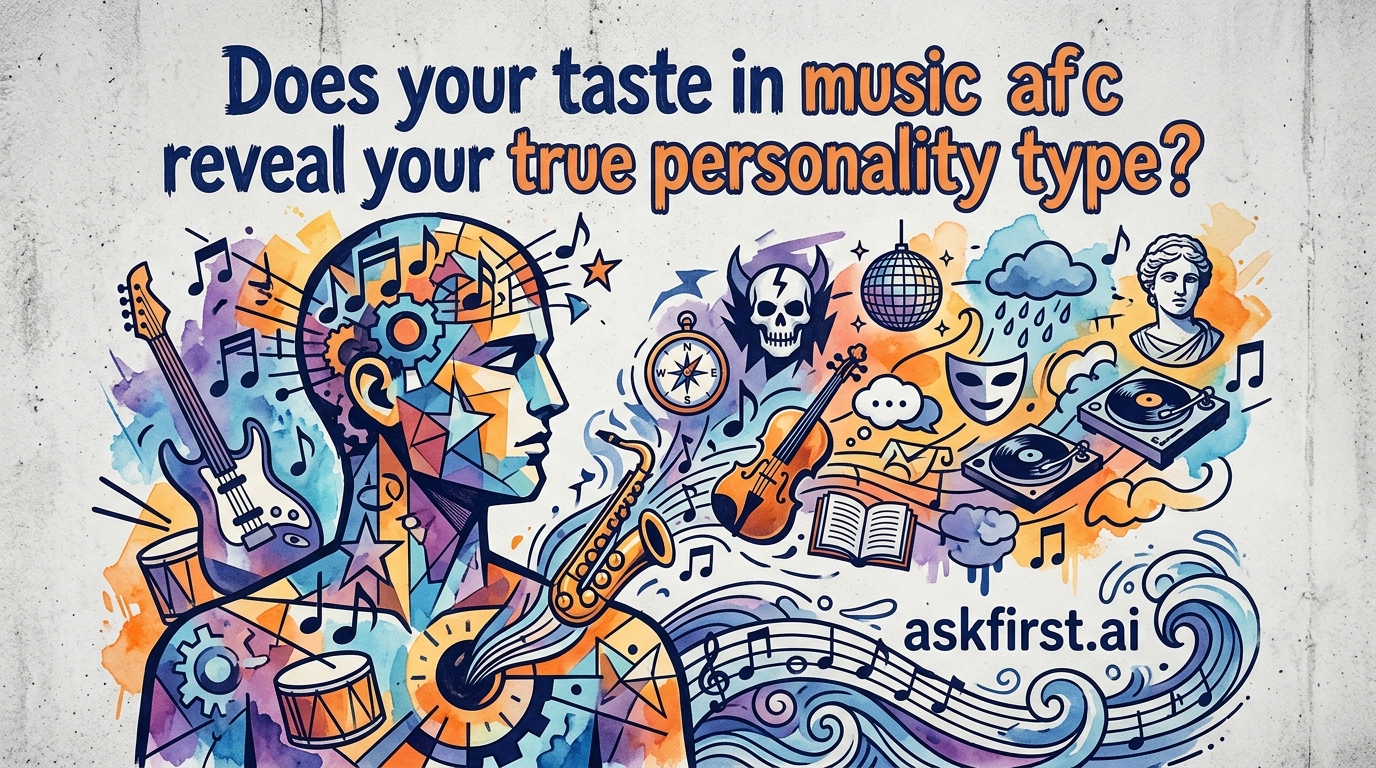
The Harmonic Fingerprint: Deciphering Personality Through Sound
Musical preference is rarely a random choice. Psychologists suggest that the auditory landscape individuals inhabit provides a direct window into the architectural structure of their psyche. Research, most notably the work by Dr. Peter Rentfrow and his colleagues, has established a link between 'Music-Personality' profiles, suggesting that listeners are essentially curating a soundtrack that mirrors their deepest cognitive tendencies.
The OCEAN Model of Personality
To understand this connection, one must look through the lens of the 'Big Five' personality traits—Openness, Conscientiousness, Extraversion, Agreeableness, and Neuroticism (OCEAN). Each trait correlates with specific stylistic preferences.
- Openness to Experience: This trait consistently shows the strongest correlation with musical diversity. Highly open individuals favor 'Reflective and Complex' genres, such as classical, jazz, and folk. These listeners seek intellectual stimulation, nuance, and structural ambiguity in their music, mirroring their desire for novelty and unconventional ideas.
- Extraversion: Extraverts gravitate toward 'Upbeat and Conventional' music. Genres like pop, dance, and R&B, which emphasize rhythmic complexity and social energy, resonate with those who thrive on external stimuli and interpersonal interaction.
- Agreeableness: People scoring high in agreeableness often prefer 'Mellow and Unpretentious' music. Soft rock, acoustic ballads, and soothing instrumental tracks reflect their empathetic nature and desire for social harmony, avoiding abrasive or overly intense sonic textures.
- Conscientiousness: While less pronounced than other traits, higher conscientiousness is sometimes linked to a preference for structured and orderly compositions, though this preference can vary significantly based on cultural exposure.
The Role of Musical Attributes
Beyond genre labels, it is the fundamental attributes—tempo, timbre, and lyricism—that serve as the true indicators. Listeners are drawn to music that reinforces their baseline emotional state or fulfills a psychological need.
- High Arousal Seeking: Individuals who enjoy music with high tempo and high volume, such as heavy metal or intense EDM, often exhibit traits associated with 'sensation seeking.' This does not necessarily equate to aggression; rather, it often signifies a need to regulate physiological arousal levels.
- Emotional Regulation: Music acts as an external scaffolding for the brain. Anxious individuals might use 'sad' or 'intense' music not to feel worse, but to feel heard—a phenomenon known as 'empathic listening' where the music validates internal states that are otherwise difficult to articulate.
The Science of Cognitive Style
Recent studies have moved beyond the Big Five to explore 'Empathizing vs. Systemizing' cognitive styles. 'Empathizers' possess a high drive to identify and respond to the mental states of others. They prefer music characterized by low arousal, emotional depth, and negative valence (sad, reflective). 'Systemizers,' conversely, display a drive to analyze patterns and rules. They gravitate toward music with high arousal, technical complexity, and positive valence (energetic, organized). This distinction explains why two people can listen to the exact same track and experience it through completely different psychological lenses.
The Cultural and Evolutionary Context
It is vital to acknowledge that while personality dictates internal preferences, culture provides the framework. An individual's music library is a hybrid of their innate psychological 'wiring' and the 'environment' they were raised in. However, even when controlling for culture, the consistent link between personality and music suggests an evolutionary purpose. Music may serve as a signaling mechanism, helping like-minded individuals identify one another within a tribe, thereby reinforcing social cohesion through shared aesthetic experiences.
Conclusion
Music is not merely a background layer to daily life; it is a manifestation of the self. While it would be reductive to claim that a single playlist could provide a complete psychological diagnosis, the evidence remains clear: the music one plays is a mirror held up to the mind. By observing these patterns, individuals can gain deeper self-awareness, recognizing that their favorite songs are often the sonic equivalent of their own core values and cognitive priorities.