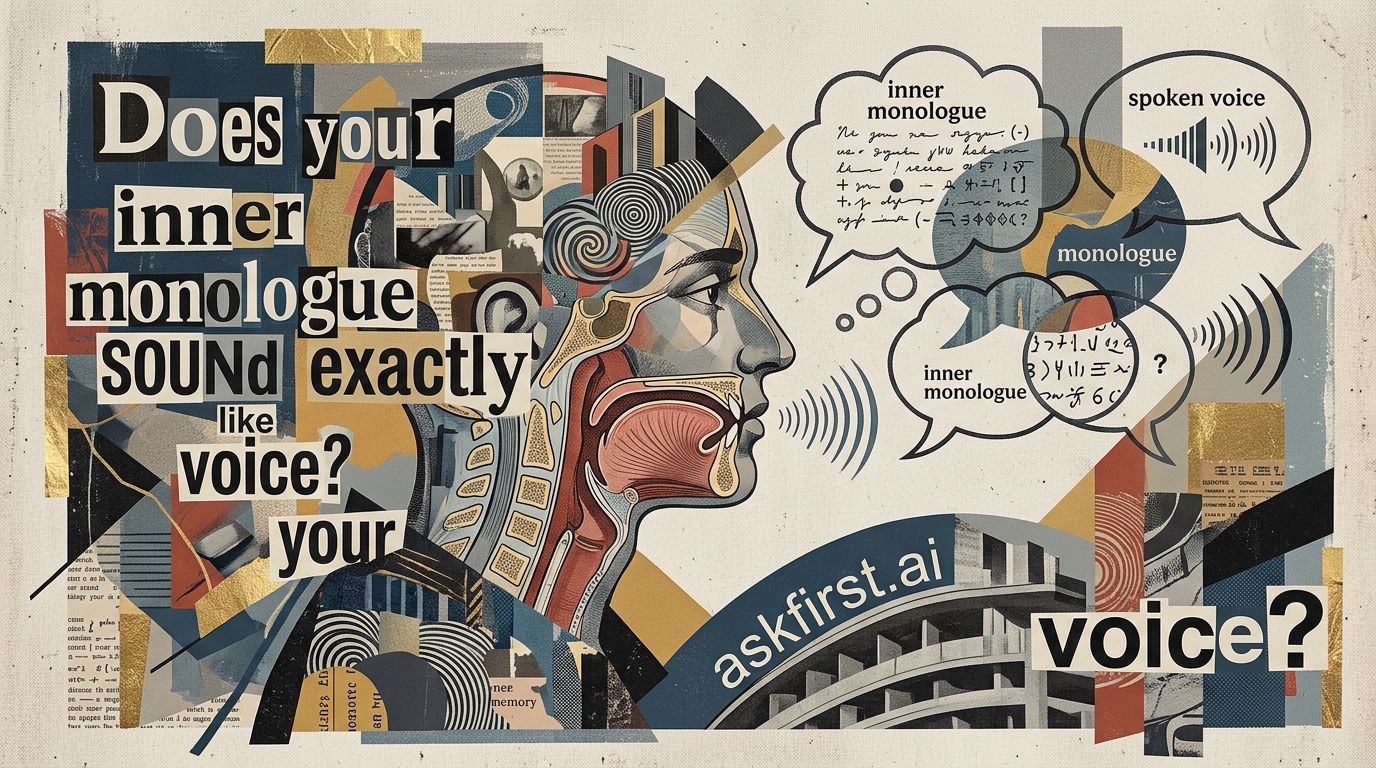
The Phenomenon of the Internal Voice
The inquiry into whether an inner monologue sounds exactly like one's spoken voice reveals one of the most fascinating divides in human cognition. While the majority of people experience an internal stream of consciousness, the sensory qualities of that voice vary drastically. Science suggests that for many, the 'voice' is not an auditory hallucination in the literal sense, but rather a representation of speech that involves the same neural substrates used for vocalization.
The Subvocalization Connection
Research indicates that when individuals think in words, they often engage in subvocalization. This is the slight, often imperceptible movement of the laryngeal muscles, tongue, and lips—the same structures used when speaking aloud. Because of this connection, the 'sound' of the inner voice is often tethered to the physical limitations and qualities of the thinker's actual voice. It feels familiar because it is essentially a silent simulation of the motor act of speaking.
Why It Might Not Sound 'Exactly' the Same
Despite the link to motor pathways, there are distinct differences that explain why the inner voice rarely sounds identical to the external voice:
- Lack of Bone Conduction: When a person speaks aloud, they hear their own voice through a combination of air conduction and bone conduction. The skull vibrates, adding lower frequencies that make the voice sound deeper and richer. The inner voice lacks this component, often making it sound 'thinner' or more 'mental' in nature.
- The Absence of Environmental Feedback: The brain modulates external sound based on ambient noise and room acoustics. The internal voice exists in a cognitive void, untouched by the physics of sound waves bouncing off walls, which creates a 'dry' sensory experience.
- Abstract Semantic Processing: For many, the inner voice is not a sound at all but an abstract, conceptual representation. Some people describe their inner monologue as 'thought-forms' that lack timbre, pitch, or cadence entirely.
An Aphantasic Perspective on Thinking
It is vital to note that not everyone experiences an inner monologue as an auditory phenomenon. The study of anaduralia (the absence of internal speech) and aphantasia (the absence of visual imagery) highlights that human thought is far from monolithic. A significant portion of the population thinks primarily in images, spatial maps, or pure 'meaning,' without the need for a linguistic soundtrack. These individuals possess a form of intelligence that functions independently of internal vocalization.
Neural Substrates and Auditory Imagery
The brain's ability to 'hear' thoughts is localized largely in areas like Broca’s area (associated with speech production) and the auditory cortex (associated with perception). In a typical internal monologue, these regions coordinate to create an 'echo' of speech. Studies using fMRI scans have demonstrated that the auditory cortex is activated during internal speech, suggesting that the brain is effectively 'tricking' itself into hearing a sound. However, because this is an internal process, it does not have the intensity of a genuine external stimulus.
Key Variables Influencing the Experience
- Vocal Training: Individuals such as professional singers or voice actors often report a more vivid or controlled inner voice because they have highly refined neural mappings for their vocal instruments.
- Linguistic Background: Bilingual individuals frequently switch languages in their thoughts. The inner voice often shifts its quality or even its personality depending on which language is being utilized, reflecting the cultural and structural nuances of that tongue.
- Emotional Context: Stress or extreme focus can alter the internal voice. Under duress, some report that the internal monologue becomes faster, higher-pitched, or more clipped, mirroring physiological states of agitation.
The Evolution of Internal Narrative
From a psychological standpoint, the internal voice acts as a form of self-regulation. By 'talking to oneself,' the brain creates a private workspace for planning, problem-solving, and emotional processing. It functions as a scratchpad where potential social interactions are rehearsed and complex ideas are refined. Because the voice needs to be 'heard' by the self to be useful for this regulation, it defaults to the most recognizable sound available: one's own voice.
Summary of the Experience
The internal voice is less of an audio recording and more of a neural simulation. It utilizes the memory of your own voice, the muscle memory of speech, and the brain's prediction models to create a stream of consciousness that serves your cognitive needs. While it captures the 'essence' of your speech—the cadence, the vocabulary, and the emotional tone—it is stripped of the physical complexities of air-born sound. It is a unique masterpiece of neurological projection, tailor-made by your brain to help you navigate your own thoughts.