The Illusion of Temporal Consistency
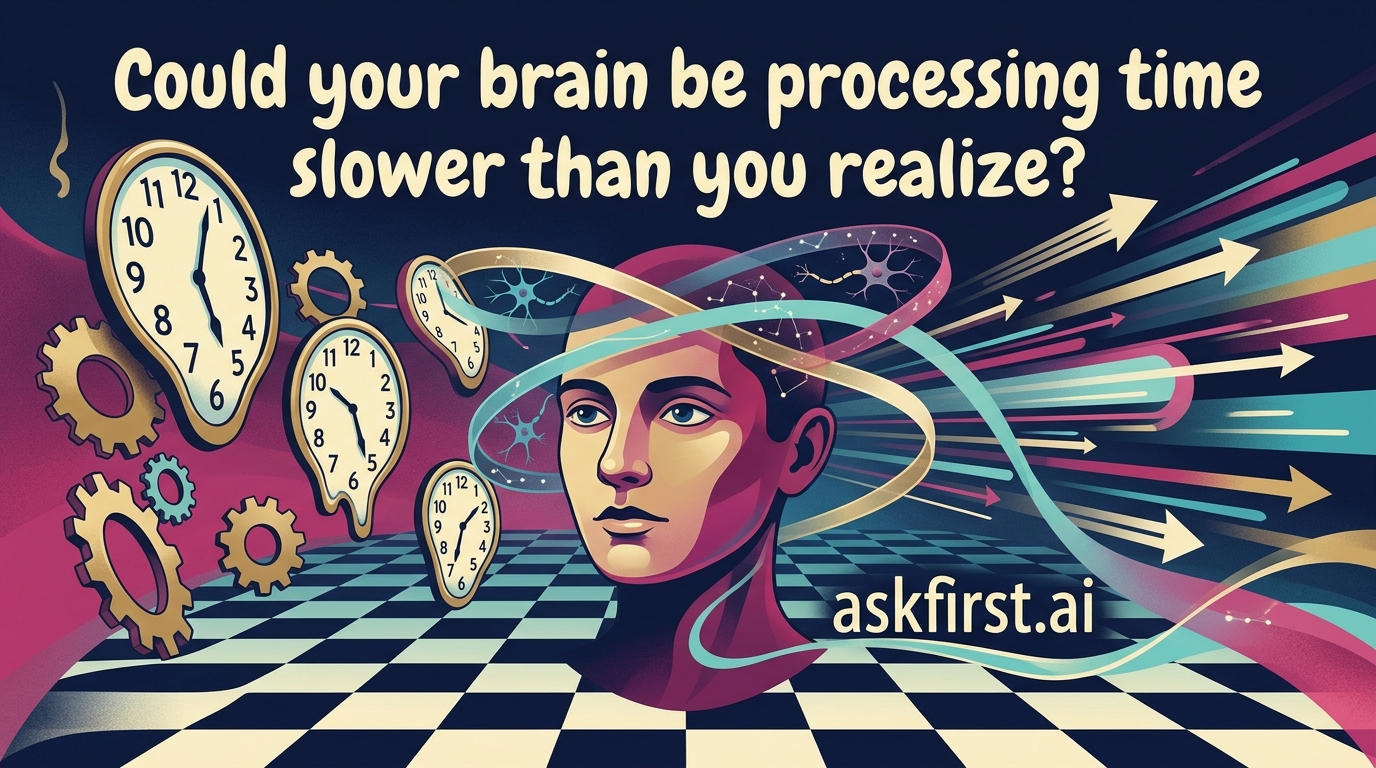
Human perception is not a direct reflection of physical reality; rather, it is a reconstructed simulation generated by the brain. When contemplating the passage of time, most individuals assume a constant, rhythmic flow. However, scientific evidence suggests that the brain’s processing speed is highly elastic, capable of expanding or contracting based on emotional states, attentional focus, and environmental stimuli. The notion that your brain might be processing time slower than you consciously realize is rooted in the complex mechanisms of neural encoding and information throughput.
The Role of Neural Sampling Rates
At the core of temporal perception is the concept of 'neural sampling.' Just as a high-speed camera captures frames at an increased rate to create smooth slow-motion footage, the brain has the capacity to increase its sampling frequency under specific conditions. When faced with high-stakes situations—such as a sudden accident or an adrenaline-spiking event—the amygdala, the brain's emotional center, kicks into high gear. Studies published in journals like Nature Neuroscience suggest that during these moments, the brain stores more dense, granular memories. When the brain reviews these records, the increased density creates the subjective feeling that time has 'stretched,' effectively causing the person to experience the event in slow motion. This is not because external time has physically changed, but because the brain is recording more data points per second than in a routine, mundane state.
Predictive Processing and Habituation
The brain is an elite prediction machine. It strives to conserve energy by automating repetitive tasks, a process known as habituation. When daily life follows a strictly predictable pattern, the brain shifts into a low-resolution sampling mode. Because the environment is familiar, the brain stops paying close attention to every detail, allowing time to pass unnoticed. This is why a summer vacation as a child—filled with new experiences and novel environments—seems to last an eternity, while a decade of adulthood in a consistent job seems to vanish in a blink. In the latter, the brain has ceased to register novel stimuli, resulting in a 'shrunken' perception of duration.
Factors Influencing Subjective Time Dilation:
- Novelty: The acquisition of new information forces the brain to process more data, slowing down the perceived passage of time.
- Attention: High levels of focus or awareness heighten the sensitivity to intervals, making minutes feel longer.
- Emotional Arousal: High-intensity emotions trigger increased cognitive processing, leading to the distortion of temporal sequences.
- Expectation: The brain’s reliance on predictive models often leads to 'time compression' when events proceed exactly as anticipated.
Can Brain Processing Speed Be Voluntarily Managed?
If the brain effectively 'speeds up' by processing more information, can individuals consciously influence their temporal experience? Emerging research in mindfulness and neuroplasticity suggests that focused attention can indeed alter the granularity of perception. By engaging in deliberate, high-awareness activities—such as learning a complex new skill, practicing deep meditative observation, or traveling to unfamiliar territories—individuals can effectively force the brain to abandon its habituation mode. This creates a denser neural record of existence, causing life to feel longer and more 'stretched.'
The Paradox of Memory and Experience
There is a critical distinction between the 'experiencing self' and the 'remembering self,' a theory popularized by Nobel Laureate Daniel Kahneman. The experiencing self lives in the present moment, where time dilation is dictated by current cognitive load. The remembering self looks back at time based on the highlights and the quantity of novel memories stored. Consequently, a period of time may feel fast while it is happening due to boredom or routine, but the subsequent memory of that period might feel even shorter because there is so little data for the brain to retrieve. This paradox illustrates that our relationship with time is not a passive observation but an active construction.
Evolutionary Utility of Time Perception
Evolution has optimized our sense of time primarily for survival. The ability to sense the passage of time allows organisms to predict dangers, manage energy consumption, and optimize social interactions. If the brain processed time at an ultra-slow, high-resolution speed constantly, it would be overwhelmed by redundant data, leading to cognitive fatigue. Conversely, if it processed time too quickly, we would fail to perceive rapid environmental changes, leaving us vulnerable. Thus, the fluctuating speed at which we perceive time is a strategic biological feature, allowing us to allocate neural resources where they are most needed. By understanding that time is subjective, individuals can reclaim control over their experience, transforming mundane existence into a more vivid, prolonged reality through the simple, intentional introduction of novelty and increased present-moment focus.