The Illusion of Temporal Acceleration
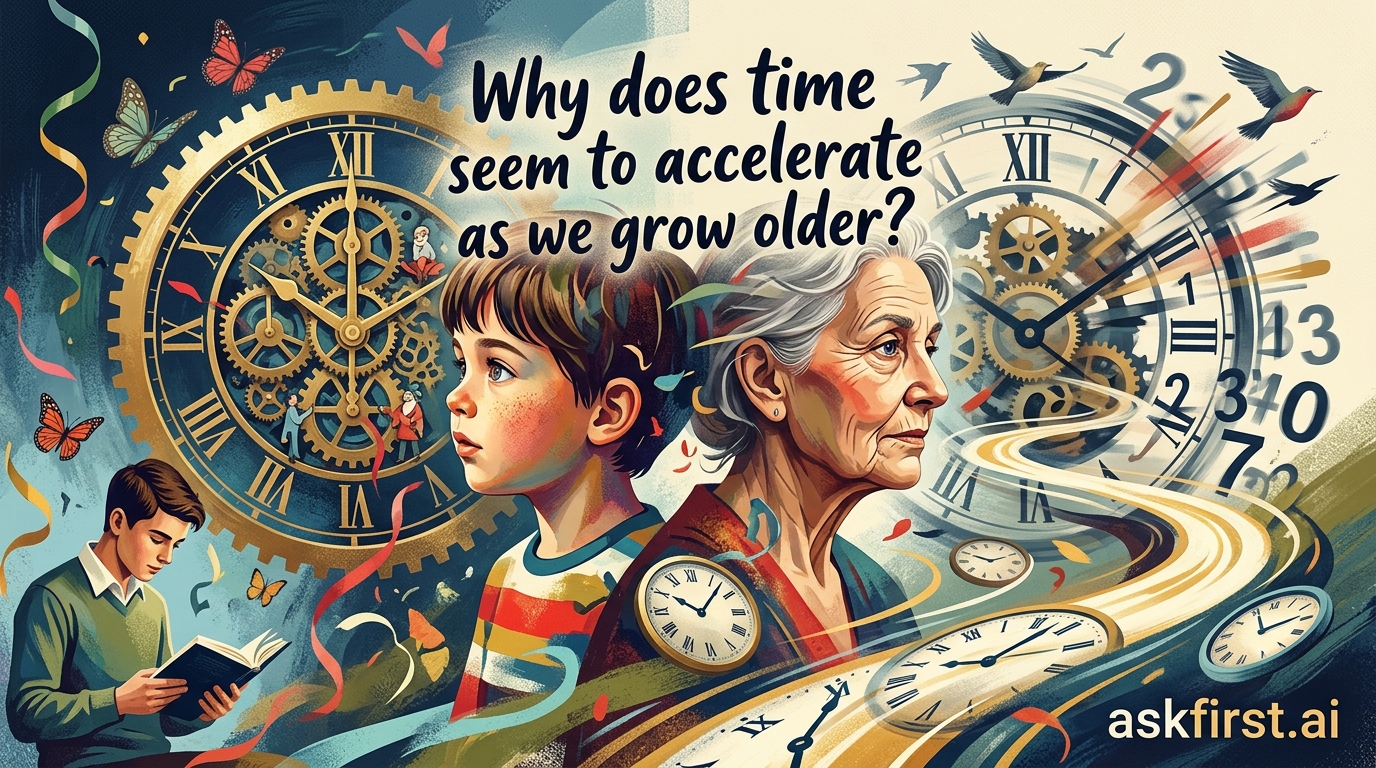
The perception that time accelerates as humans age is one of the most universal experiences in psychology, yet it remains a complex paradox of neurobiology and cognitive processing. Scientists, philosophers, and psychologists have studied this phenomenon for decades, uncovering that the way the brain encodes memories significantly alters our sense of duration.
The Proportional Theory
One of the most popular explanations is the Proportional Theory, often attributed to philosopher Paul Janet. This theory posits that our perception of time is relative to the total time we have already lived. When a person is five years old, one year represents twenty percent of their entire life experience. By contrast, when that same person reaches fifty, a year constitutes only two percent of their existence. Consequently, our brains subconsciously measure segments of time against the vast reservoir of our past experiences, making later years feel objectively shorter because they occupy a smaller fraction of our cumulative memory.
The Role of Novelty and Neural Encoding
Beyond pure mathematics, the Novelty Bias plays a critical role in how we perceive the passage of time. During childhood, the world is a landscape of "firsts." We learn to read, ride a bicycle, navigate social hierarchies, and discover complex academic subjects. These experiences require intense focus and heavy cognitive processing. The brain records these novel events with high levels of detail. Because the brain dedicates more "storage space" to new experiences, we perceive these periods as being longer.
As we age, our daily routines become more predictable. When a task becomes habitual, the brain operates on a form of autopilot, conserving energy by utilizing existing neural pathways rather than forging new ones. When the brain has no new data to store—because a day spent at the office looks nearly identical to the previous day—it processes that segment of time as a single, collapsed memory. This creates the illusion that weeks or months have simply vanished, as there are fewer "landmarks" in our cognitive map to anchor those periods.
Biological Clocks and Heart Rate
Some researchers argue that biological factors, such as the slowing of our metabolic rate, influence time perception. Early work by researchers like Dr. Robert Ornstein suggested that a higher level of stimulation and physiological arousal corresponds to a slower perception of time. As the human body matures and slows, the internal processing speed—or the rate at which our nervous system transmits information—may undergo subtle changes. If internal biological processes slow down relative to the outside world, the external world seems to move more quickly, reinforcing the sensation that the clock is ticking faster.
Strategies to Dilate Subjective Time
Understanding these mechanisms offers a unique opportunity to reclaim our sense of duration. If time feels fast because of repetition, the solution is deliberate novelty. Incorporating new habits, learning complex skills, or traveling to unfamiliar environments forces the brain to move out of its default mode network and begin actively registering new information again. By breaking the cycle of habit, we effectively force the brain to increase the frequency of memory markers, which stretches our perception of time.
- Embrace Lifelong Learning: Mastering a new language or musical instrument forces the brain to create new synaptic connections.
- Practice Mindfulness: Being fully present in the moment increases the density of sensory input, which prevents time from being "collapsed" by the brain’s autopilot system.
- Change Daily Environments: Small shifts in routine—such as changing one's commute or reorganizing a workspace—can disrupt the habit loop.
Conclusion
Ultimately, the acceleration of time is not an objective reality, but a consequence of our brain's efficiency. As we master the environment around us, we spend less time observing the details of life. To make time feel as expansive as it did in childhood, one must prioritize newness and intentional observation. By shifting from a state of passive consumption to active, novel experience, we can successfully hack our cognitive internal clock and make every year feel fuller, richer, and longer.