The Evolutionary Basis of Social Regret
Human memory is not a perfect recorder of past events; it is a selective filter designed for survival. The phenomenon often referred to as the 'spotlight effect' combined with the brain's innate negativity bias creates a powerful mechanism that makes embarrassing moments stick in the psyche. From an evolutionary perspective, humans are obligate social animals. In ancestral environments, group acceptance was a prerequisite for survival. Being ostracized could effectively lead to death, as individual survival outside a tribal unit was nearly impossible. Consequently, the brain developed a high-sensitivity alarm system for social rejection. Embarrassment serves as a painful social signal, warning the individual that a behavior has violated a group norm. By retaining these memories, the brain attempts to prevent the individual from repeating the same social error, thereby safeguarding their position within the hierarchy.
The Negativity Bias and Cognitive Salience
Psychologically, the brain prioritizes negative experiences over positive ones—a phenomenon known as the Negativity Bias. Evolutionary psychologists posit that the brain is hardwired to learn more from negative stimuli because those stimuli often present an immediate threat to survival. An embarrassing social interaction is cognitively 'expensive' and 'salient,' meaning it stands out from the mundane background of daily life. When a person missteps verbally, the physiological stress response—often involving a spike in cortisol and adrenaline—further cements that memory. This physiological arousal acts like a chemical stamp, ensuring the event is stored with greater clarity and accessibility than neutral or positive interactions.
The Spotlight Effect and Self-Referential Processing
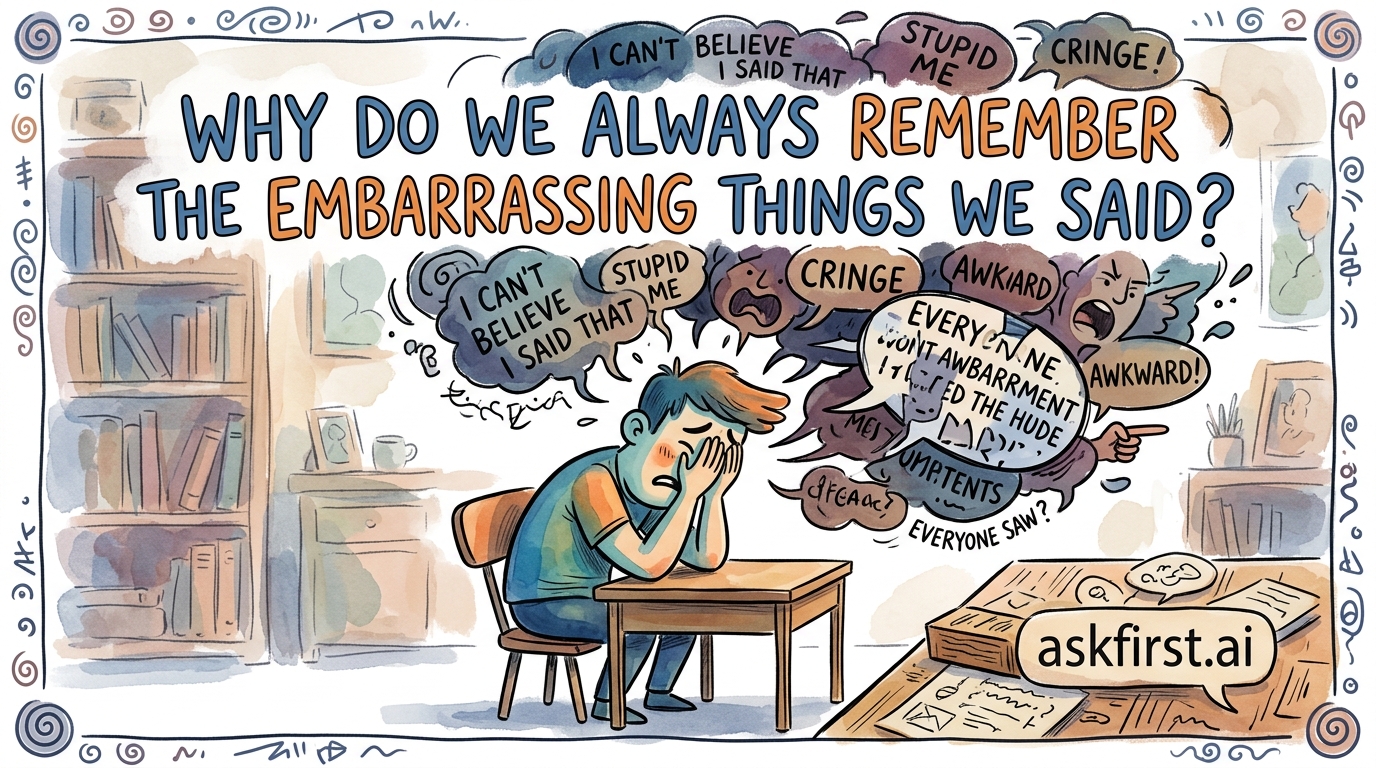
Another critical factor is the Spotlight Effect, a psychological tendency where individuals overestimate the degree to which others notice their actions or appearance. In moments of embarrassment, the mind constructs an internal narrative where every bystander is critically evaluating the mistake. In reality, most observers are preoccupied with their own thoughts and internal anxieties. However, because the individual is the center of their own universe, the memory of a social blunder becomes a 'self-referential' task. Research in neuroscience suggests that the medial prefrontal cortex—a region involved in processing information about the self—becomes hyper-activated during moments of self-consciousness. This excessive processing power reinforces the memory, effectively turning it into a mental loop that replays during times of rest.
The Mechanics of Ruminative Cycles
Why do these memories resurface at the most inconvenient times, such as when trying to sleep? This is due to the Zeigarnik Effect, which describes the tendency of the mind to remember uncompleted or interrupted tasks better than completed ones. A social blunder represents a 'closed loop' in the mind that hasn't been successfully 'fixed.' Because there is no clear resolution to the embarrassing act—the mistake is finalized and cannot be retracted—the brain treats it as a persistent, unfinished project. Ruminating on what should have been said is an attempt by the brain to 'solve' the puzzle or rewrite the outcome. Although this is a natural cognitive process, it often leads to a cycle of rumination where the individual accidentally strengthens the neural pathways associated with the embarrassing memory every time it is retrieved.
Managing the Mental Echoes
To mitigate the frequency and impact of these recollections, psychologists often recommend several evidence-based strategies:
- Cognitive Reframing: Consciously acknowledging that the 'spotlight' is largely imaginary. Most people have already forgotten the event, as they are busy worrying about their own social standing.
- Mindfulness Meditation: Practicing present-moment awareness can help break the habit of drifting into the past. By observing the thoughts without judgment, the emotional charge of the memory diminishes over time.
- Self-Compassion Exercises: Treating the memory with the same kindness one would extend to a friend who made a similar mistake can counteract the harsh self-criticism that keeps these memories alive.
- Exposure and Acceptance: Understanding that perfection is not a prerequisite for human connection. Recognizing that everyone experiences similar lapses can normalize the event, stripping it of its power to cause distress.
Ultimately, the ability to cringe at past statements is a sign of a functioning social brain. It is the byproduct of an organism that is deeply invested in its communal bonds. By viewing these memories as biological feedback rather than character flaws, one can move past the discomfort and gain a healthier perspective on the fallibility inherent in the human condition.