The Paradox of Social Density
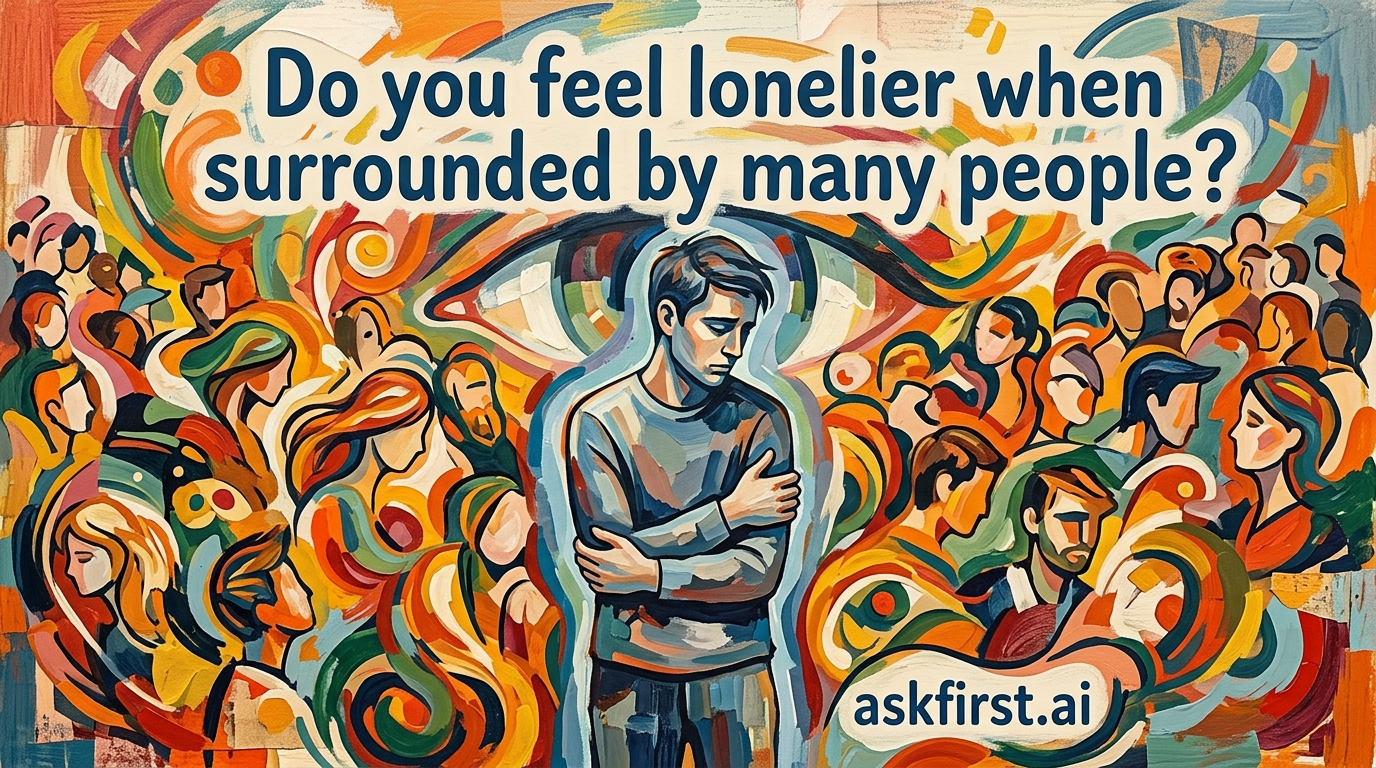
The sensation of isolation amidst a bustling crowd is a well-documented phenomenon in psychological literature, often referred to as 'urban loneliness' or 'the paradox of social density.' While common sense might suggest that proximity to others reduces feelings of exclusion, the human brain often processes social environments based on the quality of connection rather than the sheer number of physical bodies present. When an individual is surrounded by many people yet experiences a lack of meaningful interaction, the perceived gap between one's desired social state and the actual social reality becomes amplified, leading to a profound sense of psychological dissonance.
Psychological Mechanisms at Play
1. Social Comparison Theory
Proposed by Leon Festinger in 1954, Social Comparison Theory suggests that individuals determine their own social and personal worth based on how they stack up against others. In a crowded environment, the brain performs rapid, involuntary evaluations. If an observer perceives others to be engaging in deeper, more authentic connections, a feeling of being 'the odd one out' often ensues. This constant, silent comparison creates a psychological barrier that reinforces feelings of alienation.
2. Sensory Overload and Cognitive Fatigue
Modern urban environments often present an overabundance of stimuli. When the brain is overwhelmed by noise, movement, and the sheer visual clutter of a crowd, cognitive resources become depleted. This fatigue lowers the threshold for emotional processing, making it more difficult to engage in the vulnerable, high-energy interactions required to stave off loneliness. Consequently, the individual retreats inward as a defense mechanism, ironically deepening the very loneliness they seek to avoid.
The 'Invisible Crowd' Effect
Research indicates that feeling invisible in a crowd is fundamentally different from being physically alone. When physically solitary, the expectation for social engagement is low, meaning the brain does not expend energy seeking validation from others. In contrast, being in a crowd sets an implicit social expectation. When these expectations go unmet, the result is a heightened sensitivity to social exclusion. This is known as the 'invisible crowd' effect, where the lack of acknowledgement from strangers acts as a constant reminder of one's detachment from the collective social fabric.
Distinguishing Loneliness from Solitude
It is essential to distinguish between loneliness—a distressing state of feeling unfulfilled or disconnected—and solitude, which is the constructive experience of being alone. Solitude can be highly restorative, fostering creativity and self-reflection. However, loneliness in a crowd prevents this constructive state. Because the individual is surrounded by the potential for connection but lacks the actual manifestation of it, the brain remains in a state of 'social hunger.' This state is evolutionarily adaptive; humans are hardwired to seek belonging because, historically, isolation from the group was a survival risk. Today, however, this mechanism misfires in our hyper-connected, anonymous urban landscapes.
Strategies for Mitigating Crowd Loneliness
To navigate these environments with greater psychological ease, experts recommend several proactive strategies:
- Active Engagement: Rather than passively observing the crowd, initiate micro-interactions. A simple smile or a brief polite gesture to someone in proximity can break the perception of anonymity.
- Mindful Presence: Grounding techniques, such as focusing on sensory details of the environment (the architecture, the ambient sound), can help shift the brain from 'social comparison mode' to 'observer mode,' reducing the pressure to belong.
- Quality over Quantity: Focus on finding small clusters or 'third spaces'—cafes, parks, or community centers—where the environment is designed for interaction rather than just flow. Quality interactions are the primary antidote to social hunger.
- Internal Validation: Strengthening the internal sense of self-worth reduces the reliance on external recognition from strangers. A person who is secure in their own identity is significantly less prone to feeling lonely in high-density areas.
Conclusion: Reimagining Our Social Spaces
Loneliness in a crowd is not a failure of character, but a byproduct of the modern human condition. As urbanization continues to increase, understanding this psychological friction is crucial. By acknowledging that feelings of isolation among many are a natural, albeit uncomfortable, response to sensory overload and unmet social cues, individuals can begin to reclaim their experiences. The goal is to transition from a state of passive isolation to one of mindful participation, recognizing that the crowd is not an enemy to connection, but a field of untapped potential for meaningful human experience.