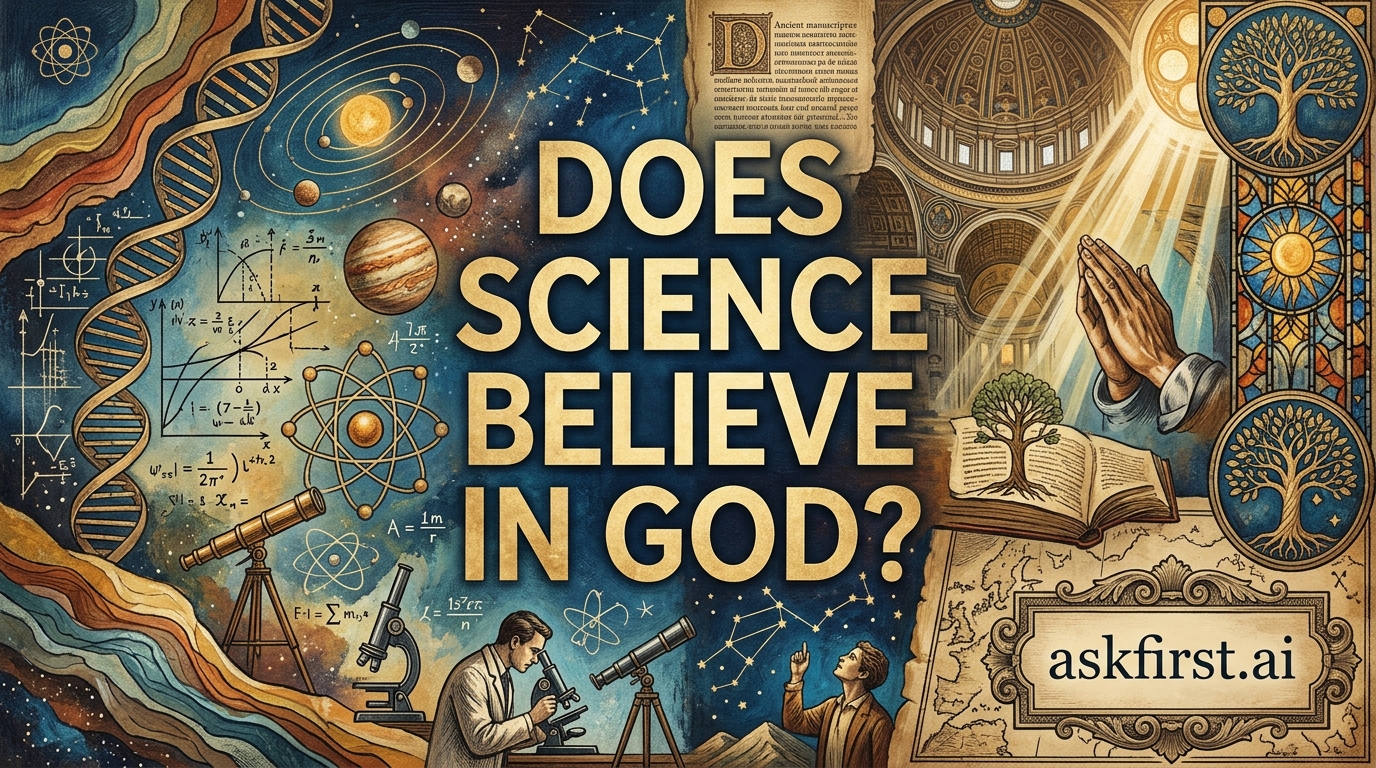
The intersection of scientific inquiry and theological belief is one of the most complex, enduring, and nuanced dialogues in human history. To ask whether "science believes in God" is to fundamentally misunderstand the nature of both entities. Science is not a sentient being capable of belief, nor is it a monolithic ideology; it is a systematic methodology of observation, experimentation, and peer-reviewed analysis. Religion and theology, conversely, operate within frameworks of revelation, tradition, and subjective existential experience.
The Methodological Boundary
The primary reason science cannot "believe" in God lies in the limitations of the scientific method itself. Science relies on methodological naturalism, which stipulates that for a hypothesis to be scientific, it must be testable, falsifiable, and grounded in natural phenomena. Because the concept of a deity is typically defined as supernatural—existing outside the constraints of space, time, and physical law—it falls outside the scope of empirical verification.
As the renowned physicist Stephen Hawking articulated in his seminal work A Brief History of Time (1988), the laws of physics are sufficient to explain the evolution of the universe from the moment of the Big Bang without necessarily requiring divine intervention. For many scientists, this is not an atheistic statement but a professional one: if an explanation can be found within the physical realm, the introduction of a supernatural agent becomes superfluous to the scientific model.
The Spectrum of Belief Among Scientists
While science as a process remains agnostic, individual scientists hold a vast spectrum of beliefs. The historical narrative that science and religion are perpetually at war—the "conflict thesis"—is largely considered a historical myth by modern scholars of the history of science, such as John Hedley Brooke in his book Science and Religion: Some Historical Perspectives (1991).
Sociological studies reveal that the scientific community is as diverse as the general population regarding faith:
- Theistic Scientists: Many prominent scientists have viewed their work as a way of "thinking God’s thoughts after Him." Francis Collins, the former director of the National Institutes of Health and leader of the Human Genome Project, is a prominent example. In his book The Language of God (2006), he argues that the intricate design of the human genetic code is entirely compatible with a belief in a Creator.
- Atheistic/Agnostic Scientists: Conversely, thinkers like Richard Dawkins, author of The God Delusion (2006), argue that the scientific worldview leaves no room for supernatural explanations. For this group, the "God of the Gaps"—the tendency to attribute unknown phenomena to divine action—shrinks as scientific knowledge expands.
- NOMA (Non-Overlapping Magisteria): The late paleontologist Stephen Jay Gould proposed in his work Rocks of Ages (1999) that science and religion occupy "non-overlapping magisteria." He argued that science covers the empirical realm (what the universe is made of and how it works), while religion covers questions of ultimate meaning and moral value. In this view, they are separate lenses that do not contradict each other because they address fundamentally different inquiries.
The "Fine-Tuning" Argument and Modern Cosmology
In recent decades, the debate has shifted toward the "fine-tuning" of the universe. Physicists have discovered that if the fundamental constants of nature—such as the strength of gravity, the electromagnetic force, or the expansion rate of the universe—differed by even a fraction of a percent, life as we know it could not exist.
Authors like Paul Davies in The Goldilocks Enigma (2006) explore whether this precision points toward a designer or whether it is a consequence of a "multiverse" theory, where infinite universes exist and we simply happen to reside in one that supports life. This creates a fascinating tension: does the universe’s apparent design imply a Creator, or is it a statistical inevitability in a vast, perhaps infinite, set of possibilities? Science currently lacks the data to definitively answer this, leaving the conclusion to the personal philosophical framework of the observer.
Conclusion
Science does not "believe" in God, nor does it disprove God. It is a tool for understanding the mechanics of the natural world. Whether those mechanics imply a deeper, transcendent intelligence is a question of metaphysics, not physics.
The history of science is populated by devout believers—from Isaac Newton, who saw the clockwork of the heavens as evidence of divine majesty, to Georges Lemaître, the Catholic priest who first proposed the Big Bang theory. Their existence proves that the rigorous application of the scientific method is entirely compatible with a profound religious faith. Ultimately, the question of God remains a personal inquiry that sits beyond the reach of a laboratory beaker or a telescope. Science provides the "how," but the "why" remains a question that individuals must answer for themselves, informed by science, philosophy, and their own lived experience.