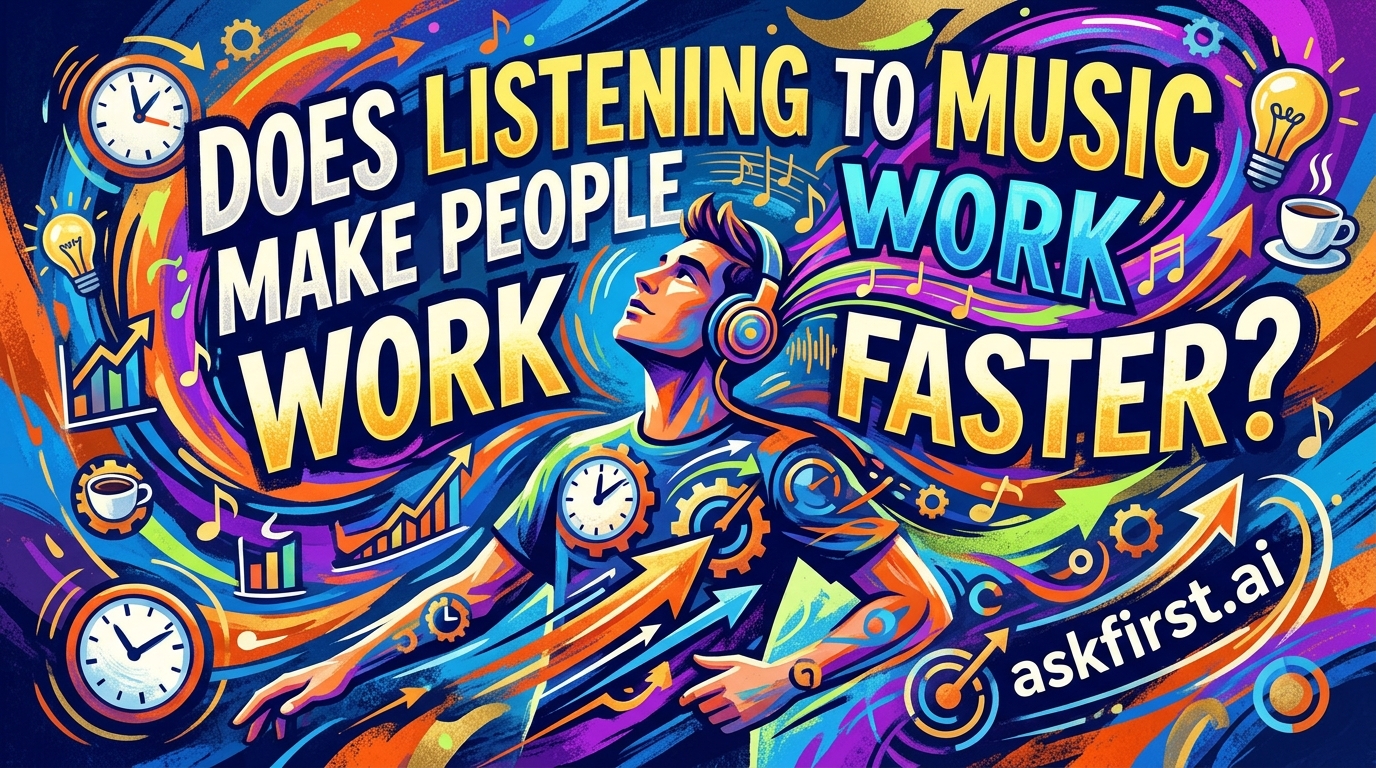
The relationship between auditory stimulation and cognitive performance is a subject of intense scientific scrutiny. While common wisdom suggests that music serves as an effective 'productivity hack,' the reality is governed by the Arousal-Mood Hypothesis and the Yerkes-Dodson Law. Contrary to the popular belief that music inherently accelerates output, the actual impact is nuanced, highly dependent on task complexity, musical genre, and the individual's cognitive architecture.### The Role of Task Complexity and the Yerkes-Dodson LawThe Yerkes-Dodson Law posits that there is an optimal level of physiological arousal for performance. If arousal is too low, the individual feels lethargic; if it is too high, anxiety and mental overload take hold. Music acts as a sensory stimulant that elevates arousal levels. For repetitive, low-complexity tasks—such as data entry, assembly line work, or basic organization—music can bridge the gap between boredom and engagement, thereby increasing the speed of completion. This phenomenon is often termed the 'Mozart Effect' in productivity circles, though it is scientifically more accurate to attribute it to mood enhancement and optimal arousal maintenance.However, for tasks requiring high cognitive load, such as writing complex reports, coding, or analytical problem-solving, music can become a hindrance. This is due to Irrelevant Sound Effect (ISE). When the brain attempts to process linguistic information (language) and concurrent musical lyrics, it experiences a cognitive bottleneck. The phonological loop in working memory becomes overwhelmed, leading to decreased accuracy and slowed reaction times.### The Impact of Musical Structure and LyricsThe presence of lyrics is perhaps the most significant variable in whether music helps or hinders efficiency. Research consistently shows that lyrical music disrupts verbal processing. Because the brain possesses a dedicated mechanism for processing language, attempting to listen to songs while reading or writing creates interference. In contrast, instrumental music, ambient soundscapes, and binaural beats tend to be less distracting. Classical music, particularly compositions with a consistent rhythm, can induce a 'flow state,' helping to regulate the brain's alpha waves and sustain focus over extended periods. Scientific studies suggest that tempos ranging from 60 to 70 beats per minute (BPM) are most conducive to relaxation and cognitive stability.### Individual Differences and Personality TraitsPsychological research, notably work involving Eysenck’s theory of personality, suggests that introverts and extroverts respond to background stimulation differently. Introverts generally have a higher baseline level of cortical arousal. Consequently, they are more easily overstimulated by background noise and often perform better in quiet environments. Extroverts, who have a lower baseline of arousal, actively seek out sensory input to reach an optimal performance level. Therefore, what functions as a 'speed booster' for an extrovert may be viewed as a 'mental drag' by an introvert. It is essential to recognize that individual preference acts as a primary mediator of the music-productivity relationship.### The 'Flow' Trigger: Why We Think We Are FasterThe perception of increased speed often stems from the elevation of dopamine levels triggered by listening to preferred music. Dopamine is a neurotransmitter involved in reward processing and motivation. When the brain receives auditory stimuli that it finds pleasant, the reward system is activated, reducing the perceived effort of the task. This 'reduced effort' feeling is often mistaken for actual increased speed. While the subjective experience is that work is being completed faster, objective measures may indicate that while the individual is happier, the actual output velocity remains unchanged or may even fluctuate depending on the difficulty of the work.### Practical Guidelines for Auditory OptimizationTo harness music effectively in a professional or academic environment, consider the following evidence-based strategies: * Align Music with Task Intensity: Use upbeat, lyrical music for manual or repetitive tasks. Switch to lo-fi, instrumental, or silence for deep, creative, or analytical work. * Prioritize Instrumental Genres: If the task involves language (reading, writing, emailing), avoid lyrics entirely to minimize cognitive interference. * Volume Matters: Keep music at a background volume. High-decibel input consumes cognitive resources that should be dedicated to the primary task. * Consistency Over Variety: Choose playlists with consistent tempos. Abrupt changes in rhythm, genre, or volume can trigger an 'orienting response' in the brain, causing the individual to shift focus away from the task to the audio source. In summary, music does not function as a universal accelerator of human speed. Instead, it serves as a sophisticated emotional and sensory tool that must be calibrated to the nature of the work at hand. While it can undoubtedly make work feel more enjoyable and assist in managing mundane tasks, its application in complex cognitive work requires careful selection to avoid the detrimental effects of divided attention.





Ask First can make mistakes. Check important info.
© 2026 Ask First AI, Inc.. All rights reserved.|Contact Us