The Evolutionary Logic of Regret
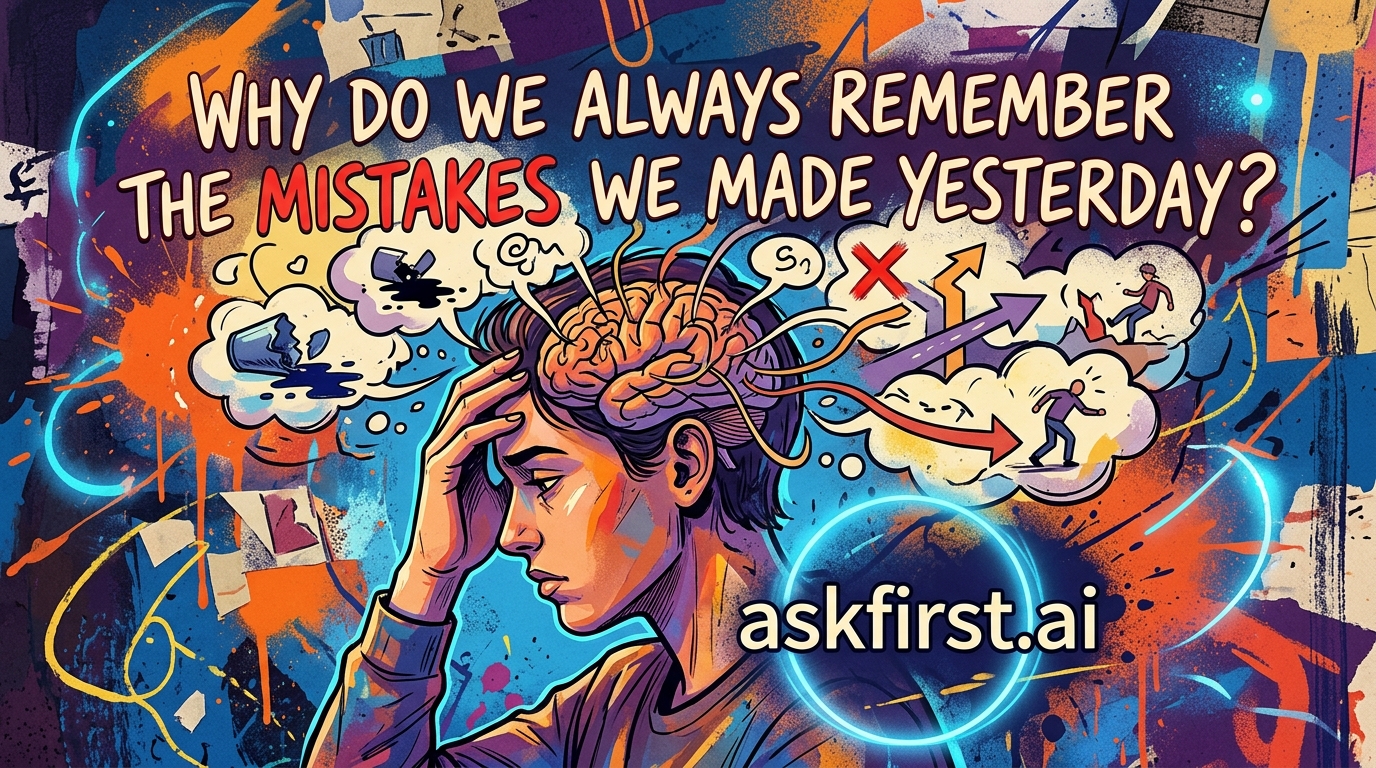
Human consciousness operates under a fascinating paradox where the mind archives failures with higher resolution than triumphs. This phenomenon, often termed the 'negativity bias,' is not a flaw in biological programming but rather a highly sophisticated survival mechanism refined over millions of years. From an evolutionary perspective, remembering a successful hunt provided short-term satisfaction, but forgetting a poisonous berry or a dangerous predator resulted in immediate removal from the gene pool. Therefore, the brain evolved to prioritize information that suggests a threat to status, health, or social standing. When a mistake occurs, the brain undergoes a 'neural alarm' phase, which imprints the memory deeper into the hippocampal architecture to ensure the same error is never replicated.
The Neurobiology of Ruminative Loops
When an individual dwells on a past mistake, they are engaging in a process known as cognitive rumination. This involves the activation of the Default Mode Network (DMN), a group of brain regions that become active when the mind is at rest and not focused on external tasks. The DMN is prone to replaying past events to extract 'data' that might aid in future survival. By repeatedly analyzing a social faux pas or a workplace error, the brain is attempting to run 'simulations' of how the outcome could have been different. While this feels like mental torture, it is the brain's internal method of skill acquisition and risk mitigation.
The Zeigarnik Effect and Unfinished Business
Psychologically, the memory of yesterday's mistake is often intensified by the Zeigarnik Effect, a concept discovered by Bluma Zeigarnik, which suggests that humans remember uncompleted or interrupted tasks better than completed ones. A mistake represents an 'unresolved' problem. Because the brain perceives a mistake as an error that hasn't been 'fixed' or 'balanced' by a subsequent positive outcome, it keeps the memory in active working memory. This acts as a mental 'to-do' list item, constantly pinging the conscious mind to seek a resolution or an apology that might close the psychological loop.
Social Status and the Fear of Ostracism
Humans are fundamentally social creatures, and social status within a group was historically essential for survival. Mistakes often carry a social cost, such as embarrassment, exclusion, or judgment from peers. Because humans are wired to fear social ostracism, mistakes that are 'visible' to others take on greater urgency. The brain elevates these memories to ensure the individual corrects their behavior to maintain group cohesion. This explains why we agonize over a slightly awkward comment made to a colleague more than we remember a task we completed perfectly.
Strategies for Transforming Regret into Growth
To move past the persistent recall of mistakes, it is vital to shift the focus from self-flagellation to system-optimization. Instead of asking 'Why am I like this?', consider the following evidence-based techniques:
- Objective Post-Mortem Analysis: Treat the mistake as a data point rather than a moral failure. Write down exactly what happened, the contributing factors, and the specific adjustment needed to avoid it next time. Once documented, the brain often feels a 'closure' sensation.
- The Third-Person Perspective: Psychological distancing helps reduce the emotional sting. By viewing the memory as if it happened to a friend, individuals can analyze the scenario with more logic and less anxiety.
- Self-Compassion as a Cognitive Tool: Studies by researchers like Kristin Neff suggest that self-compassion actually reduces ruminative loops. By acknowledging that human error is universal, the brain can de-escalate the alarm signal associated with the memory.
- Strategic Forgetting: If a mistake is truly in the past and cannot be fixed, the brain must be signaled that the threat has passed. Engaging in intense task-oriented activity can help exit the DMN loop.
Conclusion
Ultimately, the brain is a high-functioning pattern-recognition machine. The persistence of yesterday's mistakes is simply evidence that the mind is doing its job: learning, assessing, and preparing for an uncertain future. By reframing these memories as essential feedback rather than character indictments, one can harness the power of retrospection without the burden of unnecessary stress. Understanding that this process is universal allows for greater grace when navigating the learning curve of life.