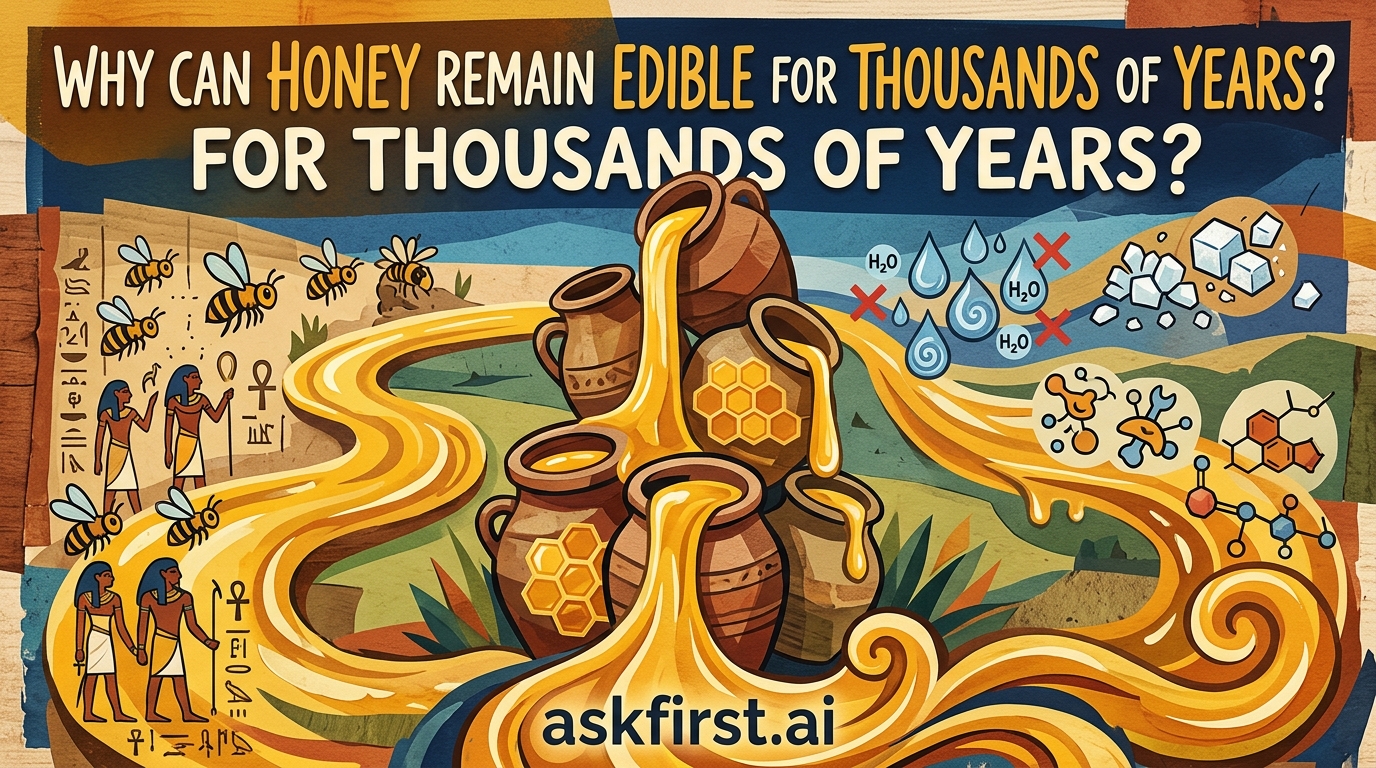
The preservation of honey over millennia is one of nature’s most remarkable chemical phenomena. Archaeologists excavating ancient Egyptian tombs—most notably those dating back to the time of the Pharaohs—have frequently unearthed pots of honey that, while crystallized and darkened, remain perfectly edible. This longevity is not a fluke of storage but the result of a precise, synergistic combination of biological, chemical, and physical factors that render the substance hostile to the very microorganisms that cause food spoilage.
The Chemical Architecture: Low Moisture and High Osmotic Pressure
The primary reason honey resists decay is its extremely low water content. Raw honey typically contains only about 17% to 18% water. Most bacteria and fungi require a water activity level significantly higher than this to thrive. Because honey is so concentrated, it functions as a potent desiccant.
This leads to the principle of osmotic pressure. When a microbe, such as a bacterium or a yeast cell, lands on honey, the honey’s high sugar concentration pulls the water out of the microorganism's cells through osmosis. This process effectively dehydrates the microbe, killing it or rendering it dormant before it can reproduce or colonize the substance. Without water, the metabolic processes required for spoilage simply cannot occur.
The Acidic Nature of Honey
Honey is naturally acidic, with a pH typically ranging between 3.2 and 4.5. This acidity is primarily due to the presence of gluconic acid, a byproduct of the enzymatic breakdown of glucose by the bees. This low pH level creates an environment that is highly inhospitable to most food-borne pathogens, such as Clostridium botulinum or E. coli. While some specialized bacteria can survive in acidic conditions, the combination of low pH and high sugar creates a "double-lock" defense system that few organisms can bypass.
The Role of Hydrogen Peroxide
Perhaps the most fascinating aspect of honey’s preservation is its ability to produce its own antiseptic. When bees collect nectar, they add an enzyme called glucose oxidase to the mixture. When honey is processed and stored, this enzyme slowly breaks down glucose into gluconic acid and hydrogen peroxide.
Hydrogen peroxide is a well-known antimicrobial agent. In honey, it is produced at low but consistent levels, which are sufficient to inhibit the growth of bacteria while remaining safe for human consumption. This discovery was detailed extensively in the work of Dr. Peter Molan, a renowned biochemist from the University of Waikato, who spent decades researching the antimicrobial properties of manuka honey. His studies, often cited in journals like the Journal of Applied Bacteriology, highlight how this chemical "slow-release" system acts as a natural preservative.
The Physical Shield of the Hive
Beyond chemistry, the physical handling of honey by bees is essential. Bees evaporate the nectar by fanning it with their wings, reducing the water content until it reaches the desired thickness. Once the honey is "ripe," they seal the honeycomb cells with a wax cap. This wax seal acts as an airtight barrier, preventing the honey from absorbing moisture from the atmosphere. Honey is hygroscopic, meaning it naturally absorbs moisture from the air; if left unsealed in a humid environment, it would eventually ferment. By keeping it sealed, the bees ensure the internal environment remains stable and dry.
Crystallization: A Sign of Purity, Not Spoilage
Many people mistake the crystallization of honey for spoilage. In reality, crystallization is a natural physical change that occurs because honey is a supersaturated solution of glucose and fructose. Over time, the glucose molecules bond together and form crystals. This process does not alter the nutritional value or the antimicrobial properties of the honey. In fact, if you find an ancient jar of crystallized honey, warming it gently in a water bath will return it to its liquid, golden state. As noted in The Honey Handbook by author Kim Flottum, crystallization is simply a sign that the honey has not been ultra-filtered or overheated, preserving its raw integrity.
Conclusion: Nature’s Perfect Preservation
The longevity of honey is a masterclass in biological engineering. By manipulating moisture levels, pH, and enzymatic activity, bees create a substance that is effectively immune to the passage of time. When kept in a sealed container, honey acts as a stable, shelf-stable energy source that remains as potent today as it was when it was first harvested by beekeepers in antiquity. Whether it is a modern-day pantry or a tomb from the First Dynasty of Egypt, the fundamental chemistry remains identical: a hostile environment for bacteria, a sanctuary for nutrients, and a testament to the evolutionary genius of the honeybee.