The Psychology of the 'Norman Door' Phenomenon
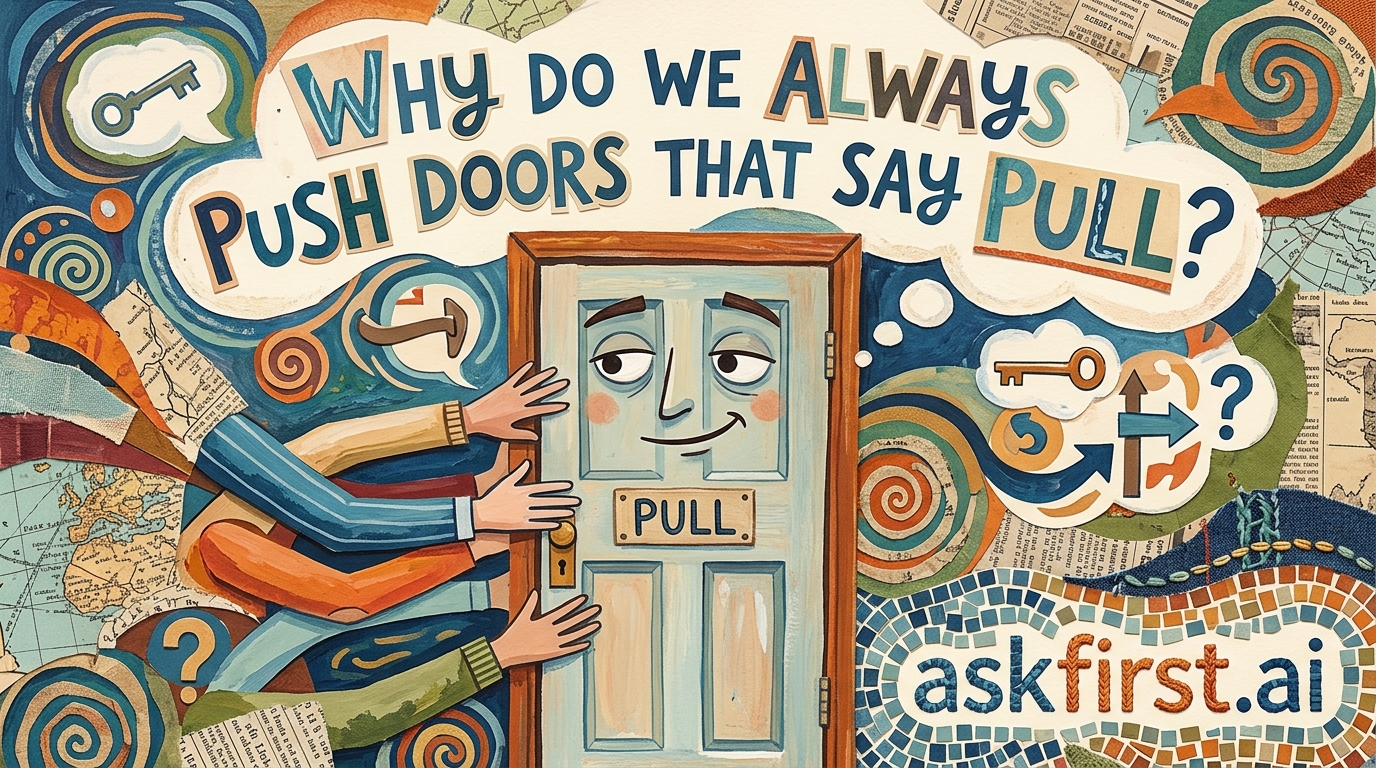
Human interaction with physical objects is governed by a set of subconscious expectations often termed 'affordances.' When an individual approaches a door, the mind subconsciously processes the surface to determine how to interact with it. If a door features a flat metal plate, a vertical handle, or even a smooth surface, the brain immediately assigns a motor schema based on previous experiences. When a person pushes a door labeled 'pull,' it is rarely an act of absent-mindedness; it is an act of human cognitive architecture colliding with flawed design.
The Design-Driven Flaw: The Norman Door
Cognitive scientist Don Norman popularized the term 'Norman Door' to describe an object whose design tells the user to do the opposite of what is actually required. This happens because designers often prioritize aesthetics—like a sleek, flat handle that looks elegant—over functional clarity. According to Norman, a door should be designed so that its function is self-evident. If a door requires a pull, the hardware should visually signal 'grip and pull.' If it requires a push, the hardware should offer a flat surface to press against. When a flat plate is installed on the side that needs to be pulled, or a large pull handle is placed on the side that needs to be pushed, the brain encounters a conflict between learned behavior and visual stimulus.
Cognitive Heuristics and Muscle Memory
Humans rely on mental shortcuts, or heuristics, to navigate the world. We encounter thousands of doors in a lifetime, and we create mental categories for them. We have learned through repetition that handles are for pulling and flat surfaces are for pushing. When a designer places a handle on the side that should be pushed, they are overriding years of ingrained muscle memory. The brain experiences a 'prediction error'—a moment where the internal model of how the world should work fails to align with physical reality. Consequently, we push because we are reacting to the visual cue of the door rather than the printed instruction. In psychology, this is known as an 'attractor'—the visual prominence of a handle draws our hand before the visual processing center can read the word 'pull.'
The Role of Habituation in Environment
In high-traffic areas, people operate on autopilot. This state of cognitive offloading allows individuals to focus on complex tasks—like planning a meeting or thinking about dinner—while navigating basic physical spaces. Because walking through a door is an 'over-learned' skill, it requires minimal conscious attention. The error of pushing a 'pull' door is a direct byproduct of this efficiency. Our brains try to minimize effort; reading signs requires more neural energy than grabbing a handle. Therefore, the visual stimulus of the hardware almost always wins the race against the semantic instruction of the sign.
How Proper Design Resolves the Conflict
Designers have developed specific strategies to prevent these errors:
- Explicit Hardware Selection: Using a horizontal bar across the door almost exclusively signals a 'push' action. Conversely, a vertical, grip-able handle signals a 'pull' action.
- Visual Hierarchy: Ensuring that the most important information (the movement required) is positioned at eye level rather than hidden near the hinge or handle.
- Environmental Cues: Utilizing tactile surfaces that naturally guide the hand to the correct location.
- Color Psychology: Using high-contrast colors to draw the user's focus toward the handle or plate they should be interacting with.
The Importance of Human-Centered Engineering
This phenomenon serves as a masterclass in why human-centered design is critical. Every time a person encounters a 'pull' door and pushes it instead, it is a failure of the interface, not the user. When systems are designed to match human intuition rather than force users to adapt to counter-intuitive layouts, efficiency improves and frustration dissipates. This is a vital lesson in ergonomics—understanding that humans will always prioritize physical cues over written instructions. By aligning visual affordances with required actions, architects and engineers can create environments that feel intuitive, seamless, and natural to navigate.