The Cosmic Scale: Comparing Mars and Earth
When we look up at the night sky, Mars often appears as a distinct, reddish point of light, sparking human curiosity for millennia. While it is our closest planetary neighbor in terms of orbital proximity, the physical reality of the "Red Planet" is one of stark contrast when held up against our home, Earth. To understand the scale of Mars, we must look at its dimensions, mass, and volume through the lens of planetary science.
Physical Dimensions: The Diameter Gap
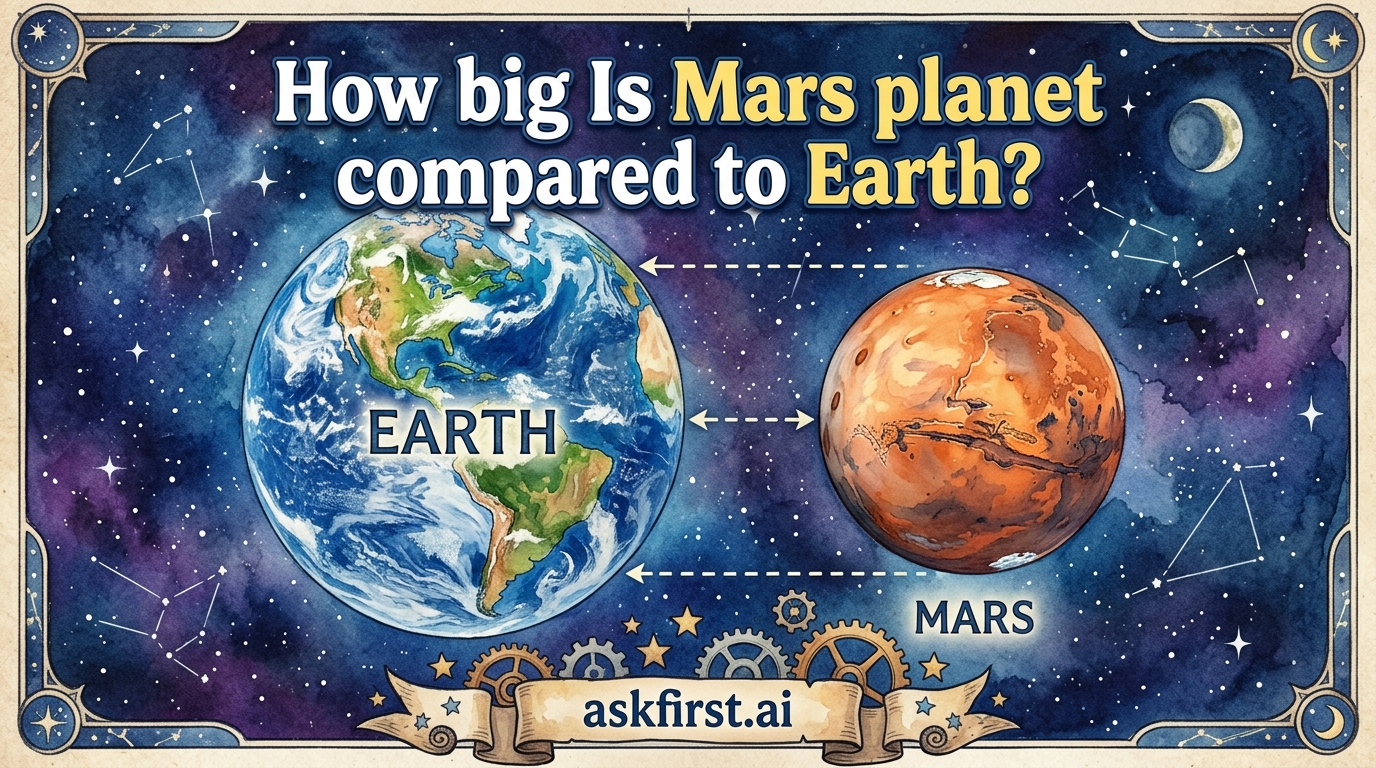
The most immediate difference between Earth and Mars lies in their physical size. Earth is significantly larger, acting as a massive terrestrial anchor compared to the smaller Mars.
- Earth’s Equatorial Diameter: Approximately 12,742 kilometers (7,918 miles).
- Mars’s Equatorial Diameter: Approximately 6,779 kilometers (4,212 miles).
If you were to place Mars next to Earth, it would be roughly half the size of our planet in terms of width. To visualize this, if Earth were the size of a standard basketball, Mars would be equivalent in size to a grapefruit. This disparity in diameter is the fundamental reason why Mars possesses significantly less surface area and gravitational pull than Earth.
Volumetric and Mass Differences
Size is not merely about width; it is about the total "stuff" that makes up the planet. Because Mars is smaller in diameter, its volume is drastically lower. If we were to fill Earth with marbles, it would take roughly six to seven Mars-sized planets to account for the same volume.
The mass difference is even more pronounced. Mars has a mass of about 6.417 × 10²³ kilograms, which is only about 10.7% of Earth’s mass. This is due to both the smaller size and the lower density of Mars. According to data provided by the NASA Mars Exploration Program, Earth’s core is composed of a much higher concentration of iron and nickel, contributing to a higher overall density (5.51 g/cm³) compared to Mars (3.93 g/cm³).
Gravity and Atmospheric Implications
The reduced size and mass of Mars have profound consequences for its environment. Because Mars is less massive, its surface gravity is significantly weaker—only about 38% of Earth’s gravity. If you were to weigh 100 kilograms on Earth, you would feel as though you weighed only 38 kilograms on the surface of Mars. This low gravity is a major factor in why Mars has been unable to retain a thick atmosphere.
In his seminal work, The Case for Mars, author Robert Zubrin explains that the low escape velocity of the Red Planet allowed solar winds to strip away much of its early atmosphere over billions of years. While Earth’s larger mass and stronger magnetic field helped retain a dense, protective atmosphere, Mars remains a thin-air world, with an atmospheric pressure less than 1% of Earth’s at sea level.
Surface Area and Geographical Scale
Despite being smaller, Mars is not a "small" world in human terms. Its total surface area is roughly 144.8 million square kilometers. Interestingly, this is almost exactly equivalent to the total land surface area of Earth. Because Earth is 70% water, the amount of "dry land" available on Mars is essentially the same as the amount of dry land available on our own planet.
However, the geological features on Mars are scaled up to epic proportions due to the planet's lower gravity. For example, Olympus Mons, the largest volcano in the solar system, stands nearly 22 kilometers high—nearly three times the height of Mount Everest. In the book Mars: The Pristine World by Peter Cattermole, the author details how the low gravity allowed volcanic structures to grow to heights that would be physically impossible on Earth, as the crust would collapse under its own weight under Earth's stronger gravitational pull.
Conclusion: A World of Unique Proportions
In summary, Mars is a medium-sized terrestrial world that serves as a "little brother" to Earth. It is roughly 53% of Earth’s diameter, 15% of its volume, and 11% of its mass. While it lacks the sheer scale and life-sustaining atmosphere of our home planet, it remains a geological giant in its own right. The differences in size are not just numerical trivia; they dictate everything from the thin, carbon-dioxide-rich atmosphere to the massive scale of its canyons and volcanoes. Understanding these proportions is the first step in the ongoing quest to explore, and perhaps one day settle, this fascinating, rust-colored world.
For those interested in further study, the Jet Propulsion Laboratory (JPL) archives and the Planetary Science Institute provide comprehensive datasets that continue to refine our understanding of these planetary comparisons, ensuring that our knowledge of the solar system remains as accurate as the technology we use to observe it.