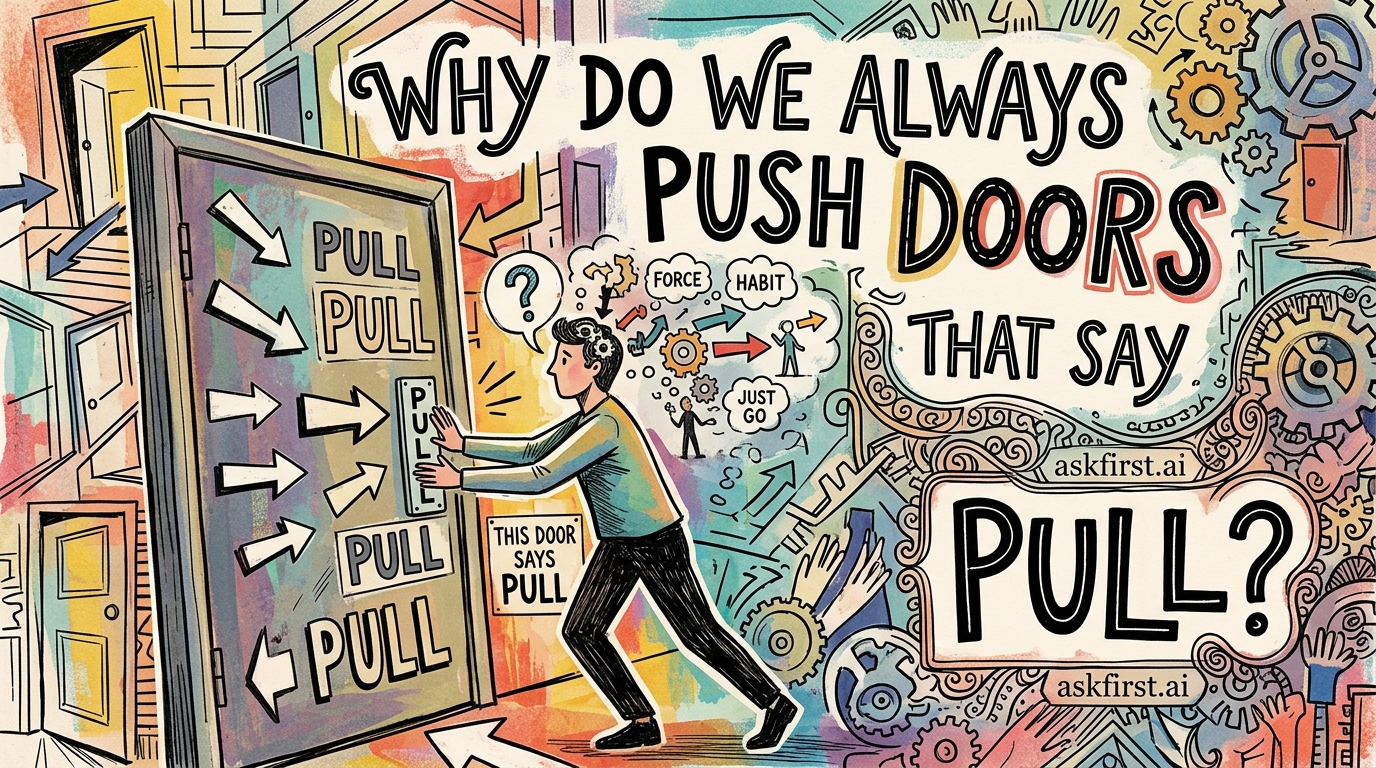
The phenomenon of pushing a door labeled 'pull' is a classic example of a 'Norman Door', a concept popularized by cognitive scientist and usability engineer Don Norman in his seminal work, The Design of Everyday Things. This behavioral lapse is not a sign of individual clumsiness or lack of intelligence; rather, it is a failure of industrial and architectural design that ignores human psychology.
The Psychology of Affordances
At the heart of this mystery lies the concept of affordances. An affordance is a visual clue that tells a user how an object should be interacted with. When a designer places a flat metal plate on a door, the subconscious brain perceives it as a 'push' signal, regardless of whether the door is meant to be pulled or pushed. If a door features a vertical handle or a pull-bar, the brain registers it as an 'affordance' for grabbing and pulling. When a door is designed with a flat plate but requires a pulling motion, it creates a 'perceptual conflict.' The visual cues signal 'push,' while the reality demands 'pull.'
Mapping and User Mental Models
Human beings operate on 'mental models'—internalized understandings of how systems function based on past experience. If ninety-nine out of one hundred doors encountered in daily life follow logical design rules, the brain automates the interaction. When we approach a door, we are not consciously analyzing the hardware; we are running a heuristic program. This program says, 'If handle, then pull; if flat plate, then push.' When a door violates this expectation, we experience a cognitive 'hiccup.' We act on the automated impulse before our conscious mind has a chance to read the sign that says 'pull.'
Why Design Fails
Many architects prioritize the 'aesthetic' of a building facade over the 'usability' of the transition points. Consider these common design pitfalls:
- The Decorative Pull: A designer may install a decorative bar on both sides of a door to ensure symmetry. Even if one side is meant to be pushed, the presence of the handle overrides the instruction, leading the user to pull and fail.
- Lack of Visual Hierarchy: Signs are often placed at eye level, but our eyes are focused on the mechanism of the door itself. We perceive the object (the handle/plate) before we process the information (the text).
- The Cultural Expectation: In many Western societies, doors that swing outward for fire safety reasons must often be pushed from the inside but pulled from the outside. If the external pull mechanism is poorly defined, the user default defaults to pushing, as that is the standard exit behavior.
Can We Fix the Human Element?
Human error is essentially 'design error.' In the field of human-factors engineering, the goal is to create 'error-proof' systems. A well-designed door should inherently communicate its function without the need for written labels. If a door requires a pull, it should have a handle that physically invites a pulling motion. If it requires a push, a simple flat plate—and nothing else—should be present. The presence of a label, such as 'PULL,' is actually a glaring indicator that the designer has failed to communicate the object's purpose effectively.
The Evolutionary Aspect
From an evolutionary standpoint, our brains are hardwired to process visual stimuli rapidly to save cognitive energy. Reading text is a slow, high-effort process compared to the instantaneous processing of spatial depth and object shape. Our ancestors relied on recognizing the shape of tools to survive. Today, we still rely on these 'pre-conscious' visual perceptions. We see a flat surface, our brain triggers the 'push' motor response, and we act. By the time the message 'PULL' is registered, the kinetic energy is already in motion.
Conclusion
Next time you find yourself frustrated while pushing a door that clearly instructs you to pull, do not blame yourself. You are witnessing a battle between your innate cognitive processing and a poorly designed environment. These encounters serve as a reminder of how deeply engineering shapes our daily experiences. By understanding these principles, we can advocate for environments that prioritize user-centered design, ensuring that our daily movements are seamless, intuitive, and efficient. Great design should never require an instruction manual, especially for something as fundamental as a doorway.