The Neurobiology of Instant Attraction
Love at first sight, often dismissed as a romantic trope or a product of sentimental storytelling, is a phenomenon that warrants serious neuroscientific inquiry. While the concept of a soulmate recognized within a fraction of a second may sound fantastical, the brain is indeed capable of rapid, complex emotional assessments that can feel exactly like instant love. To understand whether this exists, one must look at the intersection of neurochemistry, cognitive processing, and evolutionary psychology.
The Speed of Processing
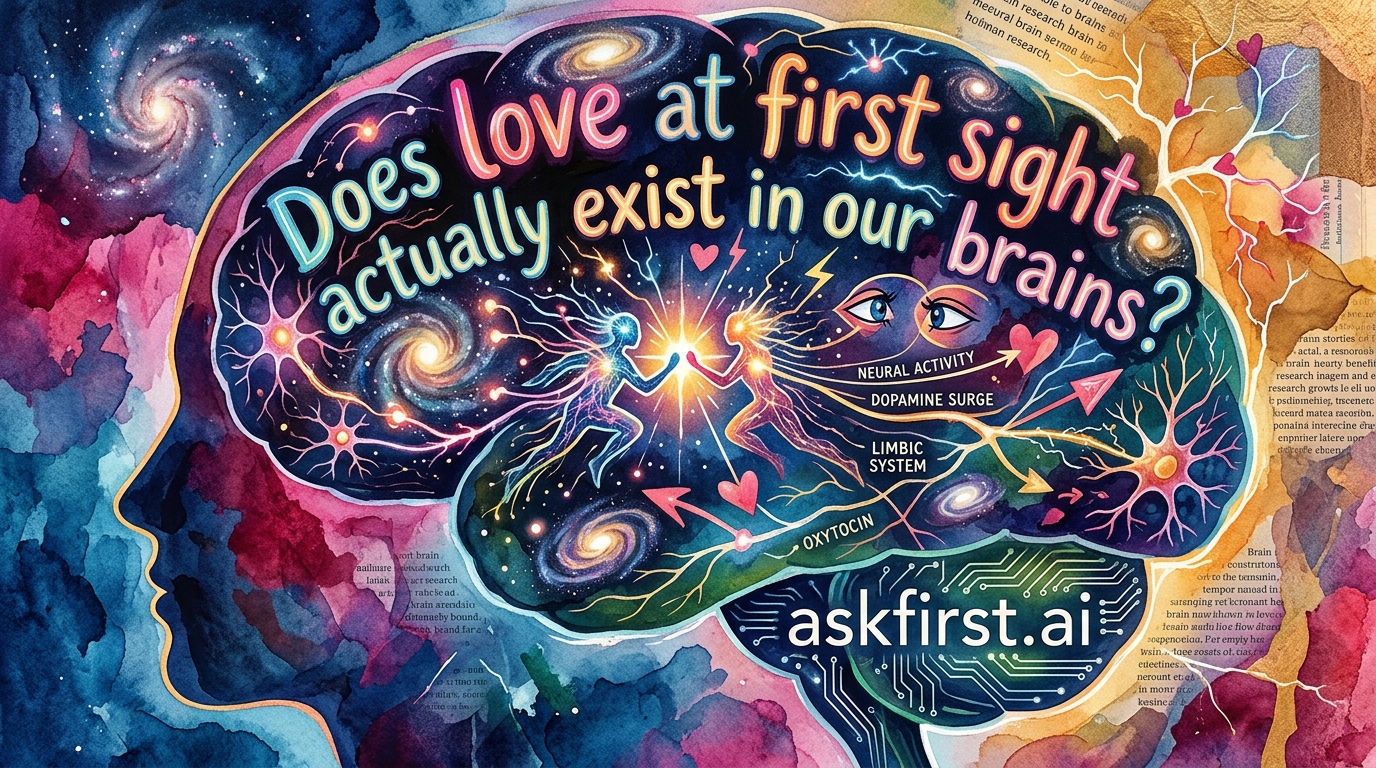
The human brain is a hyper-efficient pattern-recognition machine. Research published in journals such as Neuroscience suggests that humans can form a first impression of a face within milliseconds. When an individual encounters a potential partner, the brain’s ventral tegmental area (VTA) and the caudate nucleus—regions heavily associated with reward processing and motivation—begin firing rapidly. This is the same neural circuitry involved in addiction and intense cravings. The brain is not just observing; it is evaluating potential genetic compatibility and emotional resonance at lightning speed.
Neurochemical Fireworks
When a person experiences the feeling of instant attraction, the brain releases a potent cocktail of chemicals:
- Dopamine: The neurotransmitter associated with reward and euphoria. It creates the "high" associated with the early stages of infatuation.
- Norepinephrine: This chemical drives alertness and physiological arousal, explaining the racing heart and sweaty palms commonly associated with seeing someone special.
- Oxytocin: Often called the "cuddle hormone," even initial surges can contribute to feelings of attachment and trust, laying the groundwork for emotional bonding.
This biochemical surge is real, tangible, and measurable. It validates that the brain is undergoing a state of extreme activation. However, neuroscientists argue this is technically 'limerence'—an involuntary state of intense romantic desire—rather than mature, long-term love. Mature love requires the prefrontal cortex to assess personality and history, whereas 'love at first sight' is primarily an evolutionary shortcut to reproduction and pair bonding.
Evolutionary Justification
From an evolutionary perspective, the ability to instantly identify a potential partner is a survival mechanism. Humans needed to make quick decisions regarding reproduction. By triggering an intense surge of neurochemicals upon seeing someone who exhibits healthy physical traits (symmetry, markers of vitality), the brain incentivizes the individual to pursue that person. This 'hard-wiring' allowed ancestral humans to skip the time-consuming process of slow dating in environments where resources were scarce and danger was high. In modern times, this biological vestige remains as powerful as it was millennia ago.
The Myth of the 'Soulmate' vs. Biological Priming
It is essential to distinguish between the experience of the feeling and the reality of the relationship. While the brain does experience a genuine, overwhelming state of arousal and attraction instantly, it is not necessarily a guarantee of long-term compatibility. Critics of the concept argue that what people call 'love at first sight' is simply strong physical attraction combined with projection. We unconsciously fill in the blanks of a stranger’s personality with the traits we desire most in a partner.
Key Takeaways for Understanding the Phenomenon
- Rapid Assessment: The amygdala and the orbitofrontal cortex work together to assess social and physical cues in under 100 milliseconds.
- Reward Circuitry: The VTA creates a state of 'seeking,' which mimics the intensity of addiction.
- Psychological Projection: The brain is prone to 'halo effect' bias, where we assume a physically attractive person also possesses desirable internal character traits.
Conclusion: Is it Real?
If we define love at first sight as the 'immediate, overwhelming neurochemical response to a new person,' then yes, it absolutely exists. The brain is fully capable of generating intense emotional and physiological states in a fraction of a second. If we define it as 'finding the perfect, lifelong partner based on a single glance,' science suggests this is an optimistic psychological projection rather than a proven foresight. Regardless of the definition, the sensation remains one of the most powerful and fascinating examples of how our biology dictates our most profound human experiences. It is a testament to the fact that the brain is always looking for connection, constantly scanning the environment for the next great spark of human intimacy.