The Evolutionary Lure of Reality Television
Reality television, despite its reputation for low-brow entertainment, taps into some of the most fundamental cognitive and psychological mechanisms developed throughout human evolution. The addiction stems from a perfect storm of social surveillance, voyeurism, and the brain's innate drive to process information about status, hierarchy, and reproductive fitness.
1. Social Intelligence and the 'Social Brain' Hypothesis
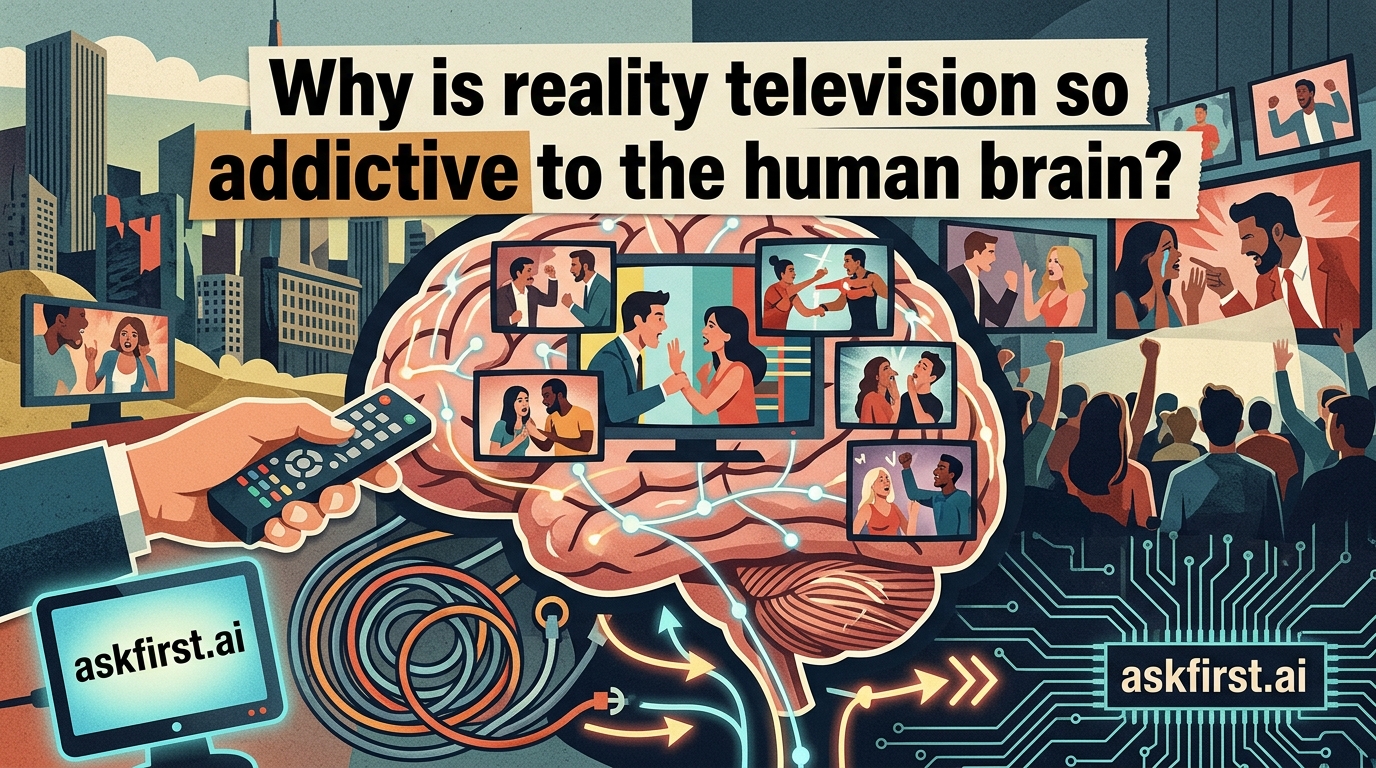
Humans are fundamentally social animals. The Social Brain Hypothesis suggests that our cognitive complexity evolved primarily to navigate intricate social networks. Reality TV acts as a surrogate for our ancestral tribe. When viewers watch shows like Survivor or Big Brother, they are not just watching entertainment; they are engaging in the mental tracking of complex social alliances, betrayals, and hierarchies. The brain perceives these interactions as real social data, activating the same regions involved in real-world networking.
2. The Dopamine Loop and Social Comparison
When a favorite contestant succeeds or suffers a setback, the brain experiences a fluctuations in dopamine. This is linked to 'Social Comparison Theory,' which suggests that humans have an innate drive to evaluate themselves in relation to others. Reality TV provides a constant stream of individuals to judge, compare, and feel superior or sympathetic toward. This vertical comparison triggers a neurochemical reward system, creating a feedback loop that encourages the viewer to keep watching to see if their 'judgments' or 'predictions' hold true.
3. The Voyeuristic Curiosity Gap
Curiosity gaps occur when a person feels a void between what they know and what they want to know. Reality TV is engineered to exploit this by utilizing cliffhangers and secret disclosures. The human brain is hardwired to seek closure for unfinished narratives, especially when those narratives involve interpersonal drama. This is often referred to as the Zeigarnik Effect: the psychological tendency to remember uncompleted or interrupted tasks better than completed ones. By constantly interrupting the flow of 'real life' drama with commercials or teases, the program keeps the viewer in a state of high cognitive arousal.
4. Para-Social Interaction and Belonging
The concept of 'para-social relationships' explains why viewers form deep, one-sided emotional bonds with reality TV stars. These relationships allow the brain to experience the benefits of social connection—such as feeling part of a group—without the actual risk of social rejection or the energy expenditure of maintaining physical relationships. During difficult times, these parasocial connections can provide a sense of stability and companionship, making the act of viewing highly habitual.
5. Cognitive Ease and Mental Simulation
Reality television often presents scenarios that are simplified, allowing for high levels of 'cognitive ease.' Unlike dense dramas or documentaries that require significant mental effort to parse complex themes, reality TV is easily processed. This allows the brain to engage in 'social simulation,' where the viewer mentally plays out scenarios: What would I do in that situation? This simulation is a powerful exercise for the prefrontal cortex, which handles decision-making and empathy, all while the body remains physically passive.
Why This Remains Evergreen
- Evolutionary Consistency: The core human traits of gossip, social hierarchy tracking, and empathy for kin or out-group members are not going anywhere. These traits have persisted for millennia and will remain relevant in the year 2030 and beyond.
- The Need for Connection: In an increasingly digitized world, the human desire for 'real' human-to-human interaction—even if mediated through a screen—is intensifying. The voyeuristic look into the lives of others serves as a digital campfire where we gather to share in the successes and failures of others.
- The Reward System: Since the mid-brain’s reward pathway for social validation is biologically fixed, the format of reality TV will likely evolve, but the underlying mechanisms of why we find it addictive remain rooted in our biological firmware.
Ultimately, reality television is not just 'trashy' media; it is a mirrors reflection of the human condition. It provides a low-stakes environment for us to process high-stakes social emotions, reinforcing why, despite our conscious protestations, we keep coming back to the screen.