The Psychology of the 'Norman Door' Phenomenon
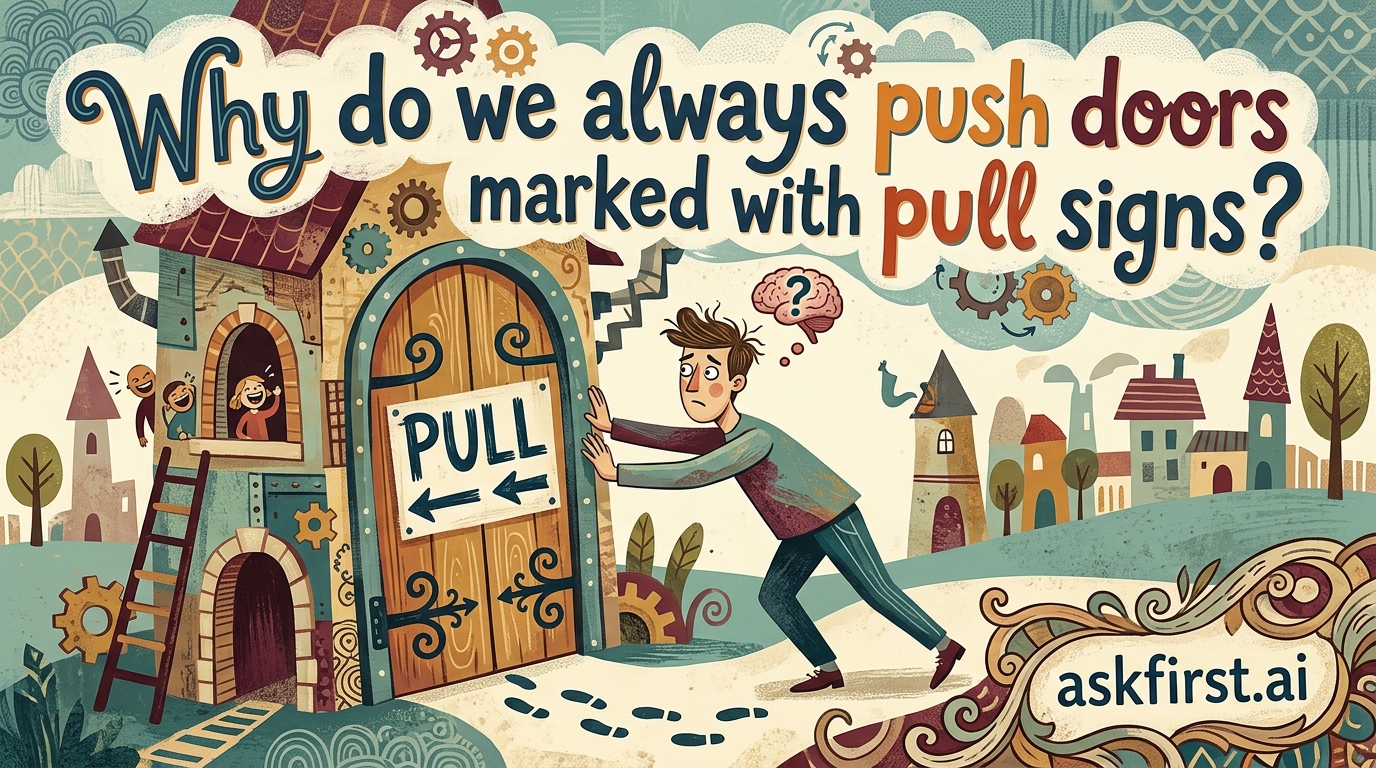
Human interaction with everyday objects is governed by a subtle interplay between intuitive behavior and flawed design. The phenomenon of pushing doors marked 'pull' is famously known in design circles as the Norman Door, named after the influential cognitive scientist Don Norman. In his seminal work, The Design of Everyday Things, Norman argues that when an object requires a sign or instruction to operate correctly, it represents a failure of design rather than a failure of human intelligence. Humans are hardwired to scan the environment for affordances—clues that suggest how an object should be used.
The Role of Affordances and Mapping
An affordance is a perceived property of an object that suggests how it might be used. A large flat plate on a door, for example, is a powerful visual affordance for pushing. Even if the text says 'pull,' the physical configuration of the metal plate screams 'push' to the subconscious mind. Our brains process visual input much faster than they process linguistic information. By the time the eyes register the word 'pull,' the motor cortex has already initiated the action of pushing. This creates a cognitive dissonance where the body follows the physical cue rather than the linguistic warning.
- Visual Dominance: Visual input takes precedence over text.
- Cognitive Load: Reading requires active processing, while tactile cues are processed automatically.
- Habitual Patterns: Frequent users of a door form muscle memory, ignoring new signage entirely.
The Architecture of Habit
Beyond simple affordances, social conditioning plays a critical role. If an individual encounters a door that requires a pull, but the door is shaped or positioned in a way that suggests a push, the user is likely to struggle. This is exacerbated by forced habits. If a person frequently visits a building where most doors are push-to-open, they develop a 'default' behavior. The brain operates on a low-energy principle, attempting to execute familiar motor sequences whenever possible to conserve metabolic resources. When an anomaly occurs—such as a 'pull' sign on a 'push-friendly' surface—the brain essentially ignores the sign, favoring the path of least cognitive resistance.
Designing for Intuition
To prevent the 'Norman Door' error, designers utilize a principle called mapping. Good mapping ensures that the control (the door handle or plate) physically mirrors the required action. For instance, a door that must be pulled should feature a vertical handle or a grip that cannot be pushed, whereas a door that must be pushed should feature a flat plate. When the physical design aligns with the intended function, the need for signage disappears entirely. A well-designed door should be 'self-explanatory.'
The Impact of Environmental Cues
Consider the following factors that influence this interaction:
- Placement: Signs are often placed at eye level, while the functional part of the door is lower. The eyes may catch the sign too late.
- Color and Contrast: Poor contrast between the sign and the door leads to 'sign blindness,' where the brain filters out the sign as background noise.
- Physical Limitations: If the handle is small or awkward to grip, users are even less likely to attempt a pull motion, instinctively falling back on the easier 'push' movement.
Why Myths Persist in Architecture
Architects and building owners often prioritize aesthetics over usability. A sleek, flush-mount handle may look sophisticated but function poorly, leading to the necessity of 'PULL' decals. These decals are essentially 'band-aid' fixes for fundamental design errors. As users, we feel frustrated by the door, yet the reality is that the architecture has failed to communicate effectively with the user's innate mental model. This creates an eternal loop of user error, as no amount of signage can override a design that physically encourages the incorrect action.
Conclusion: Engineering Better Interactions
Ultimately, pushing a door marked 'pull' is not an indicator of human error, but a testament to how visual affordances dictate behavior. By understanding these principles, we can design spaces that align with human biology rather than contradicting it. Whether at home or in the workplace, the goal of design should be to reduce the friction between intention and action. Whenever you find yourself pushing a door labeled 'pull,' remember that you are not failing the test—the design has failed to guide you correctly.