The Evolutionary Divergence of Intellect
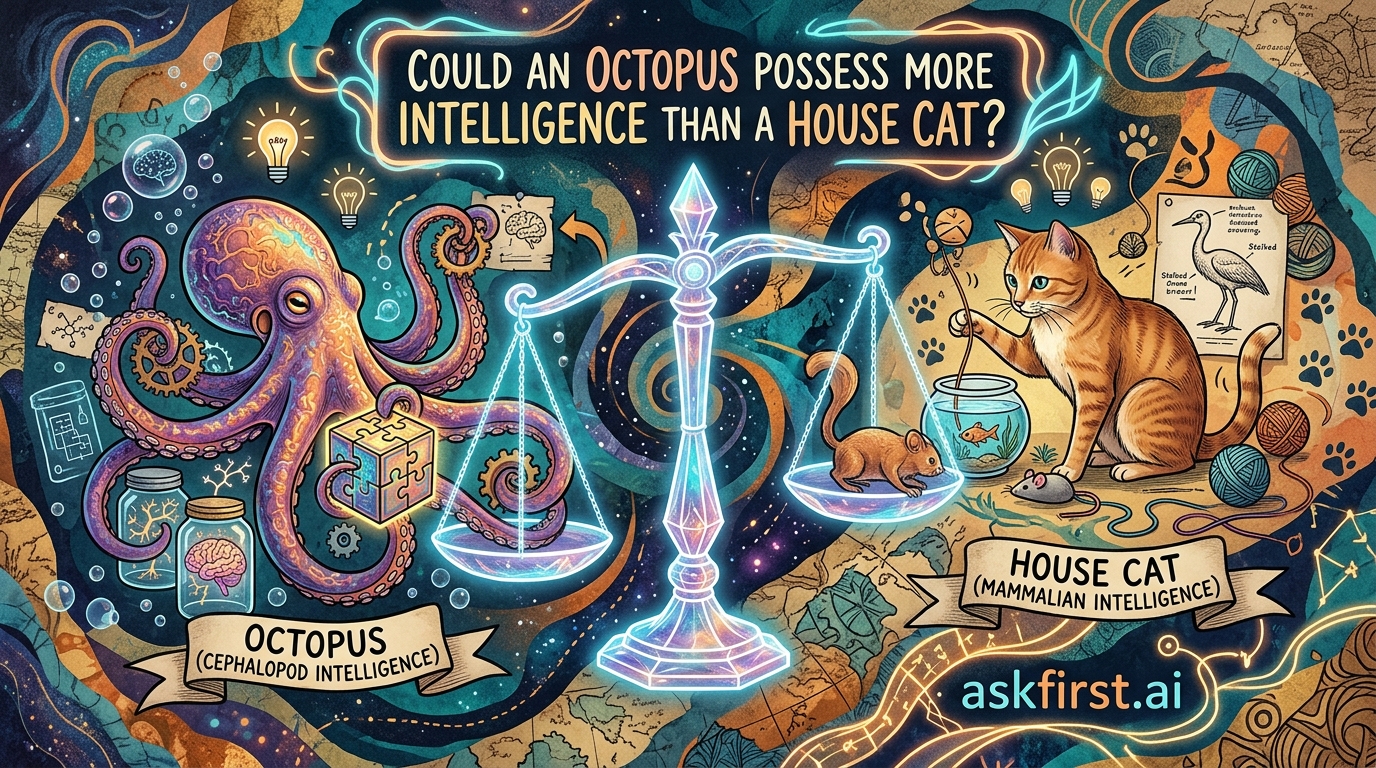
The comparison between an octopus and a house cat invites a fascinating exploration into the nature of intelligence. While cats represent the pinnacle of mammalian social and predatory evolution, the octopus (specifically the order Octopoda) offers a radical alternative: distributed, non-vertebrate cognition. To determine which holds more 'intelligence,' one must first strip away the anthropocentric bias that equates intelligence solely with social bonding or vocal communication. Octopuses possess roughly 500 million neurons, with two-thirds located in their arms rather than their central brain. This creates a sensory-rich, decentralized nervous system that functions quite differently from the feline brain.
Architectural Differences in Brain Structure
The Feline Brain: A domestic cat exhibits high-level executive function. The feline prefrontal cortex allows for complex social hierarchy navigation, patient hunting strategies, and memory retention of specific human interactions. Cats demonstrate 'object permanence' and an ability to learn via observation, both hallmarks of high-level mammalian cognition. Their intelligence is deeply rooted in social dependency and the need to interpret emotional states in their environment.
The Cephalopod Brain: An octopus operates through a decentralized architecture. Each of its eight arms acts like a semi-autonomous unit, possessing the ability to taste, touch, and 'think' locally. This allows the animal to perform complex tasks, such as unscrewing jars or traversing intricate mazes, with speed that defies the standard biological constraints of a central brain. While an octopus lacks the social complexity of a cat, it excels in spatial navigation and rapid adaptation to novel physical environments.
The Problem of Defining Intelligence
When asking if an octopus is 'smarter' than a cat, scientists must reconcile two distinct modes of operation:
- Social Intelligence: Cats win by a wide margin. They utilize complex vocalizations and body language to manage social dynamics with humans and other animals.
- Manipulative/Physical Intelligence: Octopuses represent the peak of invertebrate physical problem-solving. Their ability to solve complex mechanical puzzles suggests a level of cognitive flexibility that is arguably superior in a non-social, survival-oriented context.
Evidence of Cognitive Feats
Recent studies highlight startling cognitive abilities in cephalopods. The common octopus, Octopus vulgaris, has been documented exhibiting play behavior—a trait typically associated with complex mammals. In research settings, octopuses have successfully mimicked the actions of other octopuses, escaped from sealed aquarium tanks by navigating plumbing systems, and shown a clear capacity for long-term memory. Conversely, house cats display 'social scaffolding,' where they modify their behavior specifically to manipulate human caregivers—a form of strategic intelligence that an octopus, by virtue of its solitary nature, has never evolved to display.
Comparing Learning Styles
The cat's learning style is heavily influenced by social reinforcement. Cats learn by watching their mothers hunt or by receiving rewards from humans. This 'social learning' is a shortcut to survival. The octopus, however, is a 'self-taught' organism. Because octopuses have a short lifespan (often 1–5 years) and do not pass down cultural knowledge from parents to offspring, every cognitive achievement must be discovered independently. This makes the octopus's problem-solving repertoire even more impressive, as it is acquired through pure trial-and-error exploration rather than learned tradition.
Conclusion: Different Paths to Cognition
Is the octopus smarter than a cat? The answer lies in the environment. In a dynamic, puzzle-filled physical environment, the octopus might outmaneuver the cat entirely. In a social environment, the cat’s evolved ability to interpret, manipulate, and bond with others makes it the dominant intellectual force. We are not looking at a linear hierarchy where one is 'higher' than the other; instead, we are looking at two distinct, highly successful solutions to the problem of existence. Science increasingly recognizes that intelligence is not a single measurement—like an IQ score—but a diverse array of survival strategies. The cat represents the pinnacle of communal, emotional intelligence, while the octopus remains the absolute monarch of individual, mechanical, and sensory-driven brilliance. Both creatures remind us that the capacity to learn, adapt, and manipulate one's surroundings is a beautiful, universal biological ambition that manifests in ways as varied as the life forms themselves.