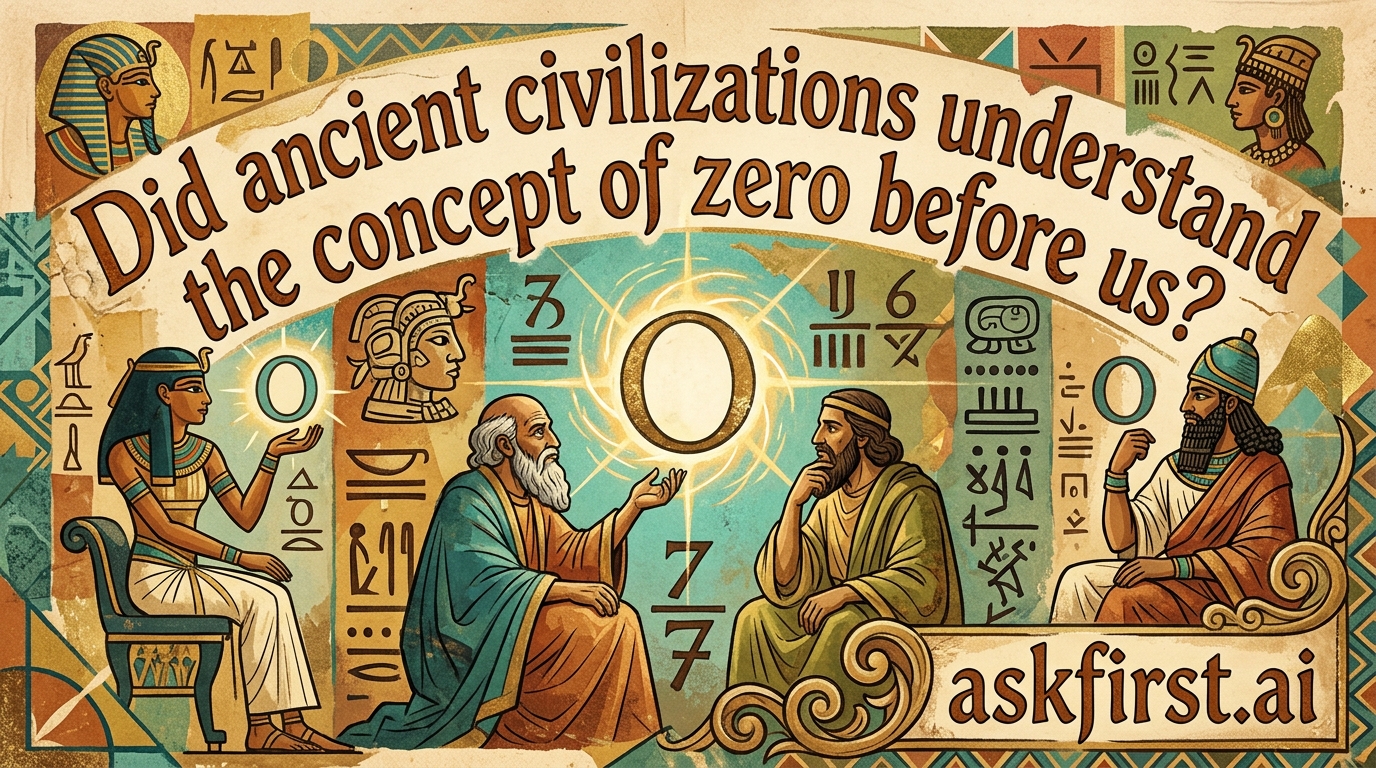
The Ancient Paradox of Nothingness
For centuries, the history of mathematics was framed through a Eurocentric lens, which often marginalized the contributions of non-Western cultures. A common, albeit incorrect, assumption is that the concept of zero as a placeholder and a number was a relatively modern European invention. In reality, the history of zero is a rich, transnational saga of intellectual evolution that dates back thousands of years. Far from being a modern epiphany, the concept of zero emerged through a series of ingenious, independent cognitive leaps across several ancient civilizations.
The Mesopotamian Placeholder
The earliest roots of zero appear in ancient Mesopotamia around 300 to 200 BCE. The Babylonians used a sexagesimal (base-60) positional number system. To distinguish between numbers like 216 and 2016, they needed a way to indicate an 'empty' place value. Originally, they left a blank space, but this proved confusing, especially when transcribing. By the mid-first millennium BCE, scribes began using a double-wedge symbol to act as a placeholder. Crucially, the Babylonians did not treat zero as a number in its own right—it was merely a mark of 'nothingness' within a positional system. They never used it to perform arithmetic operations, yet this foundational step was necessary for all future developments.
The Mayan Ingenuity
Independently, the Maya civilization in Mesoamerica developed a highly sophisticated vigesimal (base-20) number system by the 4th century CE. The Maya were exceptional astronomers, and their calendar systems required incredible precision. They utilized a shell glyph to represent zero in their long-count calendar. Similar to the Babylonians, the Maya used zero both as a positional placeholder and as a concrete concept representing completion or the end of a cycle. Their understanding of cyclical time allowed them to integrate zero into complex astronomical calculations long before European scholars acknowledged the concept. This demonstrates that human necessity—the need for astronomical tracking—spurred the conceptualization of zero on opposite sides of the globe.
The Indian Revolution: Zero as a Number
While the Babylonians and Mayans used zero primarily as a placeholder, the Indian mathematicians of the Gupta period transformed zero into a number with its own mathematical properties. In the 5th century CE, scholars such as Aryabhata and later Brahmagupta provided the formal framework that defines how we use zero today. In his 628 CE work, Brahmasphutasiddhanta, Brahmagupta explicitly described the rules for arithmetic involving zero. He stated clearly that when zero is added to a number, the sum is that number, and when it is subtracted, the value remains unchanged. He even attempted to define division by zero, noting its complexities, which foreshadowed the development of calculus. This transition—from zero as an empty space to zero as an operational value—is the true birth of modern mathematics.
The Transmission to the West
The knowledge developed in India traveled along the Silk Road to the Islamic world. Mathematicians like Al-Khwarizmi, whose name is the root of the word 'algorithm', popularized the Indian system, which included the decimal positional system and the use of zero. This system became known as the Hindu-Arabic numeral system. By the 12th century, these concepts were translated into Latin by figures like Leonardo of Pisa, famously known as Fibonacci. Despite resistance from European institutions that were deeply attached to the Roman numeral system (which lacked a zero), the mathematical superiority of the Hindu-Arabic system eventually proved undeniable. It allowed for the rapid expansion of commerce, accounting, and eventually, the scientific revolution.
Why the Concept Took So Long to Mature
The reason zero remained elusive for so long is rooted in human psychology and philosophy. For ancient thinkers like the Greeks, 'nothing' was a dangerous, abstract concept. Thinkers like Aristotle famously argued that a vacuum could not exist in nature, which inadvertently stifled the mathematical development of zero in Western classical thought. The idea of representing 'nothing' as a 'something' caused a profound ontological struggle. It took a shift in cultural mindset—viewing zero not as a void, but as a critical tool—to unlock its potential. Zero is, in effect, the bridge between simple counting and the infinite complexity of modern physics.
Conclusion
The history of zero is a testament to human intellectual curiosity. It was not a singular discovery made in a vacuum (pun intended), but a global collaboration spanning millennia. From Babylonian wedges and Mayan shells to the rigorous algebra of Indian sages and the computational prowess of the Islamic Golden Age, zero represents the ultimate triumph of abstract thought. It is the bedrock upon which our modern technological world—built on the binary code of zeros and ones—rests. Understanding that zero is both the void and the spark of modern computation confirms that ancient civilizations were not just thinkers; they were the pioneers of our digital reality.