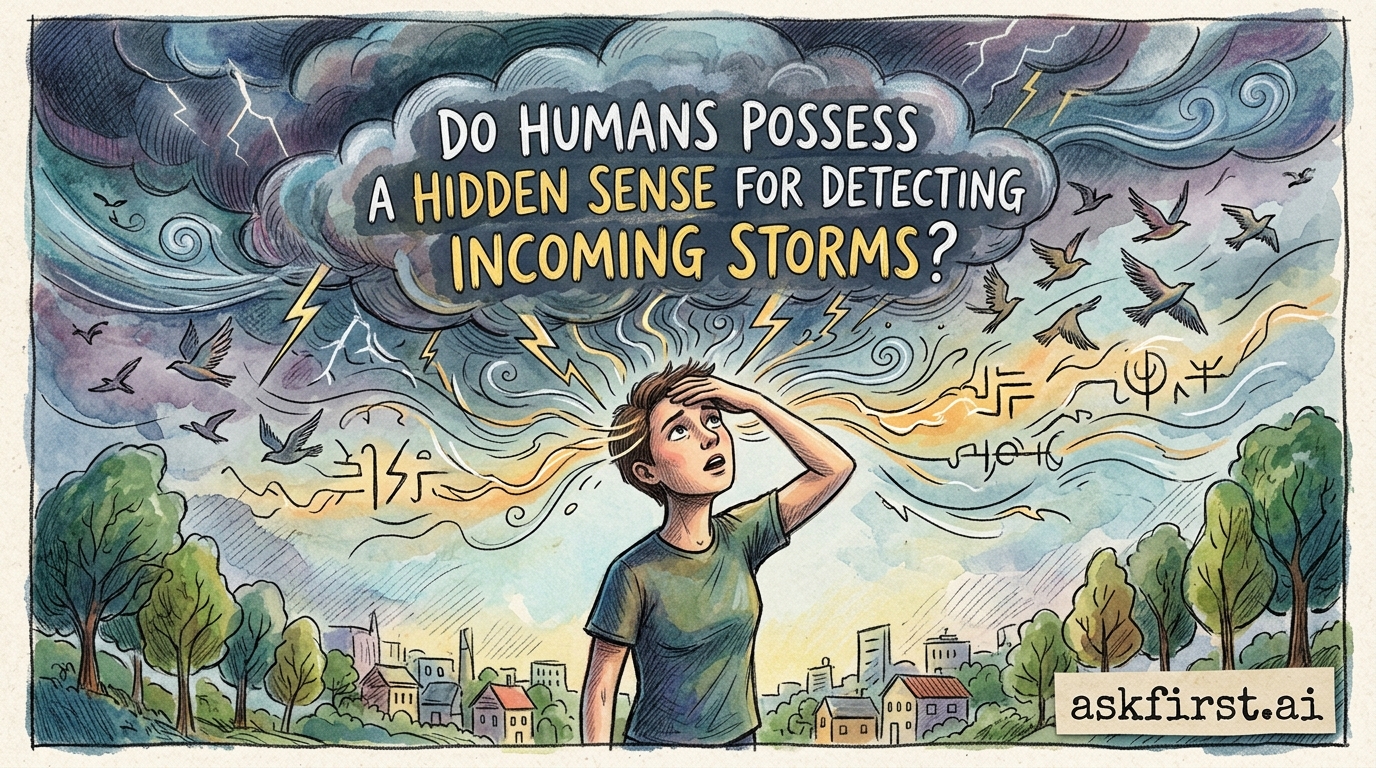
The Biological Barometer: Unlocking Human Weather Sensitivity
For centuries, folklore has been filled with tales of individuals who can 'feel' a storm in their bones. While often dismissed as superstition or simple coincidence, modern sensory biology and physiological research suggest that humans may indeed possess a subtle, latent capacity to detect shifting atmospheric conditions long before the clouds darken the horizon. This phenomenon, often referred to as barometric sensitivity, bridges the gap between ancient intuition and contemporary biophysics.
The Mechanism of Atmospheric Perception
At the core of this ability is the human body's complex interaction with barometric pressure—the weight of the atmosphere pressing down upon the surface of the planet. Atmospheric pressure changes frequently, particularly before significant meteorological shifts. While most people remain consciously unaware of these subtle fluctuations, the human body operates as a high-precision biological barometer.
- Synovial Fluid Dynamics: The joints of the human body contain synovial fluid, which acts as a lubricant for movement. Scientists theorize that as external air pressure drops—a hallmark of an approaching storm—the pressure inside the joint capsules may expand slightly. In individuals with pre-existing joint sensitivities or inflammation, this microscopic expansion can trigger sensory nerves, resulting in the localized aches famously attributed to 'bad weather.'
- The Inner Ear Equilibrium: The vestibular system, located within the inner ear, is primarily responsible for balance. However, sensitive vestibular receptors may be capable of detecting rapid changes in ambient pressure. If the pressure drops quickly, the fluid within the inner ear might shift, sending subtle signals to the brain that the environment is undergoing a transformation, which may manifest as slight dizziness or an inexplicable feeling of unease.
- Electromagnetic Sensitivity: Storms are not merely collections of wind and rain; they are intense electrostatic events. The buildup of negative charges in the atmosphere before a thunderstorm creates an electrical gradient. Some researchers suggest that human skin and the nervous system can perceive these electrostatic changes. This might explain the heightened state of arousal or electrical sensitivity reported by many individuals just before a lightning storm begins.
Psychological Priming and Cognitive Patterns
It is essential to distinguish between true sensory perception and the psychological phenomenon of pattern recognition. The human brain is an evolutionary masterpiece designed to seek order in chaos. When an individual experiences an ache or an intuition that happens to coincide with rain, the brain catalogs this as a significant event. Over time, this cognitive bias strengthens, potentially exaggerating the perceived accuracy of one's 'weather sense.' However, studies in biometeorology indicate that the correlation is not entirely psychological; there is a tangible physiological trigger, even if the interpretation varies by individual.
Historical and Cultural Context
Throughout history, various cultures have relied on 'human sensors' to predict weather. In maritime traditions, sailors often spoke of the 'smell' of a storm. This is not purely metaphorical. Before a heavy rainfall, ozone—a sharp, pungent gas—is often brought down to ground level by downdrafts from approaching storm clouds. The human olfactory system is incredibly sensitive to ozone, capable of detecting it at extremely low concentrations. What feels like a 'sixth sense' is often the nose identifying a chemical precursor to precipitation.
Are You a Weather Sensitive?
While science does not support the idea of a 'storm-detecting organ' akin to a bird's magnetoreception, it validates that humans are sensory-integrated entities deeply affected by their environment. To determine if one possesses this sensitivity, consider the following signs:
- Joint or muscular dullness: A feeling of tension in the knees, elbows, or hips preceding a pressure drop.
- Olfactory awareness: An unexplained awareness of a 'fresh' or 'metallic' scent in the air hours before a storm.
- Atmospheric anxiety: A subtle, physiological feeling of restlessness or 'prickliness' on the skin in high-humidity, low-pressure environments.
The Future of Sensory Research
As we look toward 2030 and beyond, the study of bio-atmospheric interactions is poised to grow. Understanding these hidden sensitivities is not just about confirming old wives' tales; it is about recognizing the deep, symbiotic relationship between the human nervous system and the planetary environment. Humans are not separate from the weather; they are participants in the same system, constantly reacting to the invisible currents of the atmosphere. Whether labeled as instinct, sensitivity, or biological reflex, this 'storm-sensing' capability serves as a fascinating reminder of the complex, interconnected nature of human biology and the world we inhabit.