The Evolutionary Bias: The Negativity Effect
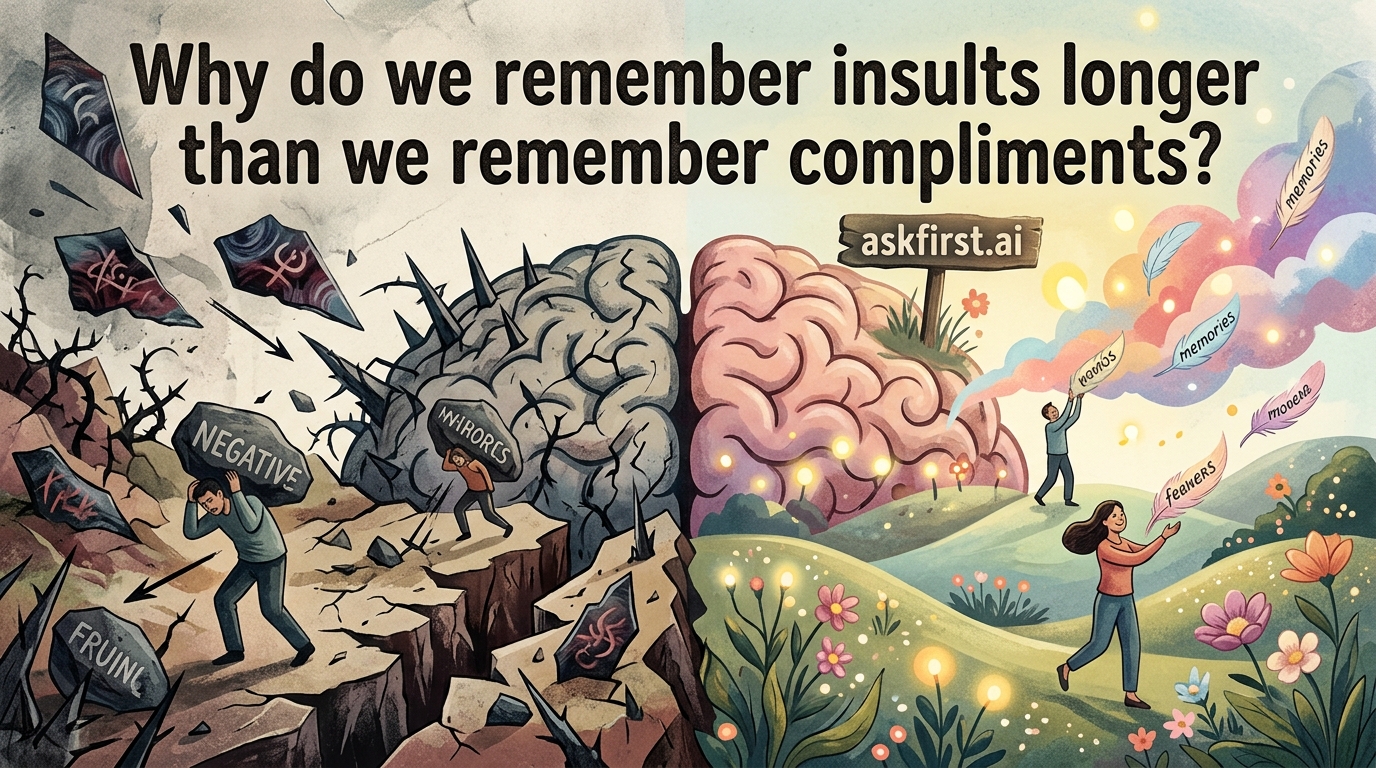
Human cognition is not a neutral recorder of events. It is a finely tuned instrument of survival that is fundamentally skewed toward detecting and ruminating upon threats. This phenomenon is known as the Negativity Bias. From an evolutionary standpoint, missing a single positive interaction might be socially inconvenient, but failing to notice a threat—such as a hostile peer or a predator—could have been fatal. Thus, our ancestors who prioritized information about danger were the ones who survived to pass on their genes. This biological legacy persists in our modern psychology, where a single harsh word can outlast a dozen accolades in the corridors of the mind.
The Neural Architecture of Memory
When an insult occurs, the brain undergoes a unique neurobiological process. Unlike neutral or positive experiences, negative experiences trigger the amygdala—the brain's emotional command center—to activate the sympathetic nervous system, inducing a 'fight or flight' response. This release of stress hormones, such as cortisol and adrenaline, chemically signals the hippocampus to encode the event with high priority.
- Emotional Intensity: Negative stimuli are processed more deeply in the prefrontal cortex than positive ones. Studies show that the brain displays greater neural activity when viewing negative images or recalling harsh criticism compared to rewarding stimuli.
- Rumination Cycles: The brain often enters a 'loop' of rumination after an insult. This is a cognitive attempt to solve the 'problem' of the negative feedback, effectively forcing the brain to rehearse the memory repeatedly, which strengthens the neural pathway for that specific memory.
The Asymmetry of Social Intelligence
Beyond simple biology, social dynamics play a massive role. Baumeister et al. (2001), in their landmark research 'Bad is Stronger than Good,' established that negative feedback carries more weight because it is perceived as more informative. Compliments often reinforce existing self-concepts or are dismissed as polite social lubrication. In contrast, an insult acts as a 'disconfirming' piece of evidence that challenges our social standing or self-worth. To preserve the ego, the mind clings to this data, analyzing it, refuting it, or stewing over it.
Practical Strategies for Emotional Regulation
Understanding why we ruminate is the first step toward managing it. To counterbalance the brain's natural bias, one must employ conscious cognitive strategies:
- Cognitive Reframing: When an insult stings, actively pause to analyze the source. Ask: 'Is this information actionable, or is it merely emotional projection from the other person?'
- The 5-to-1 Ratio: Renowned relationship researcher John Gottman suggests that for every negative interaction, humans need at least five positive ones to maintain equilibrium. Actively curating positive interactions can help dilute the impact of a singular insult.
- Mindfulness Meditation: By training the brain to observe thoughts without identifying with them, individuals can diminish the reflexive power of negative memories.
The Silver Lining: Resilience and Growth
While it may feel like a flaw, this sensitivity to negative information is also the root of human vigilance and self-improvement. Because insults leave such a profound mark, they often serve as the catalysts for significant personal change. When we move past the emotional sting, we can objectively evaluate the 'insult' for any grain of truth that might help us grow. By shifting from a defensive posture to an analytical one, we transform the 'pain' of memory into the 'fuel' for future success.
Conclusion
We remember insults longer because, in the ancient history of our species, surviving an attack was far more important than basking in praise. While our modern environment has changed drastically, our 'hardware' remains the same. Recognizing this bias allows us to stop taking negative memories as objective truths and instead see them for what they are: the lingering, vestigial echoes of a brain designed for survival. By mastering the art of conscious reflection, we can reclaim our headspace from these echoes, ensuring that our self-worth is defined by our values rather than the temporary sting of others' words.