The Paradox of Subjective Time: Why Years Seem to Shorten with Age
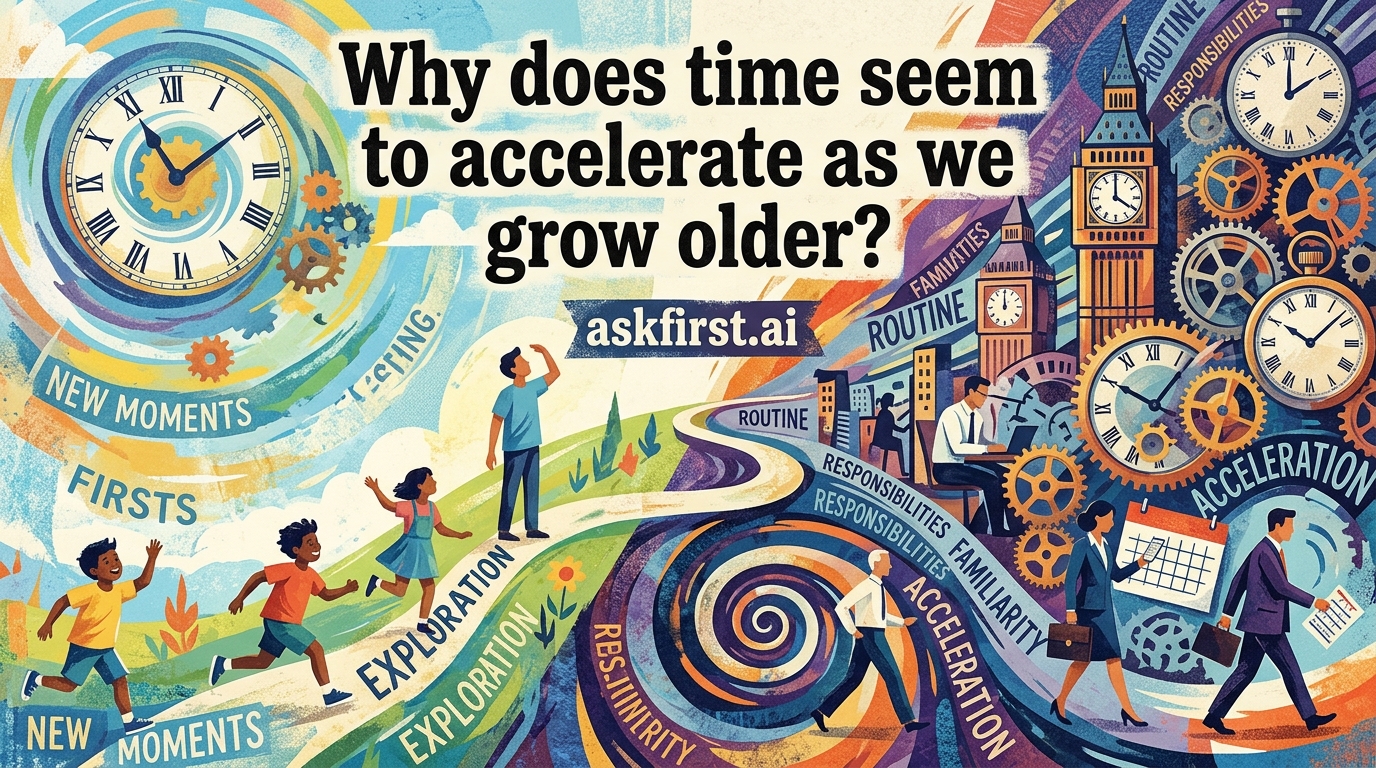
It is a near-universal observation that as we transition from childhood into adulthood, the perceived pace of time undergoes a dramatic transformation. To a seven-year-old, a single summer feels like an epoch, an endless expanse of long days and slow-turning seasons. Conversely, for a middle-aged adult, a year can vanish in what feels like a mere blink. This phenomenon, often referred to as the "Holiday Paradox" or the "Proportional Theory of Time," suggests that our perception of duration is not a fixed, objective measurement, but a malleable construct shaped by the brain's processing mechanisms.
The Proportional Theory: The Mathematical Perspective
One of the most foundational explanations for this acceleration is the Proportional Theory, first popularized by the French philosopher Paul Janet in 1877. Janet proposed that our perception of time is relative to the total amount of time we have already lived.
Consider a five-year-old child: one year represents 20% of their entire existence. The subjective weight of that year is massive because it constitutes a significant fraction of their lived experience. In contrast, for a fifty-year-old, one year represents only 2% of their life. Because the brain perceives this year as a smaller slice of the "pie" of life, it feels significantly shorter. Mathematically, our brains are essentially calibrating the duration of a year against the backdrop of our cumulative memories. As the denominator (our age) grows larger, the quotient (the perceived length of the year) inevitably shrinks.
The Role of Novelty and Neural Encoding
Beyond simple mathematics, neuroscientists—most notably Dr. David Eagleman, a neuroscientist at Stanford University and author of The Brain: The Story of You—argue that the brain’s ability to process new information is the true engine behind time perception.
When we are young, the world is a constant stream of novel stimuli. Every day involves learning new motor skills, discovering social nuances, and navigating unfamiliar environments. The brain is forced to dedicate vast amounts of neural energy to "encoding" these new experiences. Because the brain is working harder to record these memories, it creates a denser, more detailed map of that time period. When we look back, that period feels long because it is packed with rich, high-definition data.
As we age, our lives become defined by routine. We commute to the same jobs, interact with the same people, and follow predictable schedules. According to the Neural Coding Theory, when the brain encounters familiar patterns, it enters a state of "auto-pilot" to conserve energy. It stops recording the minute details of our daily routines. When we look back on a routine-heavy year, there is very little "data" to retrieve. Consequently, the brain compresses these monotonous stretches, making the time seem to vanish. This is why a vacation to a new country often feels longer than a month of typical office work: the novelty forces the brain to pay closer attention, thereby expanding the subjective experience of time.
The "Oddball Effect" and Memory Compression
In the field of cognitive psychology, the "Oddball Effect" describes how we perceive time during surprising or unique events. When an unexpected stimulus occurs, our brains process it more slowly and with higher intensity. This is why time seems to "slow down" during a car accident or a high-stakes life event; the amygdala is activated, and the brain begins recording the event with much higher resolution than it would a mundane task.
As we grow older, we encounter fewer "oddballs." Our lives become increasingly predictable. Without the punctuation of high-impact, novel events, the passage of time lacks the "markers" that our brains use to anchor memories. As noted by psychologist William James in his seminal 1890 work, The Principles of Psychology, "a time filled with varied and interesting experiences seems short in passing, but long in retrospect." However, he also noted that when life is devoid of these markers, the lack of new memories creates a feeling of emptiness in our timeline, causing the years to blend together and accelerate.
Combatting the Acceleration
Understanding the mechanics of time perception offers a practical way to reclaim the feeling of a "longer" life. If the acceleration of time is a byproduct of routine and a lack of novel input, then the antidote is intentional novelty.
- Learn New Skills: Engaging in complex tasks—such as learning a new language or musical instrument—forces the brain to exit its automated state and begin the high-energy process of active encoding.
- Travel and Exploration: Changing your physical environment forces the brain to map new surroundings, which effectively "stretches" the perceived duration of the trip.
- Mindfulness: By practicing present-moment awareness, one can increase the density of information captured during mundane tasks, effectively adding "data" to otherwise blank stretches of time.
Conclusion
The feeling that time accelerates as we age is not a trick of the light, but a fundamental feature of how our brains process reality. By shifting from a state of high-intensity learning to a state of efficient, routine-based processing, we inadvertently cause our internal clocks to speed up. By recognizing that our subjective experience of time is directly linked to the novelty and depth of our experiences, we can consciously choose to live more vibrant, varied, and challenging lives. While we cannot stop the mechanical march of the clock, we can certainly influence the richness of the journey, ensuring that our years feel as long and meaningful as they did when we were children.