The Ancient Syntax: Exploring Sanskrit as the Blueprint for Computation
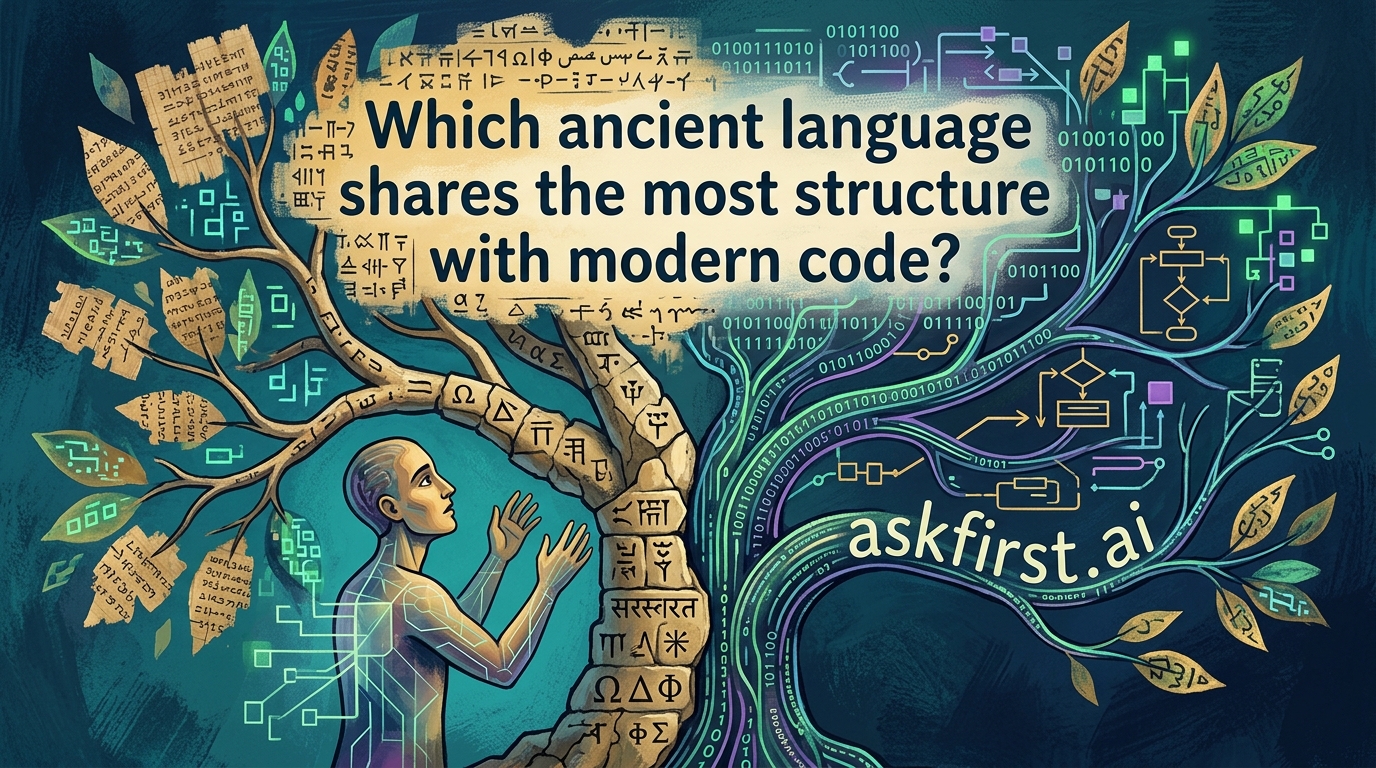
When modern software engineers look at the architecture of contemporary programming languages—such as Python, Java, or C++—they often perceive them as products of the late 20th century. However, a fascinating intersection exists between computer science and linguistics, specifically regarding Sanskrit, the ancient liturgical language of Hinduism. Many prominent computer scientists and linguists have argued that Sanskrit serves as the most structurally aligned ancient language to the logic, algorithmic precision, and rule-based systems of modern programming.
The Rule-Based Architecture
At the core of Sanskrit grammar lies the work of the grammarian Panini, who authored the Ashtadhyayi around the 4th century BCE. Panini’s work is essentially a set of roughly 4,000 grammatical rules (sutras) that generate the entire Sanskrit language. This system operates with the exactness of a formal grammar in computer science. Just as a compiler checks code against a strict set of syntax rules to determine validity, the Ashtadhyayi provides a recursive, algorithmic methodology to derive correct word forms from roots and suffixes. This modularity is strikingly similar to how modern code utilizes functions, libraries, and inheritance.
- Meta-language Utility: Panini used a meta-language to describe the rules of Sanskrit, functioning much like a programming language describes its own syntax. This approach anticipated the concept of formal logical systems by two millennia.
Why Sanskrit Resonates with Machine Logic
Morphological Precision: Sanskrit is highly inflected. Its structure relies on the combination of roots (dhatus) with suffixes and prefixes. In programming, this mirrors the process of object-oriented programming, where base classes and methods are combined to build complex functions. The language is virtually devoid of ambiguity, which is the primary requirement for machine execution.
Algorithmic Derivation: The process of generating words in Sanskrit is purely algorithmic. There is a defined sequence of operations (the sutras) that must be followed. If one applies these rules in the correct order, the output is guaranteed to be grammatically sound. This is the textbook definition of a computer program—a series of instructions that transform an input into a predictable, accurate output.
Conciseness and Efficiency: Much like high-level code, Sanskrit is designed for extreme density of information. An entire complex thought can be expressed in a single, compound word. This echoes the efficiency of high-performance coding languages where complexity is encapsulated into clean, concise modules.
The NASA Connection: A Case Study in Logic
In the 1980s, the researcher Rick Briggs published a paper in the AI Magazine titled "Knowledge Representation in Sanskrit and Artificial Intelligence." The study explored the potential of Sanskrit as a natural language for artificial intelligence. The hypothesis was that due to its rigid logical structure and avoidance of the ambiguity found in most natural languages (like English), Sanskrit could facilitate easier natural language processing (NLP). While Sanskrit did not replace C++ as the primary coding language, the logic of its structure remains a hallmark of how human-created systems can approach the purity of mathematical logic.
Comparative Structural Analysis
To understand why this is unique, one must compare it to other ancient tongues. Languages like Ancient Greek or Latin are certainly structured, but they are prone to stylistic nuances that create ambiguity for machine interpretation. Sanskrit, however, behaves like a declarative programming language. In a declarative language, the developer describes 'what' the program should accomplish without explicitly stating the 'how' for every low-level movement; Panini’s grammar functions similarly, providing a universal 'what' that results in the 'how' of language production.
- Syntactic Modularity: Just as a developer imports a library to perform a specific task, a Sanskrit speaker uses specific grammatical "operators" to modify roots.
- Predictability: The language lacks the "irregularities" that plague other tongues, as almost every form is derivable from the base rule set.
Conclusion: The Legacy of Structural Thinking
The alignment between Sanskrit and computer code is not a coincidence of history, but a testament to the power of human logical abstraction. Panini’s work stands as perhaps the earliest example of human documentation of a system that functions exactly like a digital computer. While we now use machines to manipulate silicon, the logic we use to guide them is an extension of the same cognitive architecture that produced the sophisticated grammar of ancient India. By viewing Sanskrit as a precursor to the modern compiler, we gain a deeper appreciation for the timeless nature of algorithmic thought. Whether for AI development or linguistics, the study of Sanskrit proves that human language can indeed achieve the absolute, crystalline clarity required to build the future.