The Phenomenon of the Doorway Effect
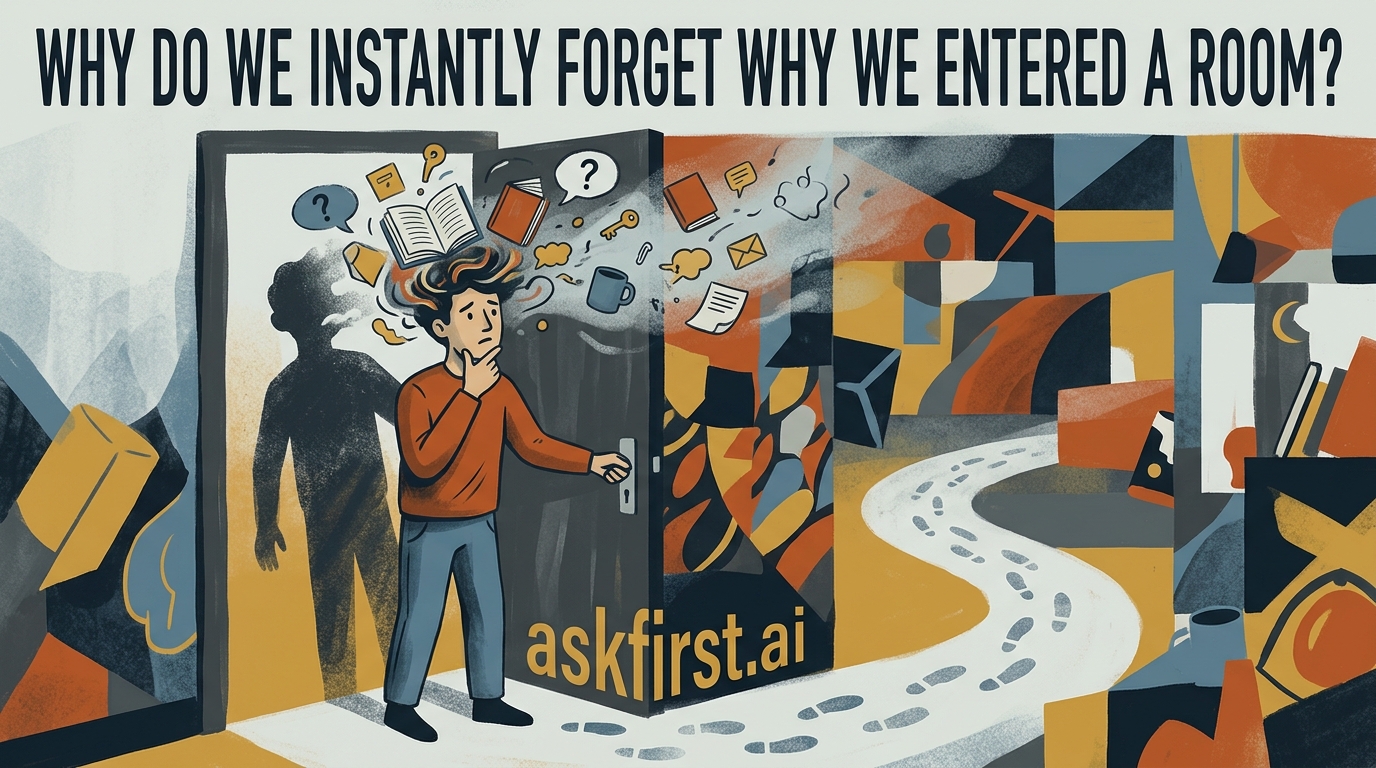
Have you ever walked from the living room into the kitchen with a clear purpose, only to find yourself standing there, staring blankly, with absolutely no idea why you made the trip? This is not a sign of early-onset memory loss or cognitive decline. In the world of cognitive psychology, this peculiar lapse is formally known as the Doorway Effect. It is a fascinating quirk of the human brain that reveals a great deal about how our minds categorize information and manage spatial awareness.
How the Brain Navigates Space
The primary theory behind the Doorway Effect centers on the concept of Event Segmentation. Research suggests that the human brain parses life into distinct 'events' to manage the constant flow of sensory data. Think of it like a film editor cutting a movie into scenes; your brain creates these mental boundaries to make life easier to process.
- Contextual Updating: When you move from one physical space to another—crossing a threshold—the brain essentially closes one 'file' of activity and opens a new one.
- Mental Reset: Walking through a doorway acts as a physical cue that you are entering a new environment. Consequently, the brain clears out the 'working memory' associated with the previous room to make space for the stimuli in the current room.
The Science of Working Memory
Working memory is the brain's equivalent of a notepad; it holds information just long enough for you to execute a task. However, this notepad has a limited capacity. When you walk through a door, the sheer act of changing environments demands cognitive resources.
- Spatial Contexts: The brain attaches your intent (e.g., 'get the scissors') to the location where that intent was formed. When the location changes, the retrieval cue for that intent becomes harder to access because the brain is busy 're-indexing' your location.
- Encoding vs. Retrieval: You encoded the thought in Room A. By moving to Room B, the context changes. Research conducted by psychologists at the University of Notre Dame demonstrated that people are significantly more likely to forget tasks when they pass through doorways compared to when they move across a room without crossing a threshold.
Can You Combat the Doorway Effect?
While this effect is a natural byproduct of how we process information, there are strategies to minimize its frequency. The brain thrives on associations and deliberate focus.
- Verbal Reinforcement: Say the task out loud as you are moving toward your destination. By involving the auditory system, you create a stronger neural pathway that is less likely to be 'reset' when you cross a threshold.
- Visual Anchoring: Attempt to visualize the object you are seeking before you start moving. If you need scissors, picture the exact pair sitting on the counter.
- Minimize Distractions: Many instances of the Doorway Effect are exacerbated by cognitive load. If you are already thinking about an email, a phone call, or a grocery list while moving, your brain is more likely to prioritize those over the task of grabbing an item.
Is It Actually Beneficial?
Interestingly, the Doorway Effect highlights the efficiency of the human brain. We are not designed to carry every single minute detail of our existence with us at all times. By clearing out the previous event's 'mental noise' as we enter a new space, we are arguably priming ourselves to be more present and responsive to the current environment. If we didn't experience this reset, our working memory would become hopelessly cluttered with obsolete information from every room we visited throughout the day.
Therefore, the next time you find yourself standing in the middle of a room wondering why you are there, try not to view it as a failure. Instead, view it as a high-speed operating system update. Your brain has successfully compartmentalized your previous task to focus on your new surroundings. It is a sign of a brain that is actively working to keep your world organized, even if it occasionally misplaces a singular intent in the process.