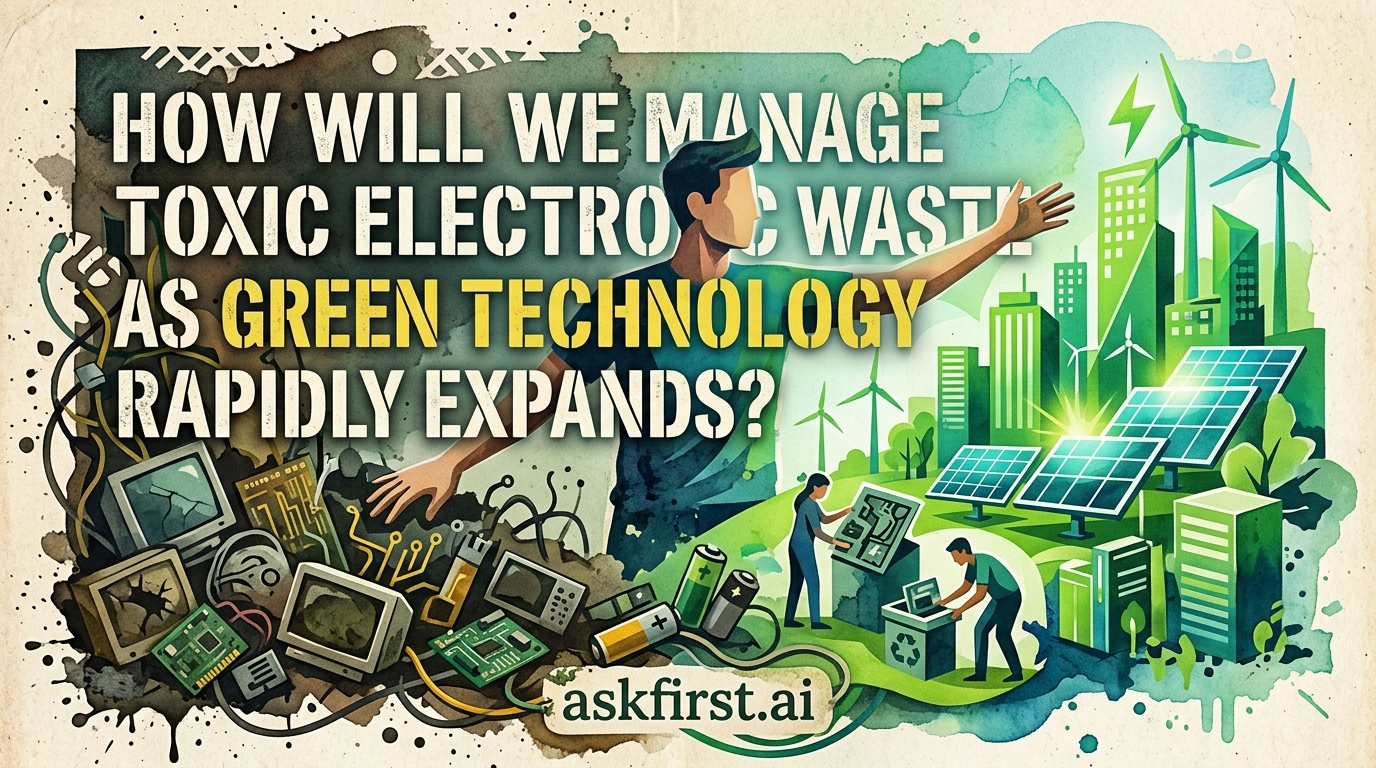
The rapid global transition toward green technology—solar panels, wind turbines, electric vehicle (EV) batteries, and high-efficiency semiconductors—is a double-edged sword. While these innovations are essential for mitigating the climate crisis, they simultaneously generate a massive, unprecedented stream of "green" electronic waste (e-waste). As we move toward 2030, the sheer volume of retired lithium-ion batteries and photovoltaic modules threatens to overwhelm existing waste management infrastructure. Addressing this challenge requires a shift from a linear "take-make-dispose" model to a sophisticated, circular industrial ecosystem.
The Anatomy of the Green E-Waste Crisis
The fundamental problem with green technology is that it relies on rare earth elements (REEs) and hazardous heavy metals. A lithium-ion battery, for instance, contains cobalt, nickel, manganese, and lithium—materials that are not only energy-intensive to extract but also toxic if leaked into the environment via landfills.
According to the International Renewable Energy Agency (IRENA) in their report "End-of-Life Management: Solar Photovoltaic Panels," the world could face a cumulative total of 78 million metric tons of solar panel waste by 2050. Similarly, the International Energy Agency (IEA) notes in "The Role of Critical Minerals in Clean Energy Transitions" that the demand for these minerals will skyrocket, making the recovery of materials from end-of-life products a strategic necessity for national security and environmental safety.
Design for Disassembly: The First Line of Defense
The most effective way to manage toxic e-waste is to prevent it from becoming waste in the first place. Engineering firms are increasingly adopting "Design for Disassembly" (DfD) principles. This approach mandates that products are built with modular components that can be easily unscrewed or detached, rather than fused with glues or resins that make recycling nearly impossible.
For example, Tesla’s Gigafactory operations have begun experimenting with "closed-loop" recycling. By designing battery packs that can be mechanically dismantled by robotics, they ensure that the cathodes and anodes can be separated, purified, and re-introduced into the supply chain. This reduces the reliance on "virgin" mining, which is notoriously environmentally destructive. As noted by Dr. Steven S. Chu in his studies on materials science at Stanford University, the ability to recover high-purity battery-grade materials is the "holy grail" of the circular economy.
Advanced Hydrometallurgical Recycling
Current recycling methods—often relying on pyrometallurgy (smelting)—are energy-intensive and release toxic fumes. The future of e-waste management lies in hydrometallurgy. This process uses aqueous chemistry to recover materials from electronic waste at much lower temperatures.
In hydrometallurgy, shredded e-waste is treated with chemical solvents to selectively dissolve target metals. This allows for the recovery of gold, silver, copper, and cobalt with high purity levels. Companies like Li-Cycle in North America are pioneering this space, utilizing "spoke-and-hub" models where batteries are shredded at local "spokes" and then processed at centralized "hubs." This minimizes the transport of hazardous materials and maximizes the efficiency of resource recovery.
The Role of Extended Producer Responsibility (EPR)
Technological solutions are insufficient without robust policy frameworks. Extended Producer Responsibility (EPR) laws shift the burden of waste management from the consumer to the manufacturer. By requiring companies to take back their products at the end of their lifecycle, governments incentivize manufacturers to create more durable, recyclable technology.
In the European Union, the Circular Economy Action Plan serves as a global benchmark. It mandates strict recovery targets for batteries and electronics. By forcing producers to internalize the cost of disposal, the market naturally shifts toward greener, more modular designs. As Ellen MacArthur, founder of the Ellen MacArthur Foundation, argues in her seminal work "Building a Circular Economy," the transition is not merely a waste management issue; it is a fundamental redesign of industrial value chains.
The Challenge of Informal Recycling
Despite technological progress, a significant portion of global e-waste is handled by the informal sector, particularly in developing nations. Workers often use open-pit burning or acid baths to extract metals, leading to severe health complications and soil contamination.
To solve this, international cooperation is required. Organizations like the Solving the E-waste Problem (StEP) Initiative provide frameworks for transferring technology and safety standards to developing regions. Integrating informal recyclers into a formal, regulated value chain is essential. By providing these workers with modern, safe, and efficient tools, we can turn a toxic health crisis into a source of sustainable employment.
Conclusion
The management of green e-waste is one of the defining logistical challenges of our century. We cannot claim to be "green" if the very technology we use to save the planet leaves behind a toxic legacy of heavy metals and hazardous waste. The solution lies in a tripartite strategy: designing for circularity, scaling hydrometallurgical recovery, and enforcing strict producer accountability.
We are currently in a transition period where the infrastructure for recycling has not yet caught up to the rapid adoption of green technology. However, through the integration of robotics, smarter chemical engineering, and global policy alignment, we can ensure that the transition to a carbon-neutral world is also a transition to a truly sustainable, waste-free society. The goal is clear: the solar panel of today must become the raw material for the battery of tomorrow.