The Neural Architecture of the Octopus
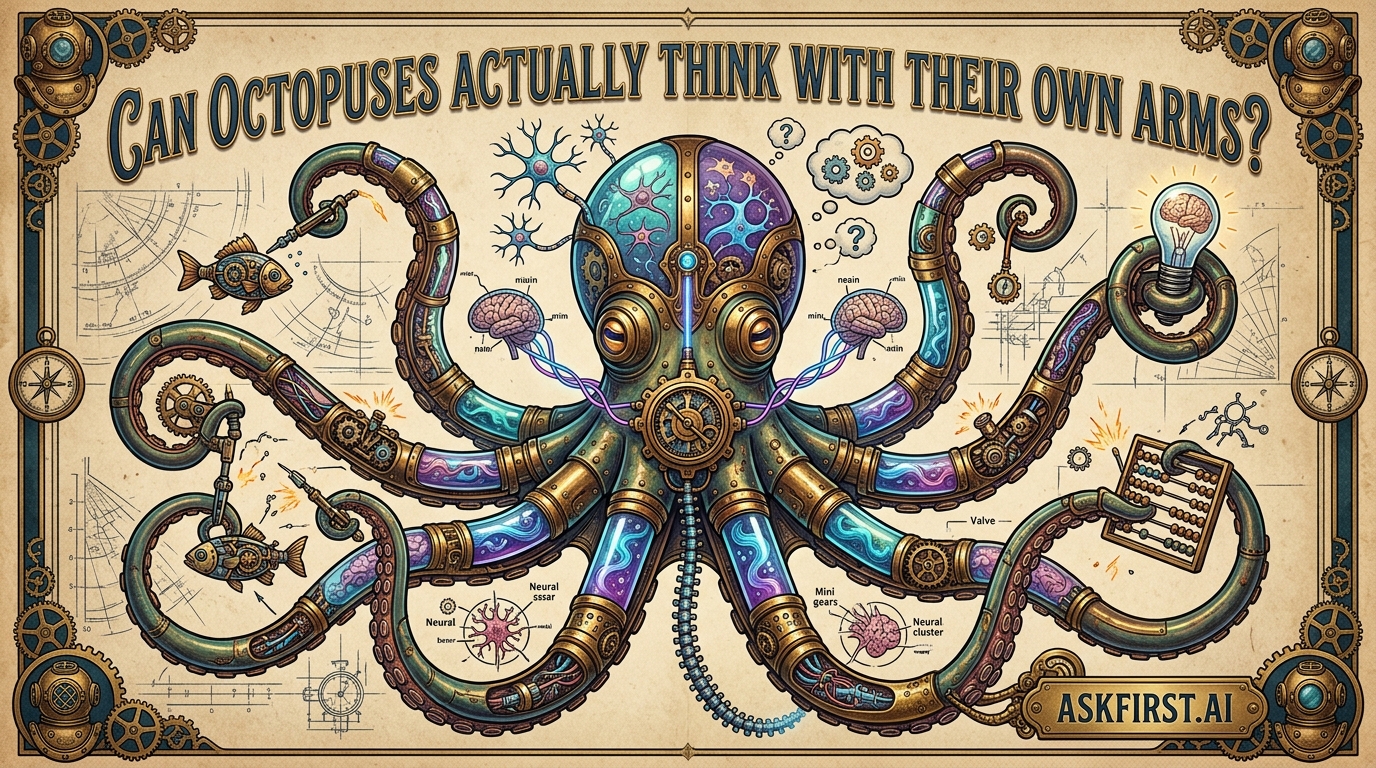
The octopus represents one of the most significant departures from vertebrate-style intelligence in the animal kingdom. While humans concentrate their cognitive processing power within a centralized brain protected by a skull, the octopus employs a highly decentralized system. This architecture suggests that an octopus does not merely 'think' with its arms, but rather that its arms possess a form of localized autonomy that allows for highly complex environmental interaction without constant supervision from the central brain.
Decentralized Processing: The Distributed Nervous System
To understand why octopuses exhibit such alien-like behavior, one must examine their neural distribution. Out of the approximately 500 million neurons in a common octopus, roughly two-thirds are located outside of the central brain. A vast majority of these neurons reside within the arms themselves, organized into structures known as nerve cords. Each arm contains a massive ganglion that processes sensory information and motor commands independently of the central brain.
- Peripheral Autonomy: When an arm encounters an object, it can taste, touch, and even manipulate the item without the central brain being aware of the specific details. This allows the animal to multitask at a level impossible for mammals.
- Reflexive Loops: The arms are capable of complex reflexive actions. If an arm is detached—though this is a traumatic event—it may still respond to stimuli like light or touch for a short period, proving the motor programs are embedded directly in the appendage.
How Independent Are the Arms?
Research indicates that while the arms operate with a degree of autonomy, they are not completely independent agents. Think of the relationship between an octopus's central brain and its arms like a human using a sophisticated tool. The brain provides the 'intent' or the 'high-level goals,' such as 'search this crevice for food,' while the arms execute the specific movements required to navigate the uneven terrain.
Scientists have observed that an octopus often watches its arms as they explore. This visual feedback suggests that while the arms have their own 'intelligence,' they remain subordinate to the central processing hub for overall coordination. The central brain maintains final authority, preventing the eight arms from performing conflicting actions, such as pulling the body in two opposite directions at once.
Sensory Integration: The Power of Suckers
The sensory capabilities of an octopus arm are staggering. Each sucker is equipped with chemoreceptors that allow the octopus to 'taste' the environment upon contact. Because of the decentralized nature of their nervous system, the octopus essentially has eight independent sensory probes feeding information back to the central brain, while also performing local analysis. This sensory input is processed rapidly, enabling the octopus to decide whether an item is edible or a threat in milliseconds.
Evolutionary Advantages of Distributed Intelligence
Why did evolution favor this bizarre design? The answer lies in the octopuses' environment and lack of skeletal protection. Being a soft-bodied animal, the octopus relies on stealth and fluidity. A centralized nervous system would require an immense amount of bandwidth for every fine motor movement. By delegating 'local' calculations to the arms, the central brain is freed up to focus on navigation, predator avoidance, and complex problem-solving. This is an evolutionary masterstroke that allows the octopus to inhabit complex coral reefs and rocky dens where coordination must be instantaneous.
Beyond the Myths: What This Means for Cognitive Science
Often, observers mistake the autonomous movement of an arm for independent thought. While it is inaccurate to say the arm 'thinks' in the sense of conscious reflection or personality, it is entirely accurate to say the arm performs 'processing.' The arms utilize a form of embodied intelligence, where the physical structure and the internal neural network work together to solve problems of movement and navigation.
Conclusion
In the final analysis, the octopus challenges our terrestrial-centric definition of consciousness and intelligence. By distributing its neural architecture, it has mastered a lifestyle that maximizes sensory efficiency and spatial awareness. The arms act as independent units of perception that operate under a unified, albeit flexible, hierarchy. As we continue to study these cephalopods, we realize that intelligence is not just a function of brain size or centralization, but a dynamic, multifaceted system that adapts to the unique needs of a species. Whether or not we define these neural processes as 'thinking,' one thing is certain: the octopus represents one of the most brilliant solutions to survival ever devised by nature.