The Biological and Philosophical Imperative: Is Death Truly Inevitable?
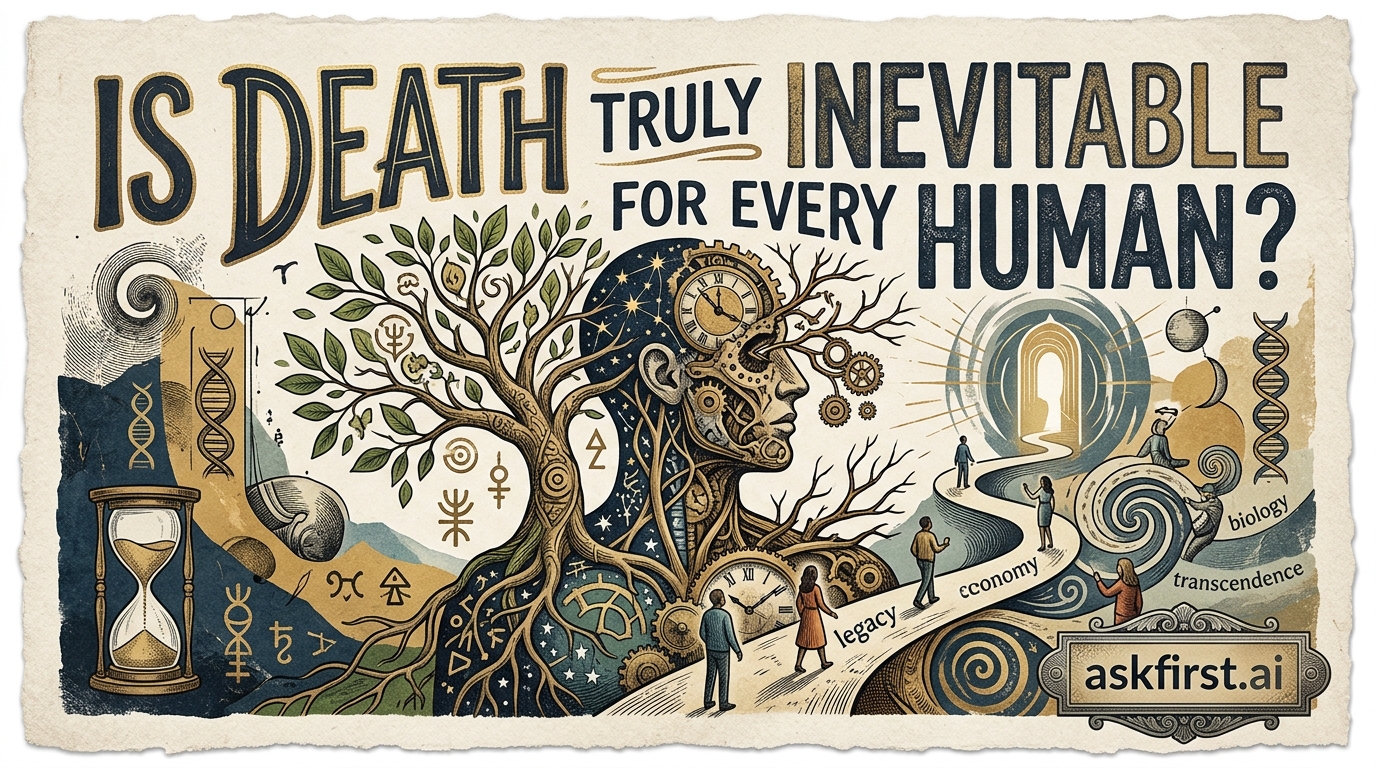
The question of whether death is an absolute, immutable end for every human being is one that has occupied the human intellect since the dawn of consciousness. From the ancient Mesopotamian Epic of Gilgamesh, where the hero desperately seeks the secret of immortality, to modern transhumanist manifestos, the pursuit of longevity remains our most persistent endeavor. To determine if death is truly inevitable, one must analyze the intersection of biological entropy, evolutionary strategy, and the current boundaries of medical science.
The Biological Reality: Senescence and Entropy
At the cellular level, death is not merely an accident; it is a programmed consequence of biological complexity. The primary driver of human aging is senescence, a process defined by the gradual deterioration of functional characteristics.
- The Hayflick Limit: In the 1960s, Dr. Leonard Hayflick, working at the Wistar Institute, discovered that normal human fetal cells in culture could only divide a finite number of times—typically between 40 and 60 times. This phenomenon, known as the "Hayflick Limit," is dictated by the shortening of telomeres, the protective caps at the ends of chromosomes. Each time a cell divides, these caps erode. When they become too short, the cell enters a state of senescence or undergoes programmed cell death (apoptosis).
- Accumulated Damage: As detailed by Dr. Aubrey de Grey in his seminal work Ending Aging, the human body is a machine that accumulates "molecular garbage." This includes mitochondrial mutations, extracellular junk, and cellular cross-linking. While the body has robust repair mechanisms, they are not perfect. Over decades, the accumulation of this biological debris leads to the systemic failure of organs, characterizing the aging process.
From a strictly biological perspective, the human body is currently engineered for a finite lifespan. We are built to survive long enough to reproduce and ensure the survival of our offspring, a concept evolutionary biologists call the "Disposable Soma Theory," first articulated by Thomas Kirkwood. Once the reproductive window closes, the evolutionary pressure to maintain the body’s repair mechanisms wanes, leading to the inevitable decline we recognize as old age.
The Transhumanist Challenge: Can We "Solve" Death?
In recent years, the inevitability of death has been challenged by researchers who view aging not as a natural law, but as a treatable disease. This shift in perspective is documented extensively in Ray Kurzweil’s book, The Singularity Is Near. Kurzweil argues that we are approaching a "longevity escape velocity," a point where medical technology advances faster than the aging process consumes our health.
- Senolytics: Scientists are currently testing drugs designed to clear out senescent cells—cells that have stopped dividing but are not dead, and which secrete inflammatory factors that damage neighboring healthy cells.
- Genetic Engineering: Utilizing CRISPR-Cas9 technology, researchers are exploring ways to lengthen telomeres safely or reprogram cells to an earlier, more "youthful" state, effectively reversing the biological clock.
- Nanomedicine: Theoretical models suggest that in the future, nanobots could circulate through the bloodstream, repairing cellular damage, fighting off pathogens, and maintaining homeostasis at the molecular level, thereby theoretically extending human life indefinitely.
Despite these advancements, it is crucial to recognize that "indefinite" is not the same as "immortal." Even if we cure cancer, heart disease, and neurodegeneration, the human body remains susceptible to catastrophic physical trauma, environmental disasters, and the eventual decay of the physical universe.
The Philosophical and Existential Dimension
Beyond the biological mechanics, one must consider the philosophical implications of death. Martin Heidegger, in his foundational work Being and Time (Sein und Zeit), posits that human existence is defined by "Being-towards-death" (Sein-zum-Tode). For Heidegger, our awareness of our own finitude is what gives life its urgency, meaning, and authenticity.
If death were removed from the human experience, would life retain its value? Many ethicists argue that the scarcity of time is what drives human creativity, love, and ambition. Without the horizon of an end, human action might lose its focus. Conversely, proponents of radical life extension, such as philosopher Nick Bostrom, argue that death is a profound tragedy that robs humanity of potential and wisdom. He contends that we have a moral imperative to treat aging as a pathology to be conquered.
Conclusion: The Current Verdict
Is death truly inevitable for every human living today? Based on our current understanding of physics and biology, the answer is a resounding yes. While we may significantly push back the boundaries of the human lifespan—perhaps reaching 120 or 150 years through personalized medicine and biotechnology—we have not yet breached the fundamental constraints of biological entropy.
The human body is an incredibly sophisticated system, but it is a system subject to the Second Law of Thermodynamics: entropy always increases. To achieve true immortality, one would likely need to transcend the biological substrate entirely—moving beyond the fragile, carbon-based framework of our ancestors. Until then, death remains the final, inevitable frontier, acting as both a biological limit and the defining context of the human experience. Whether this is a tragedy to be avoided or a necessary condition for meaning remains the ultimate question of our species.