The Psychology of the Norman Door
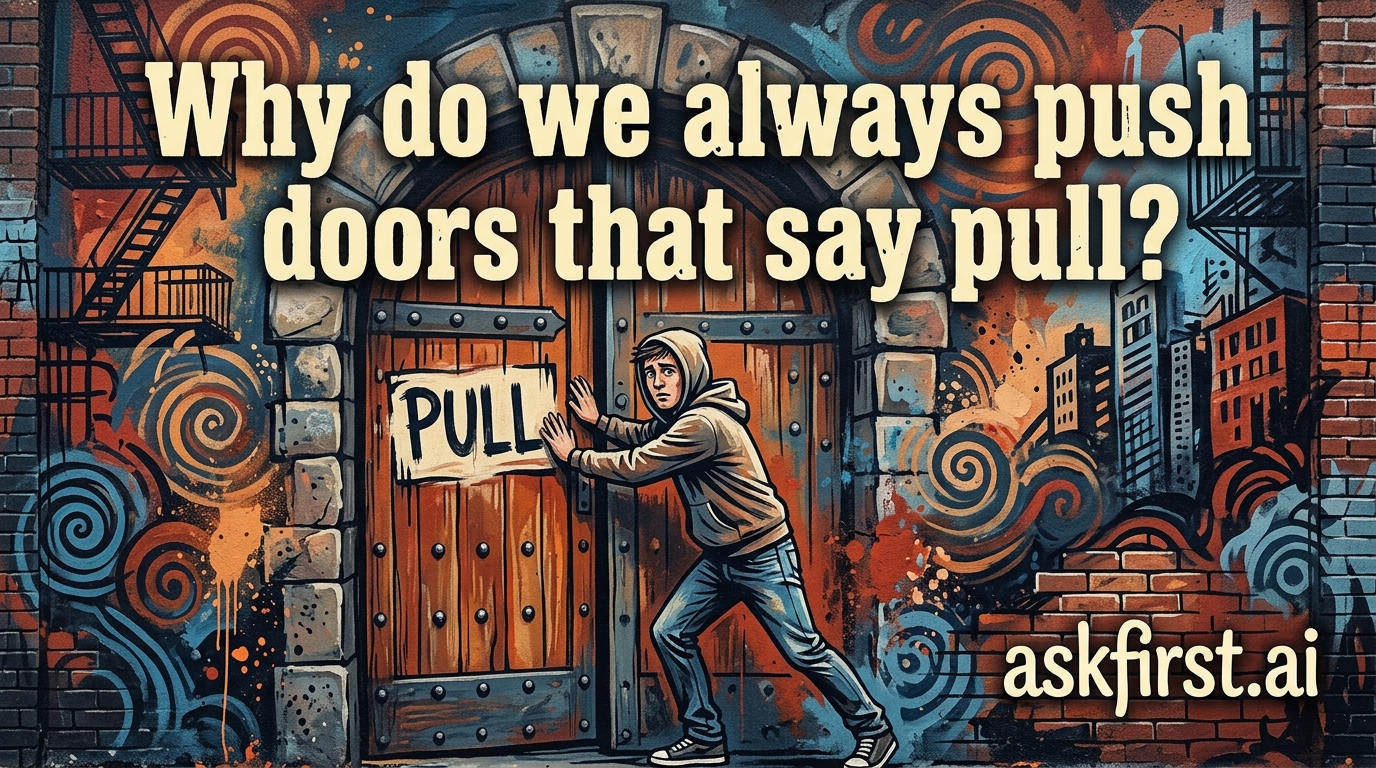
The phenomenon of pulling a door labeled 'push'—or more commonly, pushing a door labeled 'pull'—is a cornerstone of human-computer interaction and design psychology. These are often referred to as 'Norman Doors,' named after the cognitive scientist Don Norman, who popularized the concept in his seminal work, The Design of Everyday Things. The error is rarely a sign of human clumsiness; rather, it is a testament to poor design that ignores the fundamental ways the human brain processes environmental cues.
Affordances and Cognitive Maps
At the heart of the issue is the concept of an 'affordance.' An affordance is a visual clue that suggests how an object should be used. When a designer places a flat metal plate on a door, the human brain interprets that surface as a 'push' zone. The tactile experience of a flat plane invites the hand to press against it. Conversely, if a door has a vertical handle or a pull bar, the brain perceives an affordance for gripping and pulling. When a door is designed with a flat plate but requires a pull action, the user encounters a conflict between the visual design and the actual mechanical requirement.
- Visual Conflict: The eye communicates one instruction, while the sign (often ignored) communicates another.
- Heuristic Processing: Humans rely on mental shortcuts to save cognitive energy. Scanning for text on a sign takes longer than interpreting the physical shape of a door handle.
The Failure of Signage
Signage is often a 'patch' for a design failure. If a door requires a sign to explain how to operate it, the design is fundamentally flawed. Experts argue that a well-designed door should be intuitive, requiring no linguistic cues at all. When we encounter a door that requires a pull, but the design subconsciously screams 'push,' our internal mental model of a door overrides the literal text on the sticker. We stop 'reading' and start 'acting' based on the physical affordances present.
Human-Centric Design Principles
To bridge this gap, modern architecture and industrial design focus on forcing functions and mapping. Good design ensures that the physical configuration of the hardware corresponds to the motion required to open it. For example:
- The Pull Side: Should always have a handle that fits the hand, encouraging a grasping motion.
- The Push Side: Should feature a flat plate, encouraging a simple press.
When these physical cues align with the intended action, errors vanish. When they are decoupled—such as putting a vertical pull handle on a push door—the brain enters a state of 'cognitive dissonance,' leading to the classic 'push/pull' stumble.
The Evolutionary Aspect of Habits
Humans are creatures of habit. Most doors encountered in daily life follow standardized patterns. When we walk into a building, our brain is busy predicting the next sequence of physical interactions. If the environment consistently rewards a 'push' motion, the brain automates this behavior. Encountering a door that breaks this established pattern requires a conscious intervention—a moment of 'System 2' thinking, as defined by Daniel Kahneman. Because we prefer the efficiency of 'System 1' (automatic, fast processing), we often fail to switch modes in time, resulting in the comical and frustrating act of pushing against a door that refuses to budge.
Summary of Design Lessons
Understanding the Norman Door teaches us that our interactions with the world are a dialogue between our minds and the objects around us. If we feel foolish for pulling a door, we should blame the designer, not ourselves. Effective design is invisible; it works so seamlessly that we never have to think about it. By adopting user-centered design principles, environments can be created that respect human psychology rather than fighting against it. Next time you find yourself stuck, remember: you are not failing the door; the door is failing to communicate with you.