The Distributed Intelligence of the Octopus
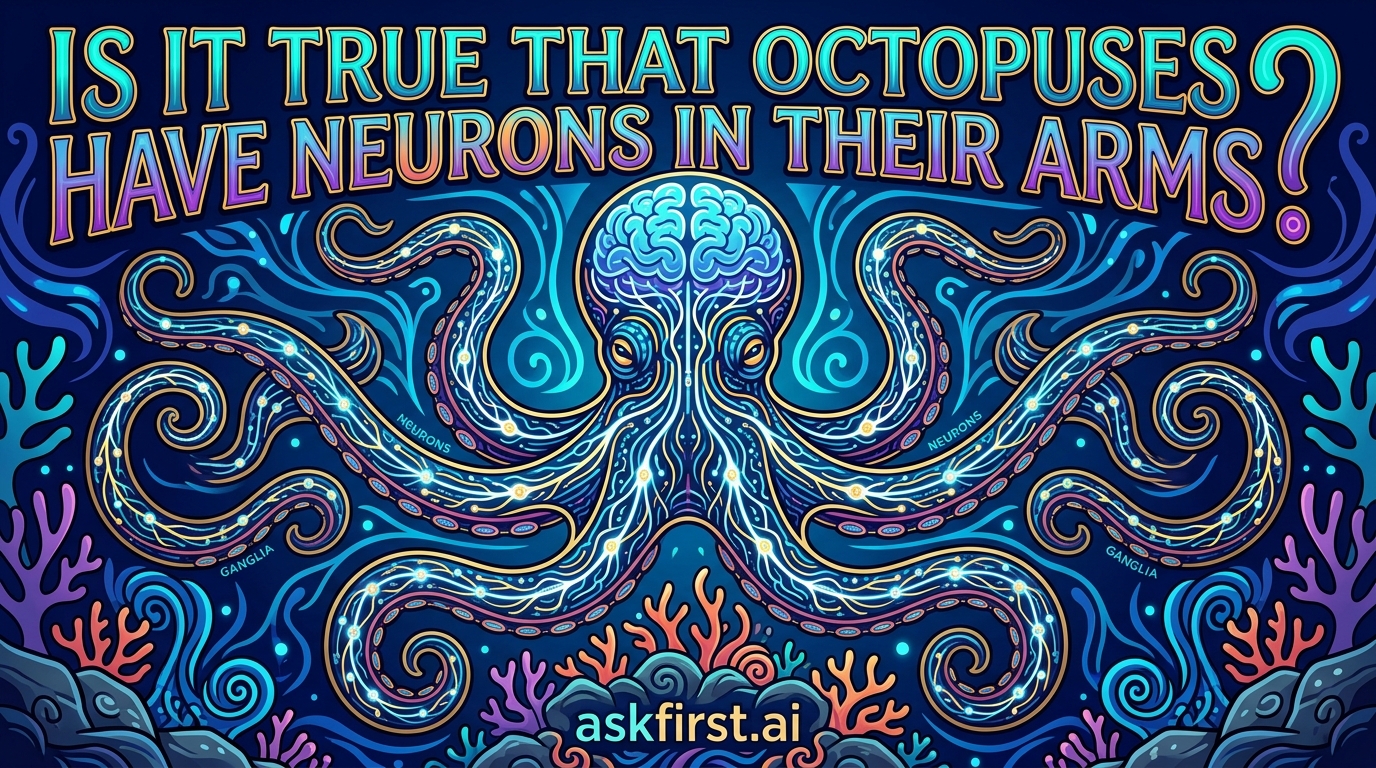
It is indeed a scientific fact that octopuses possess a remarkably decentralized nervous system. Unlike humans, whose central nervous system—the brain—dictates nearly every motor function and sensory processing task, the octopus utilizes a distributed architecture. Approximately two-thirds of an octopus's neurons are located not in its central brain, but within its eight arms. This evolutionary adaptation allows each arm to function with a surprising degree of autonomy, effectively acting as an independent brain for processing local stimuli and executing complex movements.
The Anatomy of an Alien Mind
To understand why this system exists, one must look at the physical nature of an octopus. Lacking a rigid skeletal structure, these creatures require constant coordination of hundreds of suckers and thousands of muscle fibers to move through their environment. If the central brain had to calculate every microscopic muscular contraction for eight highly flexible appendages, the processing load would be overwhelming and slow. By offloading sensory processing and motor control to the arms, the central brain can focus on high-level navigation, social interactions, and strategic decision-making. Each arm contains a dense cluster of nerve cells known as a nerve cord, which coordinates with local ganglia to allow the arm to 'taste,' 'smell,' and 'touch' the environment without waiting for instructions from the central brain.
Behavioral Autonomy and Local Control
Studies have demonstrated that even if an arm is severed from an octopus, it may continue to react to stimuli for a period. An arm can detect the texture of a surface, avoid unpleasant substances, or explore a crevice independently. This does not mean the arm is a 'separate entity' in a cognitive sense, but rather that its local nervous system remains functional enough to execute pre-programmed responses. This phenomenon illustrates that intelligence in the cephalopod world is not monolithic; it is modular. The suckers, which are covered in chemoreceptors, constantly relay information to the local arm ganglion, which then initiates actions like grasping or exploring based on the input.
Implications for Neuroscience and Robotics
This decentralized system provides invaluable insights for the field of biomimetic robotics. Traditional robots rely on a central processing unit to command every actuator, which often leads to latency and rigidity. By studying the octopus, engineers are developing 'soft robotics' that utilize distributed control mechanisms. These robots can navigate complex, uneven terrain or handle delicate objects with fluid grace, mimicking the way an octopus arm maneuvers through coral reefs. The efficiency of the octopus's nervous system serves as a masterclass in biological engineering, proving that decentralized intelligence is a powerful evolutionary strategy for survival in highly variable, three-dimensional aquatic environments.
Beyond the Human Centralized Model
For humans, consciousness is almost entirely tied to the brain encased in our cranium. When we think of intelligence, we think of central processing. However, the octopus challenges our terrestrial-centric definition of what it means to 'think.' It suggests that in the vast, alien worlds of our own oceans, consciousness can be spread throughout the body. The arms are not mere appendages; they are active, sensing, and processing extensions of the octopus's identity. This biological wonder serves as a humbling reminder of the diversity of life on Earth. Nature has evolved a sophisticated, distributed nervous system that thrives without the need for a singular, dominant control center, allowing these creatures to exhibit problem-solving skills that rival those of primates, all while being guided by a swarm of localized, intelligent nerve clusters stretching into the deep sea.
In conclusion, the presence of neurons in the arms of an octopus is not just a biological curiosity; it is a fundamental aspect of their success as masters of camouflage and escape. By treating each limb as a semi-autonomous participant in the act of living, the octopus navigates the complex challenges of its oceanic life with a speed and flexibility that few other creatures can match.