The Psychological Illusion of Accelerated Time
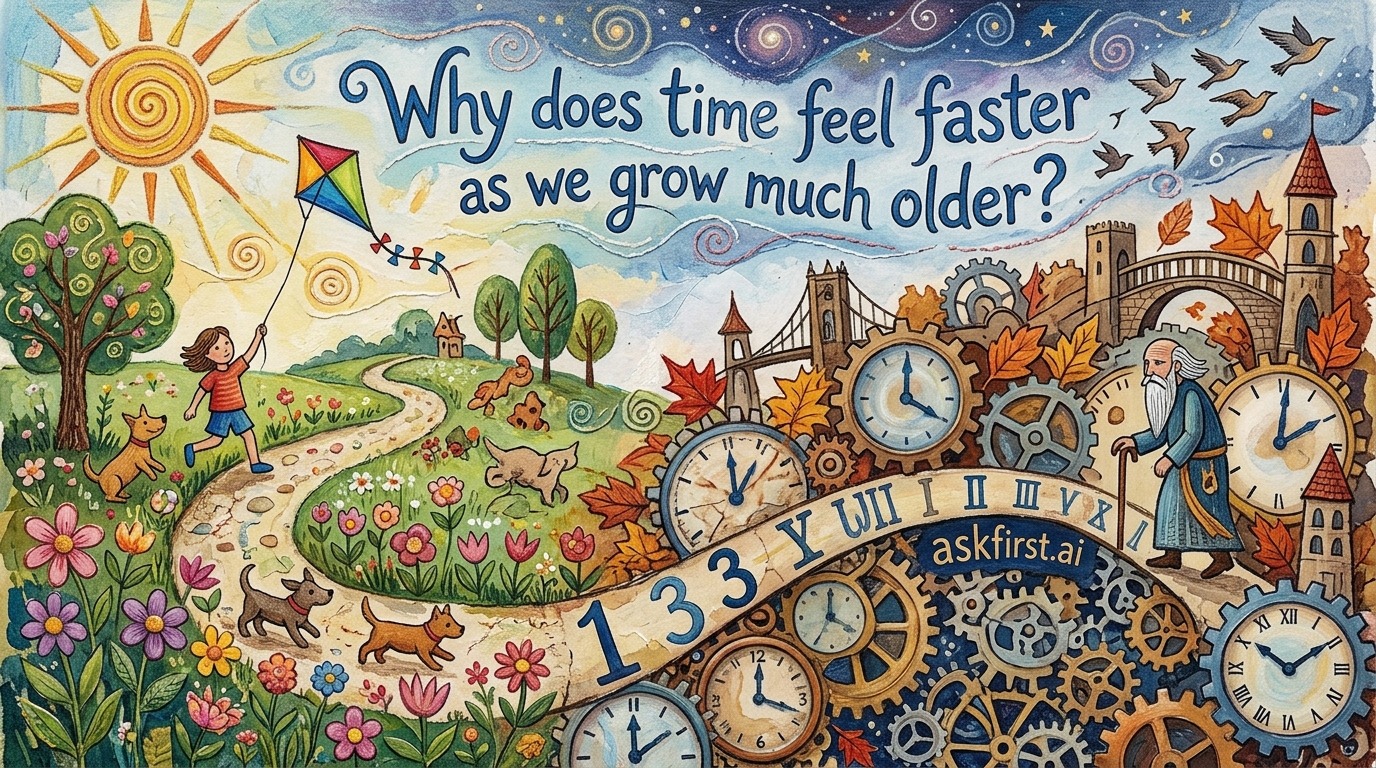
Many individuals reach midlife and beyond only to wonder where the decades have disappeared. This phenomenon, often termed the "Holiday Paradox" or the "Proportional Theory," is a fascinating intersection of cognitive neuroscience, memory encoding, and emotional processing. While clocks tick at a constant rate, human perception is entirely subjective, shaped by how the brain processes new information and emotional significance.
1. The Proportional Theory: Mathematical Scaling
One of the most compelling explanations for the feeling of accelerating time is rooted in simple mathematics. When an individual is five years old, one year represents a full 20 percent of their entire life experience. Every day feels vast because it occupies a significant fraction of one's known existence. By the time a person reaches age fifty, one year represents only 2 percent of their life. From this perspective, the brain perceives segments of time as smaller relative to the total sum of stored memories, making each year feel proportionately shorter.
2. Novelty and Information Processing
The brain functions like an information processing machine that places high priority on new stimuli. During childhood and adolescence, almost every experience—from learning to read to navigating social hierarchies—is novel. The brain is firing rapidly, creating high-density, detailed neural maps to store these "firsts." Because there is so much data being recorded, the subjective passage of time feels stretched.
In contrast, adulthood is often characterized by routine. When a person performs the same commute, completes identical work tasks, and follows predictable schedules, the brain enters an "autopilot" mode. Because there is little "new" data to encode, the memory system does not create rich, detailed nodes for these periods. When reflecting on a week of repetitive tasks, the brain finds very little to "grab onto," causing that period to seem to collapse into a blur. This is essentially the opposite of the "Holiday Paradox," where a vacation filled with new sights and sounds feels long while happening but short in hindsight due to the lack of mundane markers.
3. The Role of Dopamine and Neural Speed
Neuroscience suggests that the speed at which we process images affects our perception of time. Young children process images more rapidly, effectively recording more frames per second than adults. As the human nervous system ages, the speed at which neural pathways transmit signals may slightly decrease, and the complex networks involved in high-level cognition change. If the internal "frame rate" of our perception slows down, the external world appears to pass by more quickly in comparison, similar to how a high-speed camera captures slow-motion footage while a standard camera captures real-time movement.
4. How to "Slow Down" Subjective Time
Understanding these mechanisms offers a practical strategy for anyone wishing to make their life feel longer and more fulfilling. The goal is to maximize the novelty of experience:
- Break the Routine: Change the commute, learn a new language, or visit unfamiliar locations. New stimuli force the brain to pay attention and encode more vivid memories.
- Mindfulness Practices: Engaging in deep, attentive living prevents the "autopilot" mode. When the brain is focused on the present moment, rather than planning for the future or dwelling on the past, time perception tends to expand.
- Cultivate Mastery: Picking up difficult hobbies late in life recreates the "learning curve" of youth, which keeps neural pathways active and the brain busy with high-density data.
Conclusion: The Subjectivity of Existence
Time itself is a physical constant, but our "mental time" is a construct of our memories and our level of engagement with the world. When we stop learning, exploring, and encountering the unknown, our perceived time accelerates. By consciously choosing to step outside of comfort zones and seeking out new experiences, we effectively stretch our subjective timeline. We can, in effect, make a year feel as long as a decade by filling it with the richness of new information. The secret to a long-feeling life is not in the number of years lived, but in the density of the experiences contained within those years.