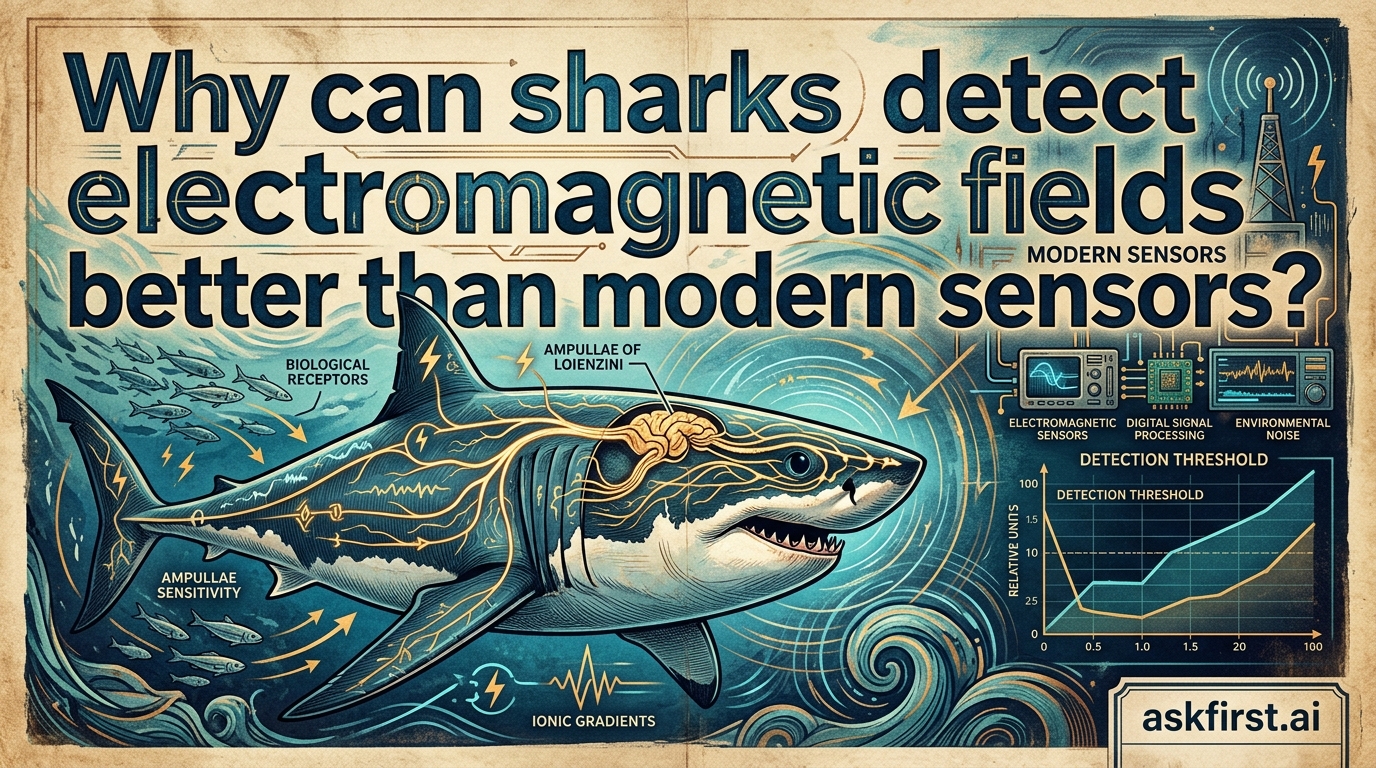
The Biological Marvel of Ampullae of Lorenzini
Sharks possess an extraordinary sensory capability known as electroreception, a trait that allows them to perceive minute electromagnetic fields generated by living organisms. At the core of this ability are the Ampullae of Lorenzini, specialized electroreceptor organs located primarily around the shark's snout and head. These are visible as small, dark pores on the skin. Inside each pore, a canal filled with a high-conductivity gel leads to a cluster of sensory cells. This gel acts as a conduit, allowing the shark to sense potential differences as low as 5 nanovolts per centimeter. This sensitivity is effectively thousands of times more acute than the best man-made sensors available today.
Comparing Biological Precision to Modern Technology
While modern man-made electromagnetic sensors, such as fluxgate magnetometers or SQUIDs (Superconducting Quantum Interference Devices), are incredibly advanced, they often face significant engineering hurdles that biological systems simply bypass. Man-made sensors require precise alignment, complex circuitry, and significant power supplies to maintain signal-to-noise ratios. In contrast, the shark's sensory system is a perfectly evolved, passive biological processor.
- Thermal Stability: Shark receptors operate at ambient sea temperatures without the need for cryogenic cooling, which many high-precision electronic sensors require.
- Sensitivity Thresholds: Biological channels allow for the detection of the faint muscle contractions of prey, such as the heartbeat or gill movements of a hidden flounder, which are buried deep beneath sand.
- Dynamic Range: Sharks can filter out the vast electromagnetic noise of the Earth’s own magnetic field to focus exclusively on the specific biological signature of prey or navigation markers.
Why Nature Wins: The Engineering Gap
One might ask, if we have such advanced technology, why is it inferior to a shark's nose? The answer lies in structural integration. A shark's system is integrated directly into its nervous system, allowing for instantaneous sensory fusion. The shark does not just 'see' the field; it integrates that field with its proprioception, vision, and lateral line sensing. Modern technology struggles to achieve this level of seamless data synthesis. Furthermore, the conductive gel found in the Ampullae of Lorenzini is a masterpiece of biochemistry. Research into this material suggests it functions as a highly efficient semiconductor, capable of converting electrical gradients into nerve impulses with minimal energy loss. Current artificial materials for sensors are often limited by impedance mismatching or manufacturing flaws at the nanoscale.
Navigation and the Earth's Geomagnetic Map
Beyond hunting, sharks use these sensors for long-distance migration. Research indicates that sharks may use the Earth’s magnetic field as a global positioning system. By sensing the intensity and angle of the Earth’s magnetic flux, they can orient themselves over thousands of miles with remarkable precision. Humans need GPS satellites, which rely on external infrastructure. Sharks carry their own map, compass, and field-intensity gauge within their anatomy. This biological ‘internal navigation system’ provides a level of robustness that is immune to electronic interference or signal jamming, a significant advantage in the unpredictable environment of the open ocean.
The Future of Biomimetic Engineering
The study of shark electroreception is driving innovation in biomimetic sensors. Engineers are currently looking at the gel-filled canal system to develop new types of sensors for subsea communications and navigation. By replicating the structure of the Ampullae of Lorenzini, researchers hope to build underwater sensors that do not require bulky, power-hungry batteries and can operate reliably in deep-sea conditions where traditional electronic components would fail due to pressure or environmental decay.
Conclusion
Sharks detect electromagnetic fields better than modern sensors because they are the result of millions of years of evolutionary refinement, focusing on efficiency, material sensitivity, and direct integration with the organism's consciousness. While humanity is beginning to understand the mechanics of these systems, we have yet to replicate the elegant, passive, and low-energy performance that the shark utilizes daily. The shark remains a pinnacle of natural bio-engineering, proving that sometimes, the most sophisticated 'technology' is found in the depths of our own oceans, honed not by engineers, but by the relentless precision of nature itself.