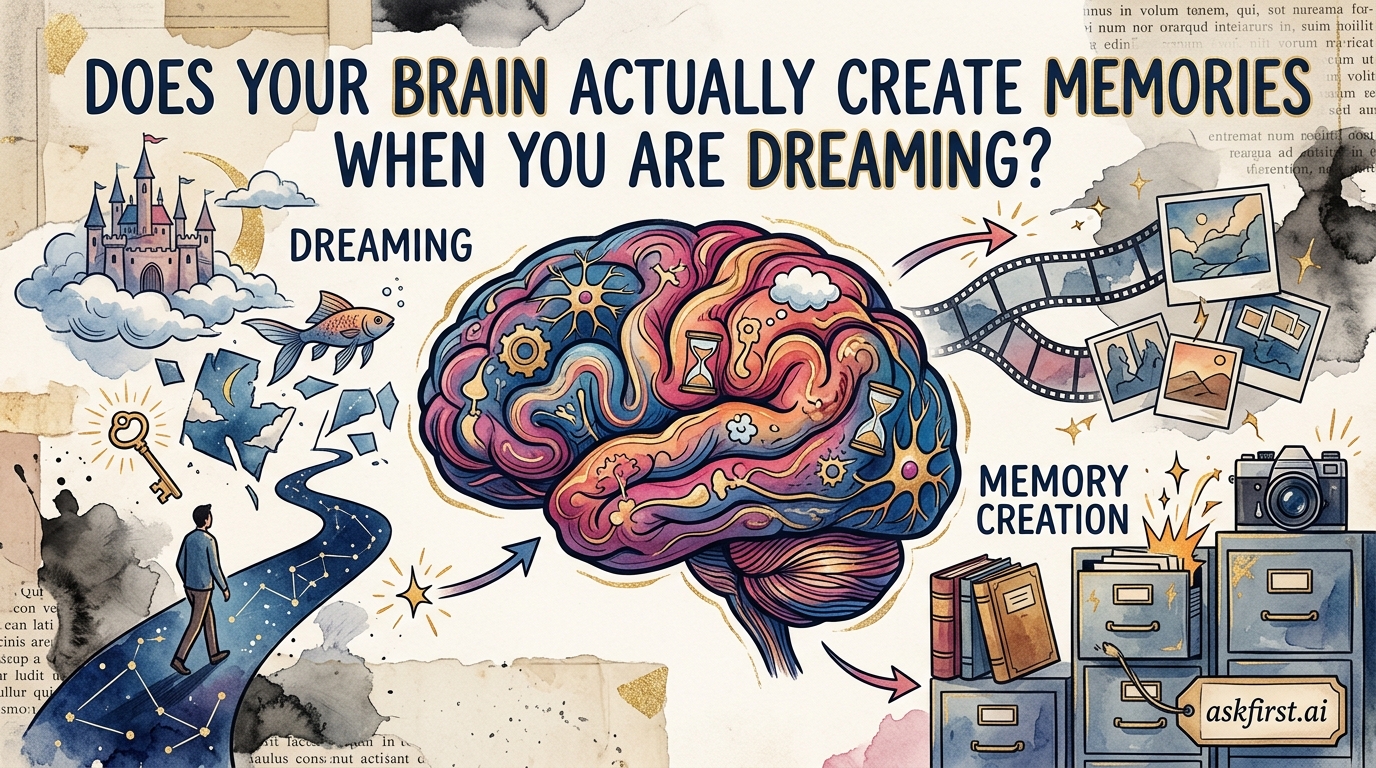
The Neurological Complexity of Dream Encoding
To understand whether the brain creates memories during dreams, one must first distinguish between the experience of dreaming and the consolidation of those experiences into long-term storage. Scientific research suggests that the brain treats the narrative content of a dream quite differently than it treats events from waking life. While dreams are generated by a complex orchestration of neurochemical signals, the ability to 'store' these experiences is severely inhibited by the physiological state of the sleeping brain.
The Neurochemical Barrier to Memory
During Rapid Eye Movement (REM) sleep, which is the stage where the most vivid and narratively complex dreams occur, the brain undergoes a profound chemical shift. Specifically, levels of norepinephrine—a neurotransmitter essential for focus and memory consolidation—are significantly reduced. Simultaneously, levels of acetylcholine rise. This chemical environment is highly conducive to internal data processing and creative synthesis, but it is notoriously poor at creating stable, long-term memory traces. This is the primary reason why dreams often vanish seconds after waking; the brain lacks the neurochemical 'glue' required to cement these internal perceptions into the hippocampus.
Dreaming vs. Memory Consolidation
It is vital to distinguish between the act of encoding a memory and the consolidation of existing memories. While the brain struggles to record the content of the dream itself, sleep is the most critical window for consolidating memories from the previous day. During deep sleep, the brain performs a 'replay' of neural activity patterns from waking hours. This process, known as memory reactivation, reinforces neural connections. Interestingly, while this is occurring, the 'story' of the dream often serves as a cognitive playground, allowing the brain to test and reorganize information. Thus, while the dream itself might be forgotten, the process of dreaming may actually aid in strengthening unrelated, waking-life memories.
The Architecture of Dream Recall
When a person remembers a dream, are they retrieving a stored memory? Evidence suggests that recall is often a reconstructive process rather than a playback. Upon waking, the brain attempts to piece together fragmented images and emotions experienced during the dream. This 'gap-filling' is an active cognitive process. The prefrontal cortex—the center of logic and narrative—activates upon consciousness and attempts to construct a coherent sequence from the scattered neural signals left over from REM sleep. Consequently, the act of remembering a dream is, in itself, a form of creation.
The Role of the Hippocampus
Recent studies on rodents and humans have shown that the hippocampus, the brain's 'library' for explicit memory, often remains active during REM sleep. However, its interaction with the neocortex is decoupled from the sensory input channels that would normally encode 'real' experience. Because the sensory cortex is essentially offline, the brain creates a 'closed loop' experience. The hippocampus is effectively writing to a file that is not being saved to the hard drive, meaning that once the sleep state ends, the information is flushed from the system. This explains why one can have a profound, vivid epiphany in a dream, only to find the memory of that specific thought dissolving before the eyes upon opening them.
Can Dreams Be Stored?
While the brain does not naturally store dream experiences like waking ones, the emotional residue of a dream is often encoded. The amygdala, the brain's emotional processing center, is highly active during REM sleep. This is why a person may wake up with a lingering sense of anxiety, sadness, or joy after a dream, even if they have completely forgotten the plot of the dream itself. This emotional state is stored, proving that the dream had an impact on the brain’s state, even if the explicit episodic memory is missing.
Practical Implications for Dream Enhancement
For those interested in retaining more of their dreams, neurological techniques exist to bypass these natural limitations. These include:
- The Intentionality Gap: By training the brain to 'log' experiences immediately upon waking, one can force the hippocampus to transition the dream from short-term memory to long-term storage.
- Lucid Dreaming: Some researchers posit that engaging the prefrontal cortex during dreaming (becoming aware that one is dreaming) can alter the neurochemical state of the dream, potentially allowing for more vivid, retrievable memories of the experience.
- Sensory Anchors: Utilizing auditory cues or specific smells during sleep has shown potential in signaling the brain to move dream content into a more 'memorable' state, though this remains an active area of neuroscientific inquiry.
In conclusion, the brain does not record dreams as memories in the standard, permanent sense. Instead, dreaming acts as a transient, high-utility processing phase. The dream itself is an epiphenomenon—a shadow cast by the heavy lifting of memory consolidation and cognitive reorganization taking place beneath the surface. You are not meant to remember the dream; you are meant to benefit from the work the brain does while the lights are out.