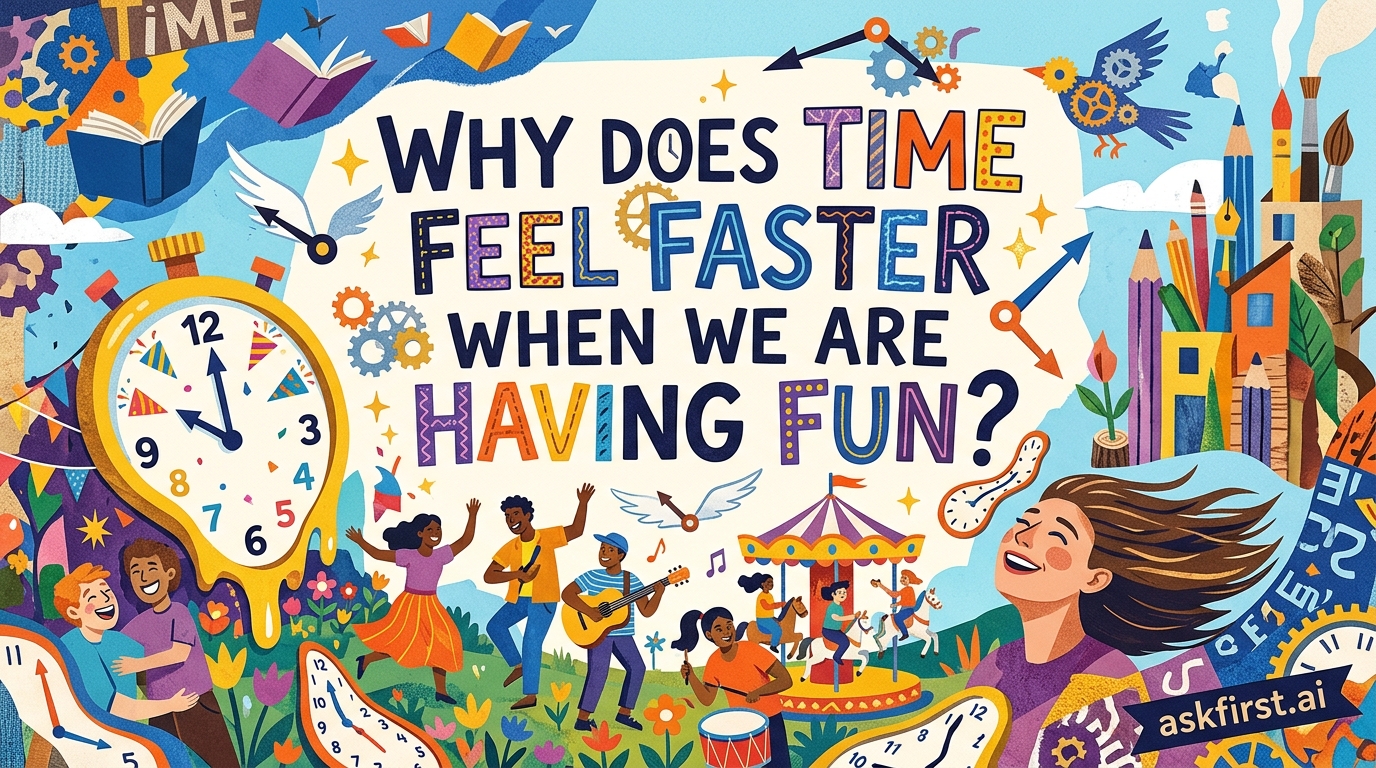
The Cognitive Illusion of Time Perception
Human perception of time is not a fixed, rhythmic pulse like a mechanical clock. Instead, it is a malleable cognitive construct, deeply influenced by physiological arousal, emotional states, and the density of encoded information within the brain. The phenomenon where 'time flies when we are having fun' is a well-documented psychological experience often referred to as the temporal acceleration effect during pleasurable states.
The Role of Memory Encoding and Retrospective Judgments
To understand why time seems to evaporate during joyous activities, it is crucial to distinguish between prospective timing (feeling time pass in the moment) and retrospective timing (judging how long an event lasted after it ended).
- Prospective Timing: During engaging or 'fun' tasks, the brain is hyper-focused on the external stimuli or the immediate activity. This intense concentration results in a reduced allocation of cognitive resources toward monitoring the passage of time. When the brain is not checking its internal 'metronome,' the perception of duration diminishes, leading to the sensation that time is moving rapidly.
- Retrospective Timing: This is the most counter-intuitive aspect of the phenomenon. When individuals look back on a fun experience, they often feel it lasted a long time if it contained many novel memories. Conversely, if an event was fun but routine, it feels like it passed in a heartbeat. This is known as the Holiday Paradox. During mundane, repetitive periods, the brain does not commit much to long-term memory, leading to the feeling that those periods 'disappeared' when viewed in retrospect.
Neurochemical Modulation of the Internal Clock
Scientific research into neurobiology suggests that neurotransmitters play a pivotal role in the perceived speed of time.
- Dopamine: Fun and pleasurable activities trigger the release of dopamine in the brain's reward centers. Elevated dopamine levels are associated with higher metabolic rates and faster internal processing speeds. When the neural 'clock' ticks faster, the world appears to move slower, but our relative perception of duration often leads to the feeling that external time is accelerating.
- The Attentional Gate Model: Psychologists propose the existence of an 'attentional gate.' In this model, the brain counts pulses emitted by an internal pacemaker. When attention is directed toward time, the gate opens wider, and more pulses are counted, making the duration feel longer. When attention is diverted toward an engaging task, the gate narrows, fewer pulses are counted, and the interval is perceived as shorter.
The Density of Novelty
Another significant factor is the novelty effect. When humans engage in new, exciting activities, the brain creates rich, dense memory structures. The brain processes these moments with high resolution. However, when we are in a state of 'flow'—a psychological state of complete immersion—the analytical self goes quiet. The loss of self-consciousness, a hallmark of deep fun, causes the individual to stop tracking duration entirely. Without the ego to serve as an anchor for chronological markers, the distinction between one hour and three hours dissolves.
Comparative Analysis: Boredom vs. Joy
It is helpful to compare this to the opposite state: boredom. During boring or repetitive tasks, the brain lacks meaningful external stimulation and begins to monitor internal states more closely. It becomes hyper-aware of the passage of time, which ironically makes each second feel like an eternity. This is why the 'watched pot never boils'—attention is locked on the duration, ensuring every micro-second is registered. In contrast, 'fun' provides the ultimate distraction, effectively blinding the observer to the passage of time until the activity concludes.
Practical Applications and Summary
Understanding these mechanisms offers insights into how one might structure their life to maximize perceived longevity. To make life 'feel' longer, one should seek novelty and new experiences, as the brain encodes these moments more deeply. To enjoy the present, one should embrace the flow state, recognizing that the feeling of time accelerating is actually a testament to the quality and engagement level of the current experience.
- Engage in Novelty: New environments and skills create memory 'bookmarks' that make life feel richer.
- Embrace Flow: Do not fear the loss of time tracking; enjoy the immersion.
- Practice Mindfulness: If time feels like it is moving too fast, bringing focus back to the present sensory experience can help anchor the perception of duration.
Ultimately, the sensation of time passing rapidly is a physiological 'thumbs up' from the brain, indicating that the activity is stimulating, rewarding, and worthy of our full, undivided attention.