The Anatomy of the Inner Voice
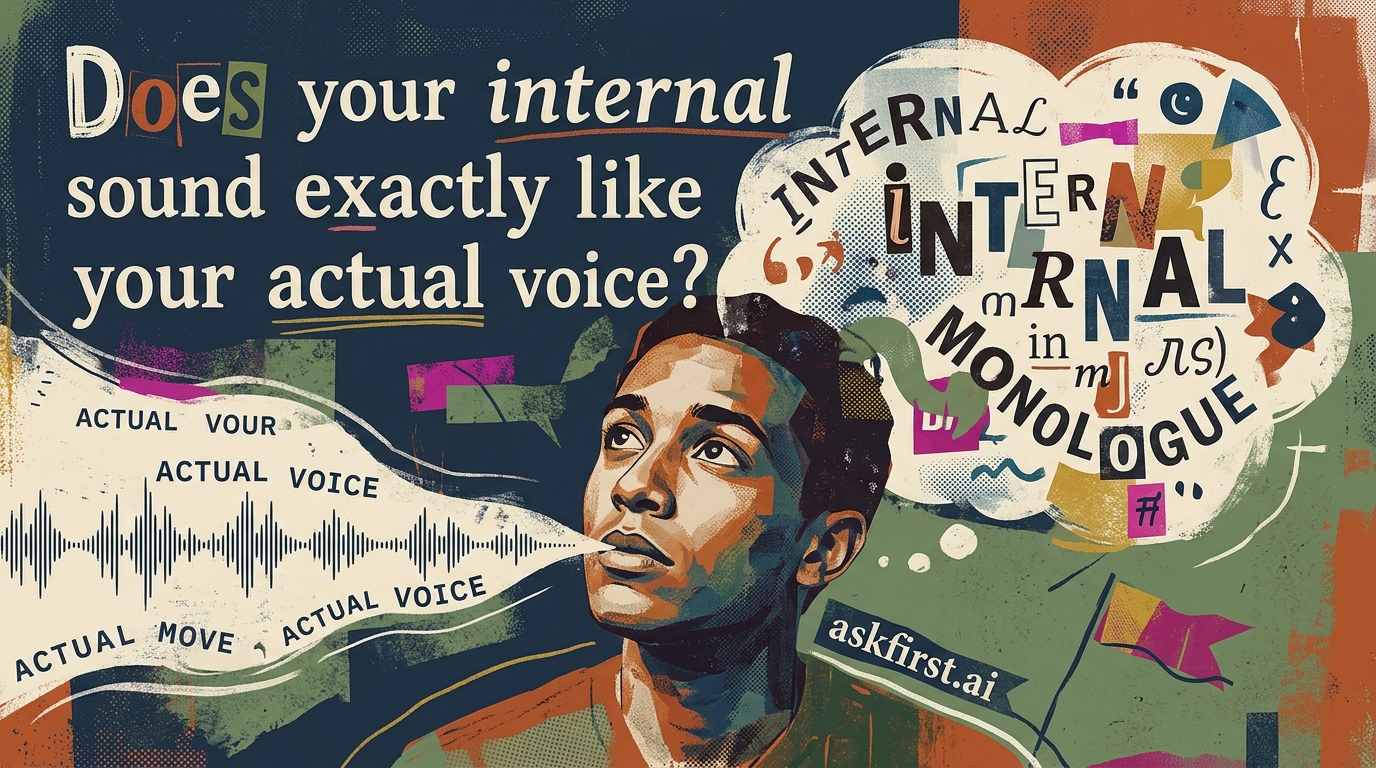
The phenomenon of the internal monologue—that persistent stream of verbal thought—remains one of the most fascinating aspects of human consciousness. Many individuals assume that this 'inner speech' is a carbon copy of their external vocal output, but scientific inquiry suggests a much more nuanced reality. Research in cognitive psychology and neuroscience indicates that while the internal monologue often mimics the cadence and cadence of one's vocal expression, it is rarely a precise acoustic replica. Instead, it functions as a mental simulation or a complex cognitive construct.
The Role of Mental Imagery and Motor Commands
To understand why the internal voice differs from the vocal one, one must look at the brain's motor system. The brain utilizes a mechanism known as 'efference copy.' When a person speaks, the brain sends a signal to the vocal cords and mouth muscles to produce sound. Simultaneously, it sends a copy of that signal to the auditory cortex to predict what the sound will be. This allows the brain to distinguish between self-generated sounds and external noise. When an individual engages in silent internal monologue, the brain appears to trigger similar motor pathways without actually activating the vocal muscles to produce full sound. Because the physical resistance of the tongue, lips, and larynx is absent, the 'sound' perceived is a refined, idealized version of the voice rather than a biological reproduction.
Why the Internal Voice Feels Different
Several factors contribute to the distinct quality of the internal monologue compared to one's literal voice:
- Absence of Bone Conduction: When people speak aloud, they hear their voice through both the air and their own skull bones. Bone conduction adds deep, resonant bass frequencies. Since the internal voice lacks this physical feedback, it inherently sounds 'thinner' or more ethereal.
- Cognitive Efficiency: The brain prioritizes information processing speed. Internal speech can happen at a rate significantly faster than articulate speech because the constraints of breathing and muscle movement are removed.
- Emotional Layering: Internal speech is often abstract. It may combine fragments of memory, visual imagery, and conceptual links that are not present when speaking to another person. This allows for a 'multimodal' experience that exceeds the limitations of standard phonetics.
Psychological and Individual Variations
It is crucial to recognize that the experience of inner speech is not universal. Approximately 30% to 50% of the population does not engage in a constant verbal internal monologue. These individuals may think in purely visual images, abstract concepts, or sensory-motor feelings. For those who do have a verbal stream, the perceived identity of the voice varies:
- Identity Mimicry: For some, the voice sounds like their own. This reinforces a sense of continuity and self-identity.
- Ambiguous Identity: For others, the voice is gender-neutral, age-agnostic, or feels like a collection of different internal viewpoints (often described as a dialogue).
- The 'Auditory Hallucination' Threshold: In non-pathological states, the internal voice is consciously controlled. However, if the brain fails to properly execute the 'efference copy' check mentioned earlier, the internal monologue can become indistinguishable from external stimuli, which is a core focus of psychiatric research into auditory verbal hallucinations.
The Impact of Language and Environment
Environmental influences play a massive role in how this internal soundscape is shaped. Studies suggest that the quality of the inner voice is culturally and linguistically contingent. Bilingual individuals often report that their inner voice 'shifts' in tone or pitch depending on which language they are currently thinking in. Furthermore, people who frequently read or engage with audiobooks often find their internal voice mimicking the cadence of characters or narrators. This 'chameleon effect' suggests that the internal voice is a fluid tool utilized by the brain for memory encoding and problem-solving, rather than a fixed anatomical feature.
Practical Applications and Scientific Importance
Understanding the discrepancies between internal and external voices has profound implications. For instance, in Neurolinguistics, mapping the gap between these two experiences helps in developing brain-computer interfaces. If scientists can eventually 'decode' the internal monologue using functional magnetic resonance imaging (fMRI), it would open doors for non-invasive communication for those with speech-impairing conditions. Moreover, the field of Self-Regulation emphasizes that by intentionally altering the tone of one's internal monologue—making it more compassionate or firm—individuals can effectively regulate stress and performance. The ability to manipulate the 'sound' of the inner voice is a powerful psychological lever that is accessible to everyone.
Conclusion
In summary, the internal monologue does not sound exactly like one’s vocal output because it is a mental construction rather than a recording. It is a sophisticated simulation that bypasses the physical limitations of the vocal tract while being subject to the subjective biases of the listener's own perception. Recognizing this distinction is key to mastering the art of self-talk and deepening the understanding of human consciousness. It is a private, infinite internal dialogue that remains one of the most remarkable features of the human experience.