The Psychology of the 'Norman Door' Phenomenon
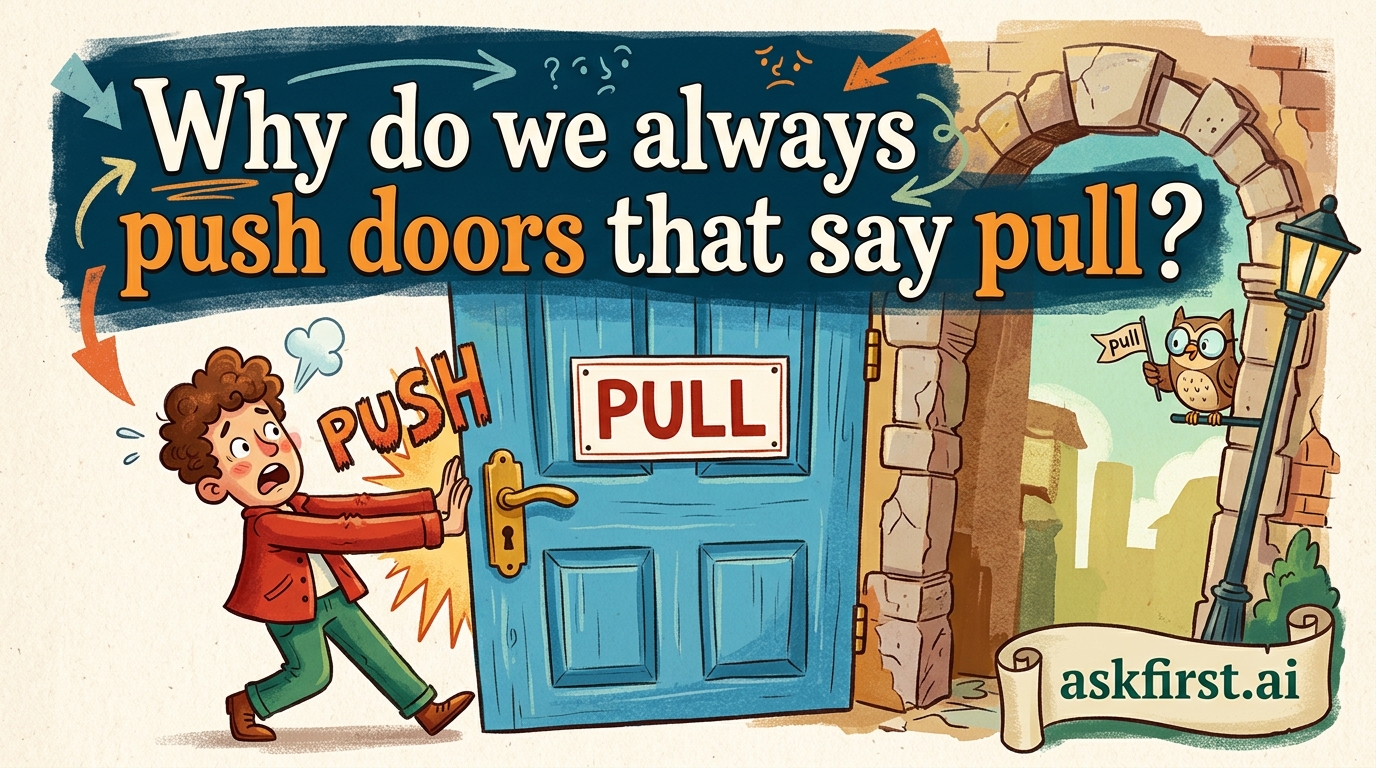
Human interaction with the built environment is governed by silent scripts, yet these scripts are often ignored due to the design principles—or lack thereof—in our daily surroundings. The phenomenon of pushing a door labeled 'pull' is a classic case of cognitive dissonance between sensory perception and functional reality. This common error is formally known in design circles as a 'Norman Door', a term coined by cognitive scientist Don Norman in his seminal work, The Design of Everyday Things.
The Role of Affordances
The fundamental reason for this confusion lies in the concept of affordances. An affordance is a property of an object that suggests how it should be used. For instance, a flat metal plate on a door signifies 'push,' while a vertical handle suggests 'pull.' When the physical design of the door provides a strong affordance for pushing—such as a large, flat surface—but the instruction mandates pulling, the brain experiences a conflict. The physical form of the door speaks a louder, more primal language than the written text. Our brains prioritize visual cues over abstract symbolic information when we are acting on autopilot.
The 'Autopilot' Effect: Cognitive Load and Habituation
Humans perform thousands of movements daily without conscious awareness. This state is referred to as System 1 thinking in behavioral psychology, as defined by Daniel Kahneman. System 1 is fast, automatic, and emotional. When a person approaches a door, the brain predicts the action required based on previous experience. If 90% of doors encountered during the day are push-operated, the brain establishes a 'push' habit. The text 'pull' is a secondary, slower process (System 2 thinking). If a person is distracted, stressed, or in a hurry, they will default to the primary, learned behavior of pushing before the brain has time to process the conflicting written command.
Design Mismatches and Architectural Failures
The architectural community often prioritizes aesthetics over functionality. Architects may choose handles or plates to complement the building's facade, inadvertently creating a design trap. For example, a vertical handle is almost universally associated with pulling, but if a door is engineered to open outward, the architect faces a dilemma: provide a handle that is easy to grip (but suggests pulling) or provide a flat plate (which is awkward to pull). When designers prioritize the look of the door over the physical movement it requires, they create an environment prone to user error.
How to Mitigate User Confusion
To bridge the gap between design and human intuition, experts suggest several design modifications:
- Eliminate Ambiguity: Match the physical hardware to the required motion. If the door must be pulled, use a handle or a grip that makes pushing physically difficult.
- Clearer Communication: Place instructions at eye level, not on the door panel itself, to ensure the message is within the focal range of the user.
- Standardization: Public infrastructure should strive for uniformity. When doors in a specific category (such as fire exits or restrooms) follow consistent patterns, users build mental models that reduce cognitive strain.
The Scientific Takeaway
When you find yourself pushing a door labeled 'pull,' do not blame your lack of observation. You are experiencing a breakdown in human-centered design. The object itself is communicating a message that your brain perceives faster than it reads words. This error is not a sign of absent-mindedness but a testament to how heavily we rely on physical cues in our environment. By understanding these principles, we can better appreciate why some designs feel intuitive while others feel like a daily battle against our own instincts. In a world designed with 'invisible' efficiency, the doors that baffle us serve as a reminder that the best design is the one that disappears, leaving the user to navigate the world without ever having to stop and think about how to operate a simple latch.